
What was advertised in a colonial American newspaper 250 years ago today?
“Restored to as good a state of health as ever he had in his life.”
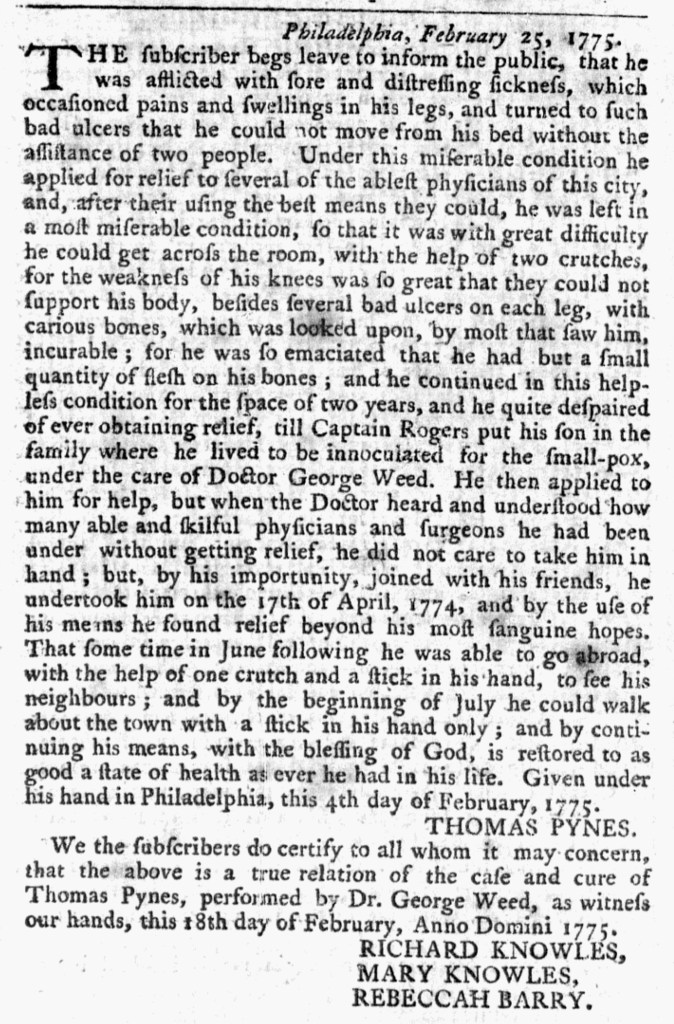
The final page of the April 4, 1775, edition of the Pennsylvania Evening Post consisted entirely of advertisements (and the colophon running across both columns at the bottom of the page). The final notice filled about two-thirds of the column, making it longer than many of the news items that ran elsewhere in that issue. It took the form of an open letter in which Thomas Pynes described how he was formerly “afflicted with sore and distressing sickness, which occasioned pains and swellings in his legs, and turned to such bad ulcers that he could not move from his bed without the assistance of two people.” In that “miserable condition,” he “applied for relief” and consulted “several of the ablest physicians” in Philadelphia, but he did not experience any relief even after they provided “the best means they could.” Most of those doctors considered him “incurable.”
Pynes endured that condition for two years, “despair[ing] of ever obtaining relief.” He eventually learned of patients “under the care of Doctor George Weed” and felt renewed hope, yet when Weed “heard and understood how many able and skilful physicians and surgeons [Pynes] had been under without getting relief, he did not care to take him in hand.” Weed overcame those misgivings when Pynes enlisted the aid of friends in petitioning the doctor. Pynes entered his care on April 17, 1774, about a year before his letter appeared in the Pennsylvania Evening Post. He reported that “found relief beyond his most sanguine hopes.” Furthermore, that relief arrived very quickly, especially considering how long he had been ill. In June, just two months after Weed commenced treatment, Pynes was able to leave his house and visit his neighbors “with the help of one crutch and a stick in his hand.” By July, he “could walk about the town with a stick in his hand only.” Under Weed’s care, “with the blessing of God,” Pynes was “restored to as good a state of health as ever he had in his life.”
A short confirmation of Pynes’s account appeared at the end of the advertisement. Richard Knowles, Mary Knowles, and Rebeccah Barry “certif[ied] … that the above is a true relation of the case and cure of Thomas Pynes, performed by Dr. George Weed.” Pynes and his friends likely did not insert this letter in the Pennsylvania Evening Post on their own, just as Joseph Wellahway and Samuel Hallo probably did not submit their testimonials to that newspaper about six weeks earlier without guidance from the doctor. Weed adopted a clever strategy in not adding anything else to these testimonials, not even giving his location, hawking the patent medicines he produced, or making other sorts of appeals. Instead, he depended on the story told by Pynes and its authenticity as affirmed by three witnesses as all the marketing necessary to draw the attention of prospective patients. Rather than an advertisement devised by the doctor, Pynes’s story looked like a narrative written and published for the benefit of the public, especially those who despaired of finding relief for the maladies that incapacitated them.
[…] The final page of the April 4, 1775, edition of the Pennsylvania Evening Post consisted entirely of advertisements (and the colophon running across both columns at the bottom of the page). The final notice filled about two-thirds of the column, making it longer than many of the news items that ran elsewhere in that issue. It took the form of an open letter in which Thomas Pynes described how he was formerly “afflicted with sore and distressing sickness, which occasioned pains and swellings in his legs, and turned to such bad ulcers that he could not move from his bed without the assistance of two people.” In that “miserable condition,” he “applied for relief” and consulted “several of the ablest physicians” in Philadelphia, but he did not experience any relief even after they provided “the best means they could.” Most of those doctors considered him “incurable.” Pynes endured that condition for two years, “despair[ing] of ever obtaining relief.” He eventually learned of patients “under the care of Doctor George Weed” and felt renewed hope, yet when Weed “heard and understood how many able and skilful physicians and surgeons [Pynes] had been under without getting relief, he did not care to take him in hand.” Read more… […]