
What was advertised in a revolutionary American newspaper 250 years ago today?
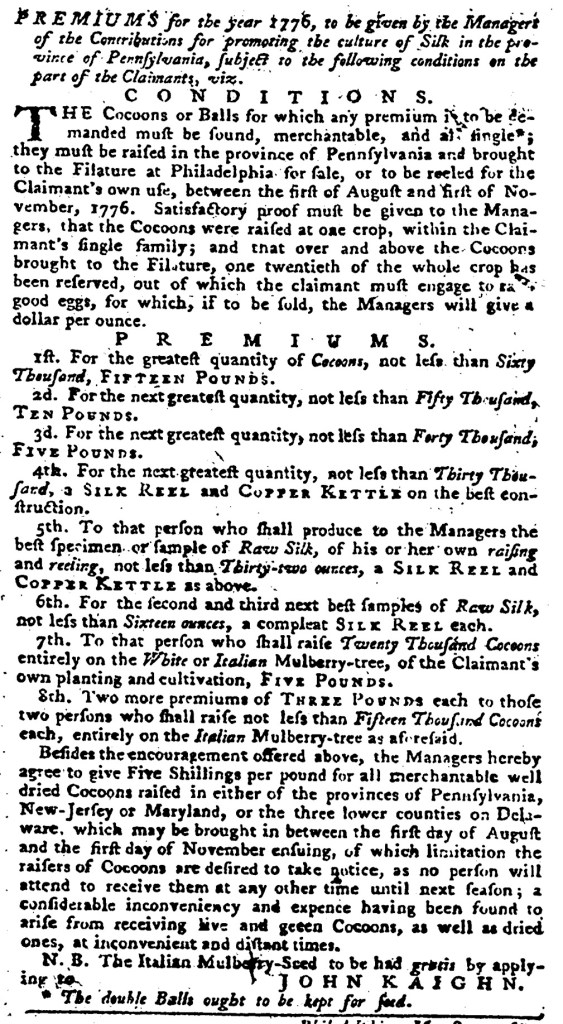
“PREMIUMS … to be given by the Managers of the Contributions for promoting the culture of Silk in the province of Pennsylvania.”
At various times in the eighteenth century, Americans sought to establish and expand silk production in the colonies. During the first years of the Revolutionary War, for instance, the “Managers of the Contributions for promoting the culture of Silk in the province of Pennsylvania” advertised “PREMIUMS” to be awarded to those who engaged in the enterprise. Their notice appeared in the Pennsylvania Gazette and the Pennsylvania Journal on May 15, 1776.
Silk production depended on raising silkworms. Four of the premiums recognized those who presented the “greatest quantity of Cocoons” that were “raised in the province of Pennsylvania and brought to the Filature at Philadelphia for sale, or to be reeled for the Claimant’s own use” between August 1 and November 1. At the filature, an establishment for reeling silk, filaments from the cocoons would be drawn and spun into thread. The managers offered a premium of fifteen pounds for the most cocoons, provided that they amounted to “not less than Sixty Thousand,” and premiums of ten pounds and five pounds for the next greatest quantities, “not less than Fifty Thousand” and “not less than Forty Thousand.” They gave one more premium, “a SILK REEL and COPPER KETTLE on the best construction,” to the fourth largest quantity of cocoons, “not less than Thirty Thousand.” Setting such thresholds required industriousness on the part of those who wished to claim the premiums.
Three more premiums went to those “who shall produce to the managers the best specimen of sample of Raw Silk, of his or her own raising and reeling.” Whoever produced the “best specimen … not less than Thirty-two ounces” received a silk reel and a copper kettle. The “second and third next best samples of Raw Silk, not less than Sixteen ounces,” each received a silk reel. Finally, another trio of premiums went to those “who shall raise [cocoons] entirely on the White or Italian Mulberry-tree, of the Claimant’s own planting and cultivation.” Raising “Twenty Thousand Cocoons” yielded a premium of five pounds with two more premiums of three pounds each for raising “not less than Fifteen Thousand Cocoons each.” A nota bene at the end of the advertisement indicated, “The Italian Mulberry-Seed to be had gratis by applying to JOHN KAIGHN.”
This contest was part of an effort to encourage “domestic manufacture” and local industry during the era of the American Revolution, but attempts to produce silk did not emerge because of the imperial crisis. Instead, colonizers had been striving for decades to establish silk production in North America. The premiums offered by the “Managers of the Contributions for promoting the culture of Silk in the province of Pennsylvania” were part of a longer history of seeking to make silk production a viable enterprise in the colonies.
[…] At various times in the eighteenth century, Americans sought to establish and expand silk production in the colonies. During the first years of the Revolutionary War, for instance, the “Managers of the Contributions for promoting the culture of Silk in the province of Pennsylvania” advertised “PREMIUMS” to be awarded to those who engaged in the enterprise. Their notice appeared in the Pennsylvania Gazette and the Pennsylvania Journal on May 15, 1776. Silk production depended on raising silkworms. Four of the premiums recognized those who presented the “greatest quantity of Cocoons” that were “raised in the province of Pennsylvania and brought to the Filature at Philadelphia for sale, or to be reeled for the Claimant’s own use” between August 1 and November 1. Read more… […]