
What was advertised in a colonial American newspaper 250 years ago today?
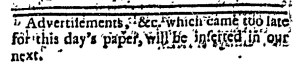
“Advertisements, &c. which came too late for this day’s paper, will be inserted in our next.”
Some advertisers and correspondents may have been frustrated when the content they submitted to the printing office did not appear in the April 12, 1775, edition of the Maryland Journal. To mollify them, the printer, William Goddard, inserted a brief note advising that “Advertisements, &c. which came too late for this day’s paper, will be inserted in our next.” No printer wished to disappoint advertisers who paid to run their notices nor correspondents who contributed the “FRESHEST ADVICES, both FOREIGN and DOMESTIC” that subscribers expected to find when they perused colonial newspapers. In this instance, some material just had not arrived in time to set the type and integrate it into the issue, but Goddard pledged that it would appear in print the following week.
The placement of the printer’s notice at the bottom of the final column on the third page suggests that he made the decision to include it shortly before taking the issue to press. Each edition of the Maryland Journal, like other colonial newspapers, consisted of four pages, two printed on each side of a broadsheet folded in half. Printers typically printed the side with the first and fourth pages and then the side with the second and third pages. As a result, the newest content, whether articles, letters, editorials, or advertisements, appeared “inside” the newspaper rather than on the front page. Goddard had just enough space for his notice to advertisers and correspondents when the compositor finished setting type and laying out the rest of the third page (the last page prepared for the press).
Many of the advertisements that did appear in that issue featured datelines, sometimes including both the town and date and other times just the date. Most on the fourth page (the first prepared for the press) were from March, along with a couple from February and the most recent from April 1, April 3 and April 4. All of them ran in the previous issue on April 5, so the compositor merely used type already set. The advertisements immediately above Goddard’s notice on the third page were dated April 6 and April 10, further demonstrating that where advertisements appeared in an issue depended in part on when they arrived in the printing office. Goddard did not play favorites or decide that some advertisements were more important than others. Instead, time constraints prevented him from immediately printing every advertisement submitted to him. Those advertisers could depend on their notices running in the next issue.