May 15

What was advertised in a revolutionary American newspaper 250 years ago today?
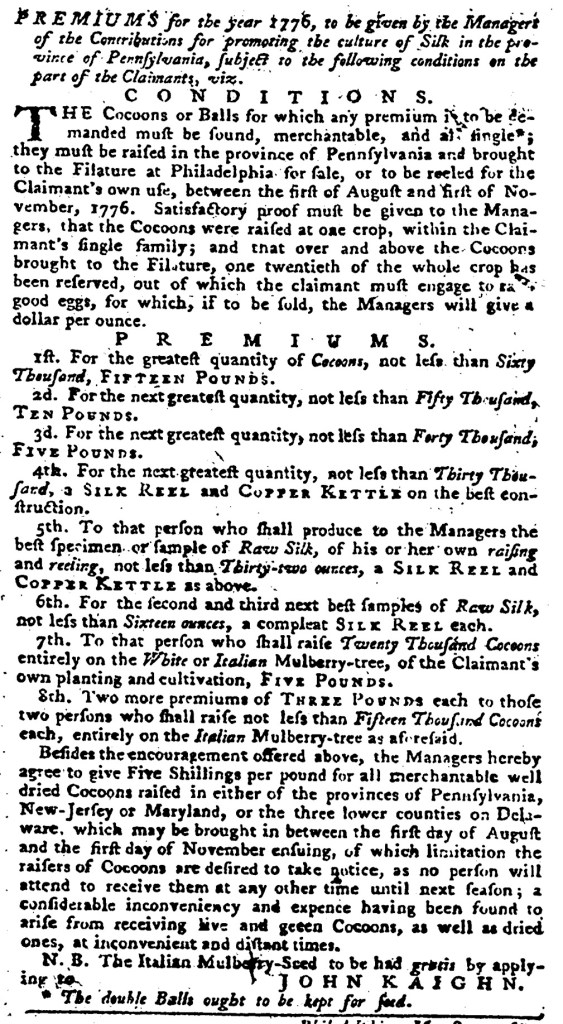
Pennsylvania Gazette (May 15, 1776).

PREMIUMS … to be given by the Managers of the Contributions for promoting the culture of Silk in the province of Pennsylvania.”

At various times in the eighteenth century, Americans sought to establish and expand silk production in the colonies.  During the first years of the Revolutionary War, for instance, the “Managers of the Contributions for promoting the culture of Silk in the province of Pennsylvania” advertised “PREMIUMS” to be awarded to those who engaged in the enterprise.  Their notice appeared in the Pennsylvania Gazette and the Pennsylvania Journal on May 15, 1776.

Silk production depended on raising silkworms.  Four of the premiums recognized those who presented the “greatest quantity of Cocoons” that were “raised in the province of Pennsylvania and brought to the Filature at Philadelphia for sale, or to be reeled for the Claimant’s own use” between August 1 and November 1.  At the filature, an establishment for reeling silk, filaments from the cocoons would be drawn and spun into thread.  The managers offered a premium of fifteen pounds for the most cocoons, provided that they amounted to “not less than Sixty Thousand,” and premiums of ten pounds and five pounds for the next greatest quantities, “not less than Fifty Thousand” and “not less than Forty Thousand.”  They gave one more premium, “a SILK REEL and COPPER KETTLE on the best construction,” to the fourth largest quantity of cocoons, “not less than Thirty Thousand.”  Setting such thresholds required industriousness on the part of those who wished to claim the premiums.

Three more premiums went to those “who shall produce to the managers the best specimen of sample of Raw Silk, of his or her own raising and reeling.”  Whoever produced the “best specimen … not less than Thirty-two ounces” received a silk reel and a copper kettle.  The “second and third next best samples of Raw Silk, not less than Sixteen ounces,” each received a silk reel.  Finally, another trio of premiums went to those “who shall raise [cocoons] entirely on the White or Italian Mulberry-tree, of the Claimant’s own planting and cultivation.”  Raising “Twenty Thousand Cocoons” yielded a premium of five pounds with two more premiums of three pounds each for raising “not less than Fifteen Thousand Cocoons each.”  A nota bene at the end of the advertisement indicated, “The Italian Mulberry-Seed to be had gratis by applying to JOHN KAIGHN.”

This contest was part of an effort to encourage “domestic manufacture” and local industry during the era of the American Revolution, but attempts to produce silk did not emerge because of the imperial crisis.  Instead, colonizers had been striving for decades to establish silk production in North America.  The premiums offered by the “Managers of the Contributions for promoting the culture of Silk in the province of Pennsylvania” were part of a longer history of seeking to make silk production a viable enterprise in the colonies.

May 26

What was advertised in a colonial American newspaper 250 years ago this week?

Pennsylvania Journal (May 23, 1771).

“Frugality and Industry make Mankind rich, free, and happy.”

Politics certainly shaped accounts of current events that ran in colonial newspapers during the era of the imperial crisis that culminated in the American Revolution.  Even more explicitly, politics appeared in letters and editorials that printed selected for publication.  Yet news accounts, letters, and editorials were not the only places that readers encountered politics in newspapers.  Advertisements often commented on current events and sought to convince readers to adopt political positions.

Such was the case in an advertisement about “A GOLD MEDAL” that would be awarded to “the Person that produces the best piece of Woollen Cloth, sufficient for a Suit of Cloathes, of Wool raised in Lancaster County.”  The advertisement in the May 23, 1771, edition of the Pennsylvania Journal declared that “it must be a sincere pleasure to every lover of this Country, to see the attention that persons of all denominations give, not only to the Woolen, but to other Manufactures that we stand most in need of from Foreign Countries.”  Such sentiments corresponded with an emphasis on “domestic manufactures,” producing more goods for consumption in the colonies, that arose in tandem with nonimportation agreements adopted in defiance of duties Parliament imposed on imported goods.  Many colonists argued that boycotts had the greatest chance of succeeding if American consumers had access to more alternatives produced in the colonies.  Such efforts also stood to strengthen local economies and reduce the trade imbalance with Britain.  In the process, goods acquired political meaning.  Colonists consciously chose to wear garments made of homespun, the cloth that inspired the competition advertised in the Pennsylvania Journal, as a badge of honor and a means of communicating their political allegiances and support of nonimportation agreements.  Even after Parliament repealed most of the duties and the colonies resumed trade with Britain, many colonists continued to advocate for greater self-sufficiency through domestic manufactures, as was the case for the sponsors of the content in Lancaster County.

The description of the medal awarded for the competition the previous year reflected the ideology of the patriot cause.  One side featured “the Bust of the Pennsylvania Farmer” with the inscription “Take away the wicked from before the King, and his Throne shall be established in righteousness.”  The image celebrated farmers.  The inscription lauded the king, implicitly critiquing Parliament for overstepping its authority in attempts to regulate colonial commerce.  The other side depicted “a Woman spin[n]ing, on the big wheel” with the inscription “Frugality and Industry maker Mankind rich, free, and happy.”  Like homespun cloth, the spinning wheel became a symbol of the patriot cause.  Including it on the medal testified to the important role women played in both politics and commerce, their labor in production and their decisions about consumption necessary to the success of domestic manufactures.  The inscription underscored that supporting domestic manufactures led to prosperity, freedom, and, ultimately, happiness.

The arguments contained in the advertisement about the contest to produce “Woollen Cloth” in Lancaster County echoed those made in letters and editorials that appeared elsewhere in the Pennsylvania Journal and other newspapers.  When they purchased space in newspapers, advertisers acquired some extent of editorial authority to express their views about any range of subjects.  Publishing an advertisement, like promoting the contest, gave the sponsors an opportunity to comment on politics and the colonial economy while simultaneously enlisting the support of others.