
What was advertised in a revolutionary American newspaper 250 years ago this week?
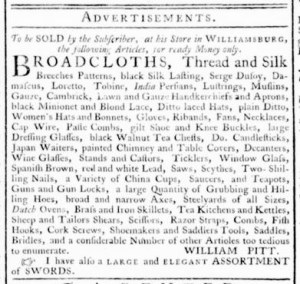
“To be SOLD … a considerable Number of other Articles too tedious to enumerate.”
In the spring of 1776, William Pitt advised the readers of John Dixon and William Hunter’s Virginia Gazette that he stocked a variety of items “at his Store in WILLIAMSBURG.” His advertisement had a familiar format, a short introduction followed by a dense paragraph of text with his name at the end and a final note that drew attention to items of particular interest.
In the introduction, Pitt declared that he sold “the following Articles, for ready Money only.” Generous credit had been an important aspect of the consumer revolution, but in times of distress many retailers insisted that their customers had to pay at the time of purchase. Pitt certainly was not alone in doing so after the war began with the skirmishes at Lexington and Concord. The body of the advertisement consisted entirely of a catalog of Pitt’s merchandise, a means of demonstrating the array of choices he made available to consumers. He stocked everything from fabrics and accessories to housewares and tools, including “BROADCLOTHS, … Muslins, Gauze, Cambrick, Lawn and Gauze Handkerchiefs and Aprons, black Minionet and Blond Lace, … Women’s Hats and Bonnets, Gloves, Ribands, Fans, Necklaces, … large Dressing Glasses, black Walnut Tea Chest, … Saws, Scythes, … a Variety of China Cups, Saucers, and Teapots, Guns and Gun Locks, … broad and narrow Axes, … Brass and Iron Skillets, … Sheep and Tailors Shears, Scissors, Razor Straps, Combs, Fish Hooks, Cork Screws, Shoemakers and Saddlers Tools, Saddles, [and] Bridles.” The length of the list was an appeal to customers in and off itself. Some of those items, especially the textiles, are not readily familiar to modern readers, but eighteenth-century consumers recognized them and could distinguish among them. Just in case he had not convinced prospective customers of the variety that awaited at his store, Pitt proclaimed that he sold “a considerable Number of other Articles too tedious to enumerate.” That was a common pitch throughout the colonies. He concluded with a shorter entry. Many advertisers used “N.B.” for nota bene (“take note”), but Pitt inserted a manicule for the same effect. “I have also,” he noted, “a LARGE and ELEGANT ASSORTMENT of SWORDS.” Gentlemen looking to outfit themselves for military service or simply to defend themselves, Pitt suggested, should visit his store. Even with the final entry about swords, his advertisement looked much like those published before the war began.