What was advertised in a revolutionary American newspaper 250 years ago today?

“For Sale at his Shop Next Door to the White-Haven Meeting House …”
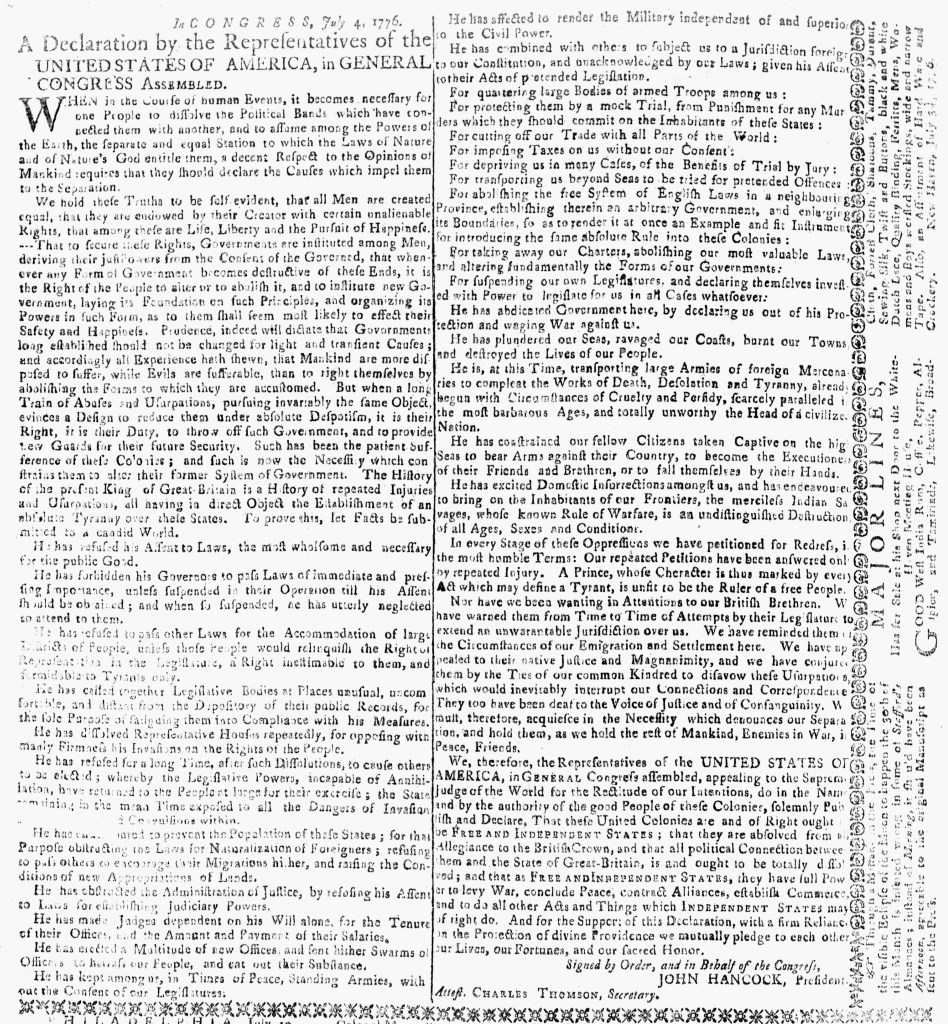
Either Thomas Green and Samuel Green did not acquire a copy of the Declaration of Independence in time to include it in the July 10, 1776, edition of the Connecticut Journal or they prioritized other news and advertisements with type already set. Due to a paper shortage, they scaled back their newspaper from four pages to two pages each week, so that also constrained how much space they had for the Declaration of Independence and other content. Even though the new nation’s founding document did not appear in the Connecticut Journal in the first issue after the printers acquired a copy, the Greens did disseminate it to readers in New Haven and nearby towns via other means. A notice from the printers appeared above the other advertisements: “To morrow, will be ready for sale, The Resolves of the Congress, declaring the United Colonies, FREE and INDEPENDENT STATES.” That broadside edition circulated for nearly a week before the Declaration of Independence appeared in the July 17 edition of the Connecticut Journal.
When it did appear, as Emily Sneff explains, the Greens “reused the typesetting for their weekly newspaper. … To create their broadsides, they formatted the Declaration in two columns separated by a line of ornamental type. In the next issue of their Journal on July 17, the Greens squeezed the same two columns of type onto the back page and used a border of or ornamental type to separate the Declaration from other pieces of news and advertisements.”[1] To fit the remaining space, the Greens rotated the text to run perpendicular to the two (wider) columns of the Declaration of Independence at the top of the page and the three (narrower) columns of news and advertisements at the bottom of the page. The content set at an awkward angle included a correction concerning “the Time of the visible Eclipse of the Moon to happen the 30th of this Month” that was “inserted wrong in some of Stafford’s Almanacs” printed by the Greens. An advertisement about goods that Major Line sold at his shop ran as two short columns of five or six lines each. The savvy printers made those short columns the same width as standard columns throughout the rest of their newspaper. When the advertisement ran in the next issue, they did not have to reset all the type but instead combined the two columns into a single notice. They repeatedly showed ingenuity in the choices they made about how to print the Declaration of Independence and other items in the Connecticut Journal.
**********
In addition to briefly recounting this story in When the Declaration of Independence was News, Emily Sneff offers more analysis of the broadside and the newspaper (with images of both) as Research Highlight for the Declaration Resources Project.
[1] Emily Sneff, When the Declaration of Independence Was News (Oxford University Press, 2026), 69.