December 7

What was advertised in a revolutionary American newspaper 250 years ago today?

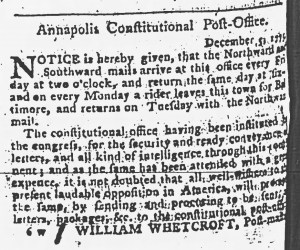
Maryland Gazette (December 7, 1775).

“Annapolis Constitutional Post-Office.”

In early December 1775, William Whetcroft became the latest postmaster to run a newspaper advertisement promoting a local branch of the Constitutional Post Office established by the Second Continental Congress.  In October, Mary Katharine Goddard placed a notice about the Baltimore office in the Maryland Journal.  Otherwise, advertisements for local branches appeared in newspapers published in New England, New York, and Pennsylvania, but not yet in newspapers from colonies south of Maryland.  The headline for this newest advertisement proclaimed, “Annapolis Constitutional Post-Office,” alerting readers of the Maryland Gazette that they had an alternative to the British imperial system.  Whetcroft commenced with an overview of his office’s schedule: “the Northward and Southward mail arrive at this office every Friday at two o’clock, and return the same day at six.”  In addition, “on Monday a rider leaves this town for Baltimore, and returns on Tuesday with the Northward mail.”

Yet Whetcroft used his advertisement to relay more than just the logistical details.  He gave an overview of the purpose that the Constitutional Post Office served as the imperial crisis intensified, hostilities commenced, and some colonizers considered whether they should declare independence rather than continue seeking redress of their grievances against Parliament.  “The constitutional office having been instituted by the congress,” the postmaster explained, “for the security and ready conveyance of letters, and all kinds of intelligence through this continent; and as the same has been attended with a great expence, it is not doubted that all well-wishers to the present laudable opposition in America, will promote the same, by sending and procuring to be sent all letters, packages, &c. to the constitutional post-office.”  Supporters of the American cause had a civic duty, Whetcroft asserted, to make use of this service.

Frederick Green, the printer of the Maryland Gazette, gave Whetcroft’s notice a privileged place the first time it appeared in that newspaper.  It appeared as the second advertisement following the news, preceded only by Green’s own advertisement for the almanac he just published and sold at the printing office.  As much as Green may have been a supporter of the Constitutional Post Office, he still had to earn his livelihood with his own endeavors!  Still, the printer had room for only two advertisements at the bottom of the final column on the second page.  He could have chosen from among several of a similar length to Whetcroft’s advertisement, yet he selected the notice about the Constitutional Post Office to appear alongside news of the revolutionary events taking place in Maryland and beyond.  In subsequent editions, that advertisement ran intermingled among others, but that was common practice for notices that printers initially gave privileged places the first time they ran in their newspapers.

November 17

What was advertised in a revolutionary American newspaper 250 years ago today?

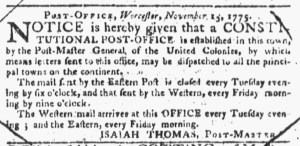
Thomas’s Massachusetts Spy (November 17, 1775).

“A CONSTITUTIONAL POST-OFFICE is established in this town.”

Isaiah Thomas, the printer of Thomas’s Massachusetts Spy, gained a new title in the fall of 1775.  He became the postmaster for the “CONSTITUTIONAL POST-OFFICE” in Worcester.  In an advertisement in the November 17 edition of his newspaper, he informed the public that “the Post-Mater General of the United Colonies” established the post office in Worcester.  That meant that “letters sent to this office, may be dispatched to all the principal towns on the continent” via a network of post offices and riders authorized by the Second Continental Congress as an alternative to the imperial postal system.  Thomas provided a schedule.  Outgoing mail “sent by the Eastern Post is closed every Tuesday evening by six o’clock.”  For outgoing mail, the post office dispatched letter received “Friday morning by nine o’clock.”  That corresponded with the arrival of new mail: “The Western mail arrives at this OFFICE every Tuesday evening; and the Eastern, every Friday morning.”  Patrons who planned accordingly could use the new postal system to correspond with friends, relatives, and associates throughout the colonies.

Thomas gave this advertisement a prominent place when he published it, placing it immediately below a notice that the Second Continental Congress created a committee to compile a “just and well authenticated account of the hostilities committed by the ministerial troops and navy in America since March last,” including “proper evidence of the truth of the facts related.”  In documenting buildings destroyed, vessels seized, and stock taken, they justified their resistance and engaged in public relations to demonstrate that colonizers had legitimate grievances.  Thomas could have placed any number of other advertisements below that notice, yet he opted for one that promoted another effort undertaken by the Second Continental Congress to protect American liberties.  It was a fitting editorial decision for a newspaper with American Oracle of Liberty as its secondary title.  In this instance, Thomas deployed an advertisement as a continuation of news about current events, keeping readers updated not only about what occurred but also about how they could support the American cause.

June 15

What was advertised in a revolutionary American newspaper 250 years ago today?

New-England Chronicle (June 15, 1775).

“We are satisfied that Mr. Bradish had no Desire … to do any Injury to his Country.”

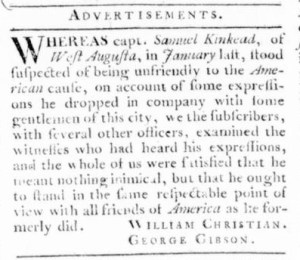
On the eve of the American Revolution and during the first months of the war, colonizers in New England resorted to newspaper to clarify their positions and frame their own narratives about how their experiences fit into current events.  They used advertisements to set the record straight for a public that might have misunderstood their actions or principles.  For nearly a year before the battles at Lexington and Concord, some of those who signed an address to the former governor, Thomas Hutchinson, upon his departure from Massachusetts to return to England ran advertisements with recantations and assurances that they supported the American cause.

Once hostilities commenced, others depended on advertisements endorsed by reputable patriots to clear their names.  Such was the case with Ebenezer Bradish, Jr., of Cambridge who had been “represented as a Person unfriendly to the just Rights and Liberties of his Country.”  To make matters worse, he moved to Boston on the same day as “the late unhappy Commencement of Hostilities betweed the Troops under the Command of General Gage,” the governor, and “the Inhabitants of this Province.”  That “increased public Suspicions against him” and “rendered [him] more odious and disagreeable to his Countrymen.”

Yet that unfortunate coincidence did not tell the entire story, according to ten men who signed a notice in which they recommended that “all Persons” treat Bradish “as a Gentlemen who is not unfriendly to the Rights and Privileges of his Countrymen,” at least “so far as we are able to discover upon strict Enquiry into his late Conduct.”  They declared that they had investigated “the Cause of his going to Boston at the Time aforesaid” as well as “his Conduct since” and determined that Bradish “had no Desire by that Means, to any Injury to his Country.”  On the contrary, they asserted,” his Design was friendly, and his Conduct was justifiable,” though they did not give more details about the circumstances.  The men who signed the notice came from various towns in Massachusetts (and one from Connecticut).  Most listed their ranks, with “Seth Pomeroy, of Northampton, (General.)” first and then five colonels, two majors, and one captain.  Even though Bradish was suspect, these men were not.  Readers could trust them when they said that they wished “to do Justice to Mr. Bradish” by “remov[ing] from the Minds of our beloved Friends and Countrymen, all groundless Apprehensions” about his conduct.

When Bradish published the conclusions reached by their “Enquiry” as an advertisement in the June 15, 1775, edition of the New-England Chronicle, he appended a nota bene that made clear he had no sympathy for British authorities or the conduct of the troops under their command.  “Whereas a Report had been unjustly spread abroad, that it not the Regulars but our own People who took the Goods lost out of my House,” Bradish proclaimed, “this is to certify to all good People, that said Report is false.”  Furthermore, it “never came from me” but instead from someone else with malicious intent.  To leave no doubt about where he stood, Bradish concluded with an indictment of British troops: “I am certain my House was not only shot at but plundered by the Regulars.”  In publishing the letter from the men who investigated his actions and his own account of what happened to his house as a newspaper advertisement, Bradish hoped to harness the power of the public prints to clear his name and restore himself to good standing among those who supported the patriot cause.

May 2

What was advertised in a revolutionary American newspaper 250 years ago today?

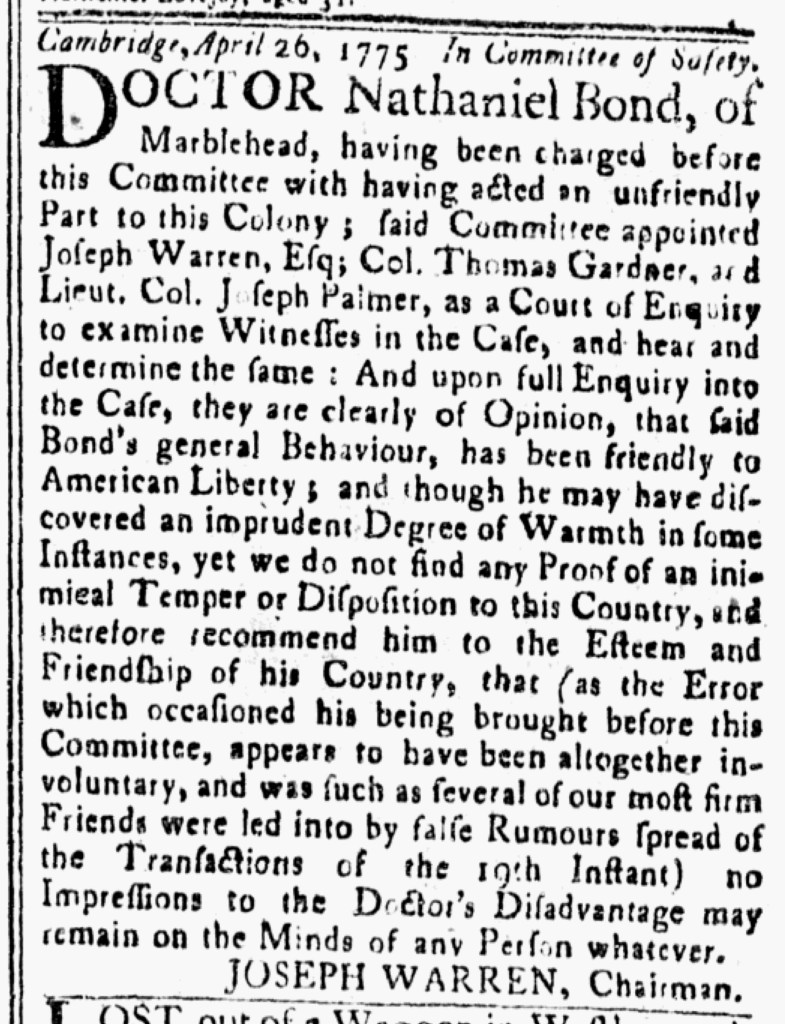
Essex Gazette (May 2, 1775).

“We do not find any Proof of an inimical Temper or Disposition to this Country.”

Advertisements in early American newspapers often delivered local news beyond the items that printers selected to cover.  Such was the case for an advertisement placed by the Committee of Safety in the May 2, 1775, edition of the Essex Gazette.  Convening in Cambridge a week after the battles at Lexington and Concord, the committee considered the case of “DOCTOR Nathaniel Bond, of Marblehead,” who had been accused of “acting an unfriendly Part to this Colony.”  The committee appointed a “Court of Enquiry” consisting of Joseph Warren, then serving as president pro tem of the Massachusetts Provincial Congress, Colonel Thomas Gardner, and Lieutenant Colonel Joseph Palmer to “examine Witnesses in the Case.”

On behalf of the Committee of Safety, Warren declared that a “full Enquiry” led him, Gardner, and Palmer to the conclusion that “Bond’s general Behaviour, has been friendly to American Liberty; and though he may have discovered an imprudent Degree of Warmth in some Instance, yet we do not find any Proof of an inimical Temper or Disposition to this Country.”  Accordingly, the Committee of Safety “recommend him to the Esteem and Friendship of his Country, that … no Impressions to the Doctor’s Disadvantage may remain on the Minds of any Person whatever.”  Given that Boston’s newspapers “are all stopt, and no more will be printed for the present,” as the printer of the New-Hampshire Gazette put it, some sort of coverage in the Essex Gazette, whether an article or an advertisement, was one of the few remaining options for Bond to rehabilitate his reputation in the public prints in Massachusetts.

While Bond may have been pleased with the Committee of Safety’s notice to the public to accord him “Esteem and Friendship” rather than shun him, readers may have been disappointed that the advertisement did not carry as much news as they wanted.  Warren noted that “the Error which occasioned [Bond] being brought before this Committee, appears to have been altogether involuntary, and was such as several of our most firm Friends were led into by false Rumours spread of the Transactions of the 19th Instant.”  What happened that brought Bond to the attention of the committee in the wake of the “Transactions” at Lexington and Concord?  What had the “Error” been?  Providing such details was not necessary to achieve Warren’s purpose of clearing Bond of the charges, yet not giving a more complete accounting may have left readers wanting to know more about what had supposedly transpired.  For some, gossip likely filled in the gaps left by an incomplete narrative in the newspaper advertisement.

December 9

What was advertised in a colonial American newspaper 250 years ago today?

Connecticut Gazette (December 9, 1774).

“Glass buttons having the word liberty printed in them.”

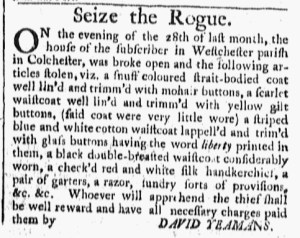
The headline for David Yeaman’s advertisement in the December 9, 1774, edition of the Connecticut Gazette alerted readers that it would document some sort of misbehavior.  “Seize the Rogue,” it proclaimed.  The rogue “broke open” Yeamans’s house and stole several items on November 28.  They included clothing, a “check’d red and white silk handkerchief,” a razor, and “sundry sorts of provisions.”  The unfortunate advertiser offered a reward to whoever apprehended the thief.

Yeamans’s descriptions of the missing garments revealed his taste and sartorial sensibilities.  The thief took a “snuff coloured strait-bodied coat well lin’d and trimm’d with mohair buttons,” a “scarlet waitcoast well lin’d and trimm’d with yellow gilt buttons” that showed very little wear, a “black double-breasted waistcoat considerably worn,” and a “striped blue and white cotton waistcoat lappell’d and trim’d with glass buttons.”  That last piece of clothing testified to more than Yeamans’s sense of fashion. It also said something about his politics and how he felt about the imperial crisis that had been intensifying for the year since the Boston Tea Party.  Those glass buttons had “the word liberty printed in them.”  Yeamans made a statement every time he wore the striped waistcoat adorned with those buttons.

This advertisement, printed immediately below entries from the “CUSTOM-HOUSE, New-LONDON,” and other shipping news in “THOMAS ALLEN’s MARINE LIST,” provided additional coverage of local news, though selected by an advertiser who paid to have it appear in print rather than by the editor who compiled “Fresh Advices from London!” and reports from Boston, New York, Philadelphia, and Hartford.  At first glance, it featured a theft, yet the details about one of the stolen garments prompted readers to think about the contents of the articles and editorials in that issue, including discussion of the Continental Association adopted by the First Continental Congress and the impact of the Boston Port Bill on residents of that city.  Those buttons with “the word liberty printed in them” contributed to discussions about politics when Yeamans wore his waistcoat and when he advertised its theft.