What was advertised in a revolutionary American newspaper 250 years ago today?
Henrich Millers Pennsylvanischer Staatsbote (January 16, 1776).
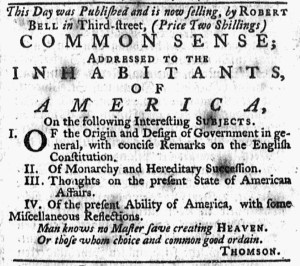
“COMMON SENSE; ADDRESSED TO THE INHABITANTS OF AMERICA.”
On January 16, 1776, Robert Bell’s advertisement for the first edition of Thomas Paine’s Comon Sense made its third appearance in the Pennsylvania Evening Post. That newspaper, the only triweekly published in Philadelphia at the time, was the first to carry Bell’s advertisement. It ran on January 9, 13, and 16, but not on January 11. During that week, Bell also inserted an advertisement for Common Sensein each of the other five newspapers printed in Philadelphia at the time. On January 16, Henrich Millers Pennsylvanische Staatsbote was the last to feature it, the only advertisement in that newspaper printed in English rather than German. Bell, already known for his savvy marketing, made sure that German settlers who could read English saw the political pamphlet advertised in the newspaper they were most likely to consult.
By that time, many of them may have already heard about the incendiary Common Sense, the way it mocked monarchy, and the arguments it made in favor of the colonies declaring independence. Throughout most of the imperial crisis, colonizers blamed Parliament for perpetrating various abuses. They sought redress for their grievances from the king. Over time, however, many identified George III as the author of their misfortune. The monarch, after all, possessed ultimate responsibility for what occurred in his realm. The Declaration of Independence listed more than two dozen grievances, assigning them all to the king rather than Parliament. The publication of Common Sense in January 1776 played a significant role in shifting attitudes about the role the king played in the imperial crisis and the war that began with the skirmishes at Lexington and Concord in April 1775.
Among the observations and arguments that Paine advanced, he stated that “in America THE LAW IS KING. For as in absolute governments, the King is law, so in free countries the law ought to be King and there ought to be no other.” It was an ideal embraced by the founding generation … and it is an ideal under threat today as the nation commemorates 250 years since the Revolutionary War and the Declaration of Independence. Citizens and the legislators who represent them must hold those who seek to be absolute rulers accountable to the rule of law so the republic remains a place where “THE LAW IS KING.”
What was advertised in a revolutionary American newspaper 250 years ago today?
Pennsylvania Ledger (January 13, 1776).
“COMMON SENSE; ADDRESSED TO THE INHABITANTS OF AMERICA.”
Robert Bell, one of the most prominent printers and booksellers in America, already had experience with extensive advertising campaigns by the time he published and marketed Thomas Paine’s Common Sense in January 1776. Within a week, Bell inserted advertisements for what would become the most influential political pamphlet of the era of the American Revolution in all six newspapers printed in Philadelphia.
He started with the Pennsylvania Evening Post on January 9, then placed nearly identical advertisements in the Pennsylvania Gazette and the Pennsylvania Journal on January 10. On January 13, the advertisement ran in the Pennsylvania Ledger (and once again in the Pennsylvania Evening Post, the city’s only triweekly rather than weekly newspaper). Bell also ran the advertisement in Dunlap’s Pennsylvania Packet on January 15. His notice had a privileged place in Pennsylvania Ledger (the first item in the first column on the first page) and Dunlap’s Pennsylvania Packet (the first advertisement following the news).
Even the Henrich Millers Pennsylvanischer Staaatsbote carried the advertisement on January 16, one week after Bell’s first advertisement appeared in the Pennsylvania Evening Post. It was the only advertisement in English, even though the newspaper’s masthead advised that “All ADVERTISEMENTS to be inserted in this Paper, or printed single by HENRY MILLER, Publisher hereof, are by him translated gratis.” Perhaps, since the pamphlet had not yet been translated into German, Bell instructed Miller to publish the advertisement in English to entice bilingual German colonizers. Later in 1776, Melchior Steiner and Carl Cist, who had recently advertised that they printed in English, German, and other languages, published a German translation, Gesunde Vernunft.
The arguments and ideas that Paine presented in Common Sense caused a popular uproar. Steiner and Cist’s German translation was only one of many local editions; printers in other cities and towns, especially in New York and New England, produced and advertised their own editions of the pamphlet. Yet neither Paine nor Bell knew in advance that Common Sense would have such a reception. It was not long before the author and the publisher had a falling out, causing Paine to work with William Bradford and Thomas Bradford, the printers of the Pennsylvania Journal, on the second edition. Before that, however, Bell applied his long experience advertising books to promoting Common Sense in the public prints when he published the first edition.
What was advertised in a revolutionary American newspaper 250 years ago today?
Story and Humphreys’s Pennsylvania Mercury (September 1, 1775).
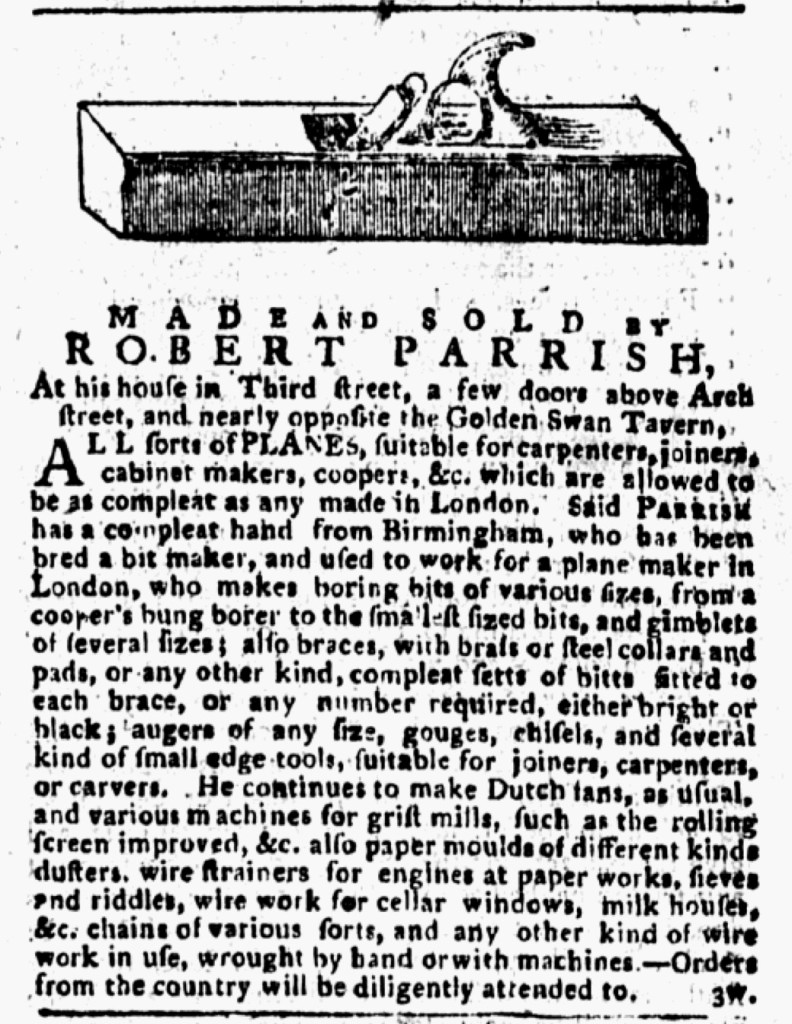
“ALL sorts of PLANES, suitable for carpenters.”
When Robert Parrish published an advertisement adorned with a woodcut depicting a carpenter’s plane in the August 26, 1775, edition of the Pennsylvania Ledger, it was the first of several appearances that image would make in newspapers printed in Philadelphia over the course of eight weeks. It next appeared in Story and Humphreys’s Pennsylvania Mercuryon September 1 as part of an advertisement with identical copy. Perhaps Parrish had clipped his advertisement from the Pennsylvania Ledger and delivered it to Story and Humphreys’s printing office along with the woodcut that he retrieved from the Pennsylvania Ledger.
Having commissioned only one woodcut constrained Parrish’s schedule for publishing his advertisements. Story and Humphreys’s Pennsylvania Mercury came out on Fridays and the Pennsylvania Mercury on Saturdays. That did not leave enough time to transfer the woodcut back and forth between the two printing offices and have the compositors in each include them in the new issues when they set the type and laid them out. Compositors, after all, sought to streamline that process as much as possible. To that end, the initial insertion of Parrish’s advertisement in the Pennsylvania Ledgerincluded a dateline, “Philadelphia, August 25, 1775,” above the woodcut, but the compositor did not include it with subsequent insertions (even though advertisements often ran with their original dates for weeks or months). It was much easier to retain the copy for the main body of the advertisement without worrying about a header that ran above the woodcut.
Parrish’s advertisement first ran in the Pennsylvania Ledger on a Saturday (in the first week of his advertising campaign) and then in Story and Humphreys’s Pennsylvania Mercury the following Friday (in the second week of his advertising campaign). It did not appear in the Pennsylvania Ledger the next day. Instead, it ran in that newspaper a week later (in the third week of his advertising campaign). In the fourth week, the woodcut returned to Story and Humphreys’s printing office and Parrish’s advertisement appeared in their newspaper once again on September 15. It did not run in either newspaper the following week but instead found its way to yet another newspaper, the Pennsylvania Journal published on Wednesday, September 27. That allowed enough time to get the woodcut back to the Pennsylvania Ledger for its September 30 edition (during the sixth week of Parrish’s advertising campaign). Parrish returned to alternating between the two original newspapers during the next two weeks. His advertisement with the woodcut went back to Story and Humphreys’s Pennsylvania Mercury for the October 6 issue and then ran in the Pennsylvania Ledger on October 14.
Investing in a woodcut increased the chances that prospective customers would take note of an advertisement, but Parrish and other advertisers had limits to how much they would spend. He apparently considered it worth it to commission a single woodcut but not more than one. Instead, he arranged to transfer that woodcut from printing office to printing office to printing office over the course of many weeks.
“She intends to open a DANCING SCHOOL … for young ladies.”
The new term had commenced, yet Sarah Hallam continued advertising her “DANCING SCHOOL” in Williamsburg in the August 31, 1775, edition of John Pinkney’s Virginia Gazette. She first promoted the school in the public prints on August 17, announcing that she “intends to open a DANCING SCHOOL, on Friday the 25th instant, for young ladies. That gave prospective pupils and their parents just over a week to enroll. Hallam advertised a second time on the eve of opening her school and again a week later to give stragglers a chance to join. She apparently considered advertising worth the investment. The advertisement continued in four more issues, through the end of September. According to the rates in the newspaper’s masthead, Pinkney charged three shillings for the first insertion (to cover setting type and space in the newspaper) and two shilling for each additional insertion (for the space once the type was set). That meant that Hallam spent fifteen shillings on advertisements in Pinkney’s Virginia Gazette. She charged twenty shillings as an entrance fee and then four pounds per year for each student. That meant that the entrance fee for just one student covered her advertising expenses.
Hallam certainly made choices about her marketing campaign, choices not limited to how long it lasted. Williamsburg had three newspapers at the time. John Dixon and William Hunter published their own Virginia Gazette, as did Alexander Purdie. Yet Hallam opted not to place notices in either of the other newspapers even though the printers charged the same rates. She had a limit to how much she would spend on recruiting new students. She apparently decided that a longer campaign in a single newspaper would be more effective than a shorter campaign in several newspapers. She may have reasoned that each Virginia Gazette circulated so widely in Williamsburg that inserting an advertisement in Dixon and Hunter’s Virginia Gazette or Purdie’s Virginia Gazette would be superfluous after running it in Pinkney’s Virginia Gazette. Why choose Pinkney’s newspaper over the others? Perhaps she appreciated that Pinkney had printed the Virginia Gazette “FOR THE BENEFIT OF CLEMENTINA RIND’s CHILDREN” after the former printer’s death in September 1774. For six months, the masthead made that proclamation immediately above the advertising rates. As a female entrepreneur, Hallam may have found meaning in choosing the newspaper formerly printed by a woman and then printed to support her children following her death.
What was advertised in a revolutionary American newspaper 250 years ago this month?
Massachusetts Gazette and Boston Weekly News-Letter (April 13, 1775).
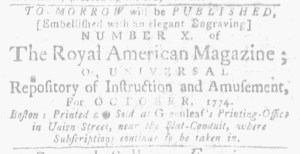
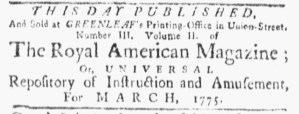
“THIS DAY PUBLISHED, The Royal American Magazine; FOR MARCH, 1775.”
On April 28, 1775, Daniel Fowle, printer of the New-Hampshire Gazette, reported that the “Boston News Papers … are all stopt, and no more will be printed for the present” following the outbreak of hostilities at Lexington and Concord. He could have also mentioned that the Royal American Magazine, published by Joseph Greenleaf in Boston, had been suspended as well. Although some of the newspapers eventually resumed, the Royal American Magazine did not. The March 1775 issue, distributed in the second week of April, was the last one for that ambitious project that had repeatedly met with mishaps. Isaiah Thomas, the original publisher, delayed the first issue when the ship carrying new types ran aground in January 1774 and then fell several issues behind because of the “Distresses” that Boston experienced when the Boston Port Act closed the harbor in June 1774 in retaliation for the destruction of tea the previous December. Shortly after Thomas advised the public that he had suspended the magazine, he announced that he transferred it to Greenleaf. The new publisher worked diligently to compile, print, and circulate the overdue issues and get back on schedule.
Massachusetts Gazette and Boston Weekly News-Letter (April 20, 1775).
Despite the challenges, he managed to do so, especially considering that eighteenth-century subscribers expected the issue for a month either at the very end of that month or early in the following month. Accordingly, when Greenleaf first announced publication of the February 1775 issue on March 13 the new issue was on time, especially given the circumstances. A month later, he ran a brief notice in the April 13 edition of the Massachusetts Gazette and Boston Weekly News-Letter: “THIS DAY PUBLISHED, The Royal American Magazine; FOR MARCH, 1775.” A week later, he placed a more extensive advertisement in the same newspaper. That one promoted the “elegant Engraving” that “Embellished” the magazine, though he did not reveal that it was a political cartoon depicting “America in Distress” engraved by Paul Revere. (See the American Antiquarian Society’s illustrated inventory of “Royal American Magazine Plates” for images and descriptions of Revere’s engravings that accompanied the magazine.) As he sometimes did in advertisements in previous months, Greenleaf stated that “Subscriptions continue to be taken in.” That advertisement appeared on April 20, the day after the battles at Lexington and Concord. Almost certainly Greenleaf composed the advertisement before such momentous events; very likely the type had already been set when word arrived in Boston. The Massachusetts Gazette and Boston Weekly News-Letter covered the “unhappy Affair” in a single paragraph that ran on the same page as the advertisement for the Royal American Magazine. It would be the last issue of that newspaper until May 19. On April 24, the final issue of the Boston Evening-Postcarried only three advertisements, one of them announcing publication of the March issue of the Royal American Magazine.
Boston Evening-Post (April 24, 1775).
That brought to conclusion an advertising campaign that lasted nearly two years when Thomas first declared that he would distribute subscription proposals. For several months, he advertised widely in newspapers in New England, New York, Pennsylvania, and Maryland, seeking subscribers in distant cities for what was the only magazine published in the colonies at the time. (Robert Aitken eventually launched the Pennsylvania Magazine in January 1775, a year after the Royal American Magazine commenced.) Thomas scaled back the advertising once he took the first issue of the magazine to press. In turn, Greenleaf also confined his advertising to Boston’s newspapers. The ambitious project ended up a casualty of the imperial crisis when resistance became revolution.
What was advertised in a colonial American newspaper 250 years ago this month?
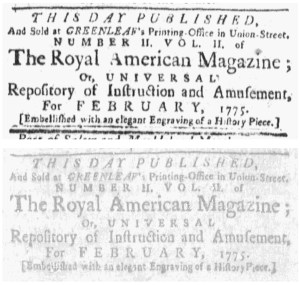
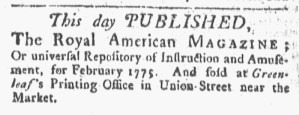
“The Royal American MAGAZINE … for February 1775.”
In March 1775, three of Boston’s newspapers carried advertisements that the February issue of the Royal American Magazine was now available “at Greenleaf’s Printing Office in Union-Street near the Market” in Boston. The advertisements first appeared in the Boston Evening-Post and the Boston-Gazette on March 13. Based on publication dates for magazines today, the February issue seems quite overdue, but in the eighteenth century published distributed magazines at the end of the month or early in the following month. Considering that Greenleaf had not advertised the January edition until February 20, it appears that he managed to take the next issue to press in just three weeks.
Above: Boston Evening-Post (March 13, 1775); Below: Massachusetts Gazette and Boston Weekly News-Letter (March 17, 1775).
The advertisement in the Boston-Gazette ran for two consecutive weeks. The more elaborate version in the Boston Evening-Post reported that the February issue was “Embellished with an elegant Engraving of a History Piece.” That copperplate engraving, executed by Paul Revere, depicted a scene from the “History of Lauretta,” a moral tale included among the contents of the magazine. The advertisement ran only once in the Boston Evening-Post, but appeared in the Massachusetts Gazette and Boston Weekly News-Letter on March 17 and 30. Once again, those printing offices seem to have shared type set in one printing office and transferred to the other. It is not clear what role Greenleaf played in that arrangement since some of the city’s printers engaged in that practice on other occasions.
What is clear is that Greenleaf’s marketing campaign was not nearly as extensive as the one devised by Isaiah Thomas when he first proposed publishing the Royal American Magazine and announced distribution of the first several issues. Yet the number of advertisements and the array of newspapers that carried them diminished even during Thomas’s tenure as publisher of the magazine, likely due to the evolving political situation in Boston and throughout the colonies. He had promoted the magazine widely in the months before colonizers dumped tea into Boston Harbor, but only began publishing it as they contended with the aftermath, including the closure of the port and other punitive measures passed by Parliament in the Coercive Acts. Even as Thomas filled the magazine with patriot propaganda, he and other residents of Boston experienced “Distresses” that apparently made marketing the Royal American Magazineless of a priority. For his part, Greenleaf advised the public about new issues, but he did not attempt to replicate the initial marketing strategy devised by Thomas.
What was advertised in a colonial American newspaper 250 years ago today?
Massachusetts Gazette and Boston Weekly News-Letter (February 26, 1775).
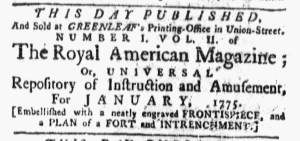
“The Royal American Magazine … For JANUARY, 1775.”
When Joseph Greenleaf acquired the Royal American Magazine from Isaiah Thomas, the original printer, near the end of the summer of 1774, the magazine had fallen two months behind, largely due to the hardships caused by the Boston Port Act. Over the next several months, Greenleaf worked diligently to return the magazine to its publication schedule, achieving that goal with publication of the December 1774 issue during the first week of January 1775. While that may seem late by twenty-first century standards, magazines bore the date of the previous month, not the upcoming month, in the eighteenth century. Subscribers anticipated receiving that month’s issue at the very end of the month or the beginning of the next month.
Although Greenleaf managed to get the magazine back on schedule at the beginning of the new year, that did not last long. The January issue, anticipated around the first of February, was not available until nearly the end of the month. On February 20, a notice in the Boston Evening-Post announced, “THIS DAY PUBLISHED … The Royal American Magazine … For JANUARY, 1775.” It was the first advertisement that mentioned the magazine in February, except for the final appearance of Henry Christian Geyer’s notice that critiqued the Royal American Magazine because it “was not printed with his Ink” that he “manufactured” in Boston. Greenleaf’s progress may have been stalled, in part, by producing a supplement to the first volume of the magazine during January. That supplement included a title page for the entire volume to insert if subscribers had all the issue bound together, an address to subscribers, and an index. It also delivered an installment of Thomas Hutchinson’s History of Massachusetts-Bay, a premium offered to subscribers when Thomas circulated subscription proposals.
Boston Evening-Post (February 20, 1775).
Greenleaf published only two advertisements for the Royal American Magazine in February 1775. His notice that first appeared in the Boston Evening-Post on February 20 ran three days later in the Massachusetts Gazette and Boston Weekly News-Letter. As had been the case in January, it seems that the printing offices shared type that had been set in one location and transferred to the other.
The January 1775 issue turned out to be one of the last issues of the Royal American Magazine, despite the plans for improvement that Greenleaf sketched in the address to subscribers in the supplement. The printer could not contend with the circumstances in Boston as the political situation worsened. Although Greenleaf and the subscribers did not know it at the time, the first battles of the Revolutionary War would take place within a couple of months. In their wake, some newspapers printed in Boston suspended publication and others ceased publication. The Royal American Magazine was not the only periodical that became a casualty of the imperial crisis.
What was advertised in a colonial American newspaper 250 years ago today?
Massachusetts Gazette and Boston Post-Boy (January 30, 1775).
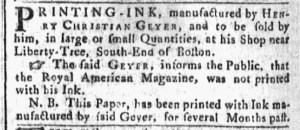
“The Royal American Magazine, was not printed with his Ink.”
The final mention of the Royal American Magazine in newspaper advertisements published in January 1775 may not have been the kind of coverage that Joseph Greenleaf, the printer, desired. Henry Christian Geyer once again inserted his notice for printing ink that he made and sold “at his Shop near Liberty-Tree” in Boston in the January 30 edition of the Massachusetts Gazette and Boston Post-Boy. In it, he noted to the public that “the Royal American Magazine, was not printed with his Ink.”
Beyond that squabble, Greenleaf did advertise the Royal American Magazine on eight occasions in three of the five newspapers printed in Boston that January. On January 5, he ran notices in both the Massachusetts Gazette and Boston Weekly News-Letter and the Massachusetts Spy. In the former, he announced that he “JUST PUBLISHED … NUMBER XII. of The Royal American Magazine … For DECEMBER, 1774.” To entice curiosity, he noted that issue was “Embellished with elegant Engravings.” He also stated that he continued to accept subscriptions at his printing office. That advertisement ran in three consecutive issues. As was his custom, he ran a shorter advertisement in the Massachusetts Spy. Extending only three lines, it advised, “This day was published, by J. GREENLEAF, THE Royal American Magazine, or Universal Repository, No. XII. for DECEMBER, 1774.” That advertisement in the Massachusetts Spy ran only twice. Another version appeared in the January 16 edition of the Boston Evening-Post, much closer in format to the one in the Massachusetts Gazette and Boston Weekly News-Letter except but without the call for new subscriptions.
That Greenleaf disseminated the December edition of the magazine in early January was a feat. In the eighteenth century, monthly magazines came out at the end of the month that bore their date or early in the next month, unlike modern magazines released in advance of the dates on their covers. When Greenleaf acquired the Royal American Magazine from Isaiah Thomas in August 1774, publication had fallen behind by two months because of the “Distresses of the Town of Boston, by the shutting up of our Port.” Over the next several months, Greenleaf steadily caught up on the overdue issues, delivering the December issue to subscribers right on time at the beginning of January.
On January 23, Greenleaf inserted a new advertisement in the Boston Evening-Post, this time alerting readers that he published “A SUPPLEMENT to The Royal American Magazine … With the Title-Page and Index to Vol. I. for 1774.” That supplement consisted of a two-page address to the subscribers, a seven-page index, and the next twenty-four pages of Thomas Hutchinson’s History of the Province of Massachusetts-Bay, a monthly feature and premium for subscribers. In the address, Greenleaf explained that since the magazine had been “suspended near two months by the original undertaker, I have been obliged to publish one oftner than once in three weeks.” Furthermore, he considered it “necessary to apologize for the poor appearance of the work the last six months.” He did not have type “so good as I could wish” and could not acquire more because of the “non-importation agreement, which it was MY DUTY to comply with.” Fortunately, a friend assisted him in obtaining “almost new” type for continuing to publish the magazine. He also acknowledged that the ink “has been poor, but as it was of AMERICAN MANUFACTURE my customers were not only willing but desirous I should use it.” When Geyer published advertisements that mentioned Greenleaf did not use his ink in printing the Royal American Magazine, it may have been just as much an attempt to distance his product from the “poor” appearance of the magazine as it was an effort to shame Greenleaf into purchasing from him in the future. The index concluded with “DIRECTIONS to the BOOK-BINDER for placing the PLATES, &c. in the ROYAL AMERICAN MAGAZINE, for 1774.” Bookbinders usually incorporated the copperplate engravings that accompanied eighteenth-century magazines yet removed the advertising wrappers that enclosed them.
Curiously, when an advertisement about the supplement ran in the January 26 edition of the Massachusetts Gazette and Boston Weekly News-Letter, it looked identical to the one in the Boston Evening-Post. If that was indeed the case, it was not the first time that those printing offices seemed to share type that had already been set, a matter for further investigation.
What was advertised in a colonial American newspaper 250 years ago this month?
Boston Evening-Post (December 26, 1774).
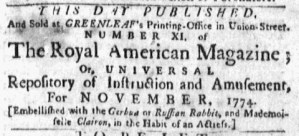
“THIS DAY PUBLISHED … The Royal American Magazine … For NOVEMBER, 1774.”
Joseph Greenleaf published a new issue of the Royal American Magazine and advertised sporadically in December 1774. Perhaps the troubles that Boston experienced in the wake of the Boston Port Act, the Massachusetts Government Act, and the other Coercive Acts played a role in placing advertisements without the same attention to developing a marketing strategy that Isaiah Thomas had sometimes shown when he first launched the magazine, though the original publisher had also advertised somewhat haphazardly in his final months as proprietor before transferring the publication to Greenleaf. In general, Thomas had been much more intentional about advertising in the early stages when he sought subscribers than he had been once the magazine began circulating to readers.
As previously noted, Greenleaf advertised on November 17 that he would publish the October edition of the Royal American Magazine the following day, but no subsequent advertisements appeared in any of Boston’s newspapers until December 5. On that day, the Boston-Evening Post ran a notice that declared, “THIS DAY PUBLISHED … The Royal American Magazine … For OCTOBER, 1774.” To entice readers, Greenleaf noted that the issue was “Embellished with an elegant Engraving of the Dancing Bishops.” Eighteenth-century readers knew that “THIS DAY PUBLISHED” meant that a book, pamphlet, almanac, magazine, or other item was available for sale, not necessarily that it had been published on that day. As a result, Greenleaf could have published and circulated the October edition any time between November, if he had not met any delays after his previous advertisement, and December 5.
Three days later, Greenleaf placed advertisements in both the Massachusetts Gazette and Boston Weekly News-Letterand the Massachusetts Spy. In the former, he hawked the October edition of the magazine, “Embellished with an elegant Engraving.” That notice did not describe the engraving, but it did indicate that Greenleaf continued to take in subscribers. A much shorter advertisement in the Massachusetts Spy announced, “To-morrow will be published, by J. GREENLEAF, THE Royal American Magazine, No. XI. For NOVEMBER, 1774.” Subsequent advertisements suggest that Greenleaf did indeed publish the new edition in the next few days. That meant that whatever difficulties he experienced in the past month, he was nearly on time in delivering the November issue of the Royal American Magazine. In the eighteenth-century, magazines usually came out at the end of the month or the first week of the next month rather than in advance of the date on the cover.
During the following week, Greenleaf inserted advertisements for the November edition of the Royal American Magazine in four of the five newspapers published in Boston at the time. Rather than submit identical copy to the printing offices, he devised four variations, starting with one that ran in the Boston Evening-Post on December 12. In that one, he stated that the November issue was “THIS DAY PUBLISHED” and promoted two engravings, “the Gerubaor Russian Rabbit, and Mademoiselle Clarion, in the Habit of an Actress.” (Paul Revere produced all the engravings for the Royal American Magazine, though neither Thomas nor Greenleaf ever identified him in their advertisements.) On December 16, the Massachusetts Gazette and Boston Weekly News-Letter and the Massachusetts Spy, each published a day later than usual, both ran advertisements about the Royal American Magazine, though this time about the same edition. The advertisement in the Massachusetts Gazette and Boston Weekly News-Letter merely updated the month and issue number, presumably using type already set for the previous advertisement. The compositor for the Massachusetts Spy seemingly did something similar, updating the first line to read “This day was published, by J. GREENLEAF” instead of ““To-morrow will be published, by J. GREENLEAF.” The “T” in “THE Royal American Magazine,” slightly out of alignment in both advertisements suggests that was the case. Finally, the Boston-Gazettecarried a brief advertisement on December 19: “Just Published (No. XI) The Royal American Magazine, For November 1774, at Greenleaf’s Printing-Office, near the Market, Boston.”
Greenleaf inserted advertisements in the Boston Evening-Post and the Massachusetts Gazette and Boston Weekly News-Letter a second time, but not the Boston-Gazette and the Massachusetts Spy. For some reason, two weeks passed between the first and second appearance of those notices that did run twice. Still, Greenleaf pursued a more extensive advertising campaign for the Royal American Magazine in December than November, increasing to nine advertisements compared to only four. Although not as robust as some months, these marketing efforts gave the magazine’s November edition greater visibility in the public prints.
**********
“THIS DAY PUBLISHED … Royal American Magazine … For OCTOBER, 1774”
December 5 – Boston Evening-Post (first appearance)
“JUST PUBLISHED … Royal American Magazine … For OCTOBER, 1774”
December 8 – Massachusetts Gazette and Boston Weekly News-Letter (first appearance)
“To-Morrow will be published … Royal American Magazine … NOVEMBER, 1774”
December 8 – Massachusetts Spy (first appearance)
“THIS DAY PUBLISHED … Royal American Magazine … For NOVEMBER, 1774”
December 12 – Boston Evening-Post (first appearance)
December 26 – Boston Evening-Post (second appearance)
“JUST PUBLISHED … Royal American Magazine … For NOVEMBER, 1774”
December 16 – Massachusetts Gazette and Boston Weekly News-Letter (first appearance)
December 29 – Massachusetts Gazette and Boston Weekly News-Letter (second appearance)
“This day was published … Royal American Magazine … NOVEMBER, 1774”
December 16 – Massachusetts Spy (first appearance)
“Just Published (No. XI) The Royal American Magazine, For November 1774”
In the first week of November 1774, Joseph Greenleaf took to the pages of two of the newspapers printed in Boston to announce that he had published a new issue of the Royal American Magazine. His advertisement for the September issue that already appeared in the October 31 edition of the Boston Evening-Post ran in that newspaper once again on November 7. It actually appeared twice, once on the third page and once on the fourth. The compositor likely made an error. In addition, a similar advertisement appeared in the Massachusetts Gazette and Boston Weekly News-Letter on November 3, following up on a notice from October 27 that stated the magazine would be published the following day.
Greenleaf had been busy trying to catch up on overdue editions since he acquired the magazine from Isaiah Thomas in August. Thomas had fallen behind due to the “Distresses of the Town of Boston” following the Boston Port Act and other Coercive Acts that went into effect in the summer of 1774. He originally planned to suspend publication of the magazine, but then decided to transfer ownership to Greenleaf. In the eighteenth century, monthly magazines usually appeared at the end of the month, so subscribers expected the October edition near the end of October or in the first week of November. The September edition that Greenleaf advertised at the end of October and the beginning of November was a month overdue, yet the new publisher had made progress in getting back on schedule.
However, he may not have been able to improve on that progress. The advertisements make it difficult to determine. On November 17, Greenleaf placed advertisements in the Massachusetts Gazette and Boston Weekly News-Letter and the Massachusetts Spy. In both, he stated that he would publish the October edition of the Royal American Magazine “TO-MORROW.” In the Massachusetts Gazette and Boston Weekly News-Letter, he noted that “an elegant Engraving” accompanied the magazine, though he did not reveal its subject, and stated that “Subscriptions continue to be taken in.” If Greenleaf did indeed publish the October edition of the magazine on November 18, then he made gains on the delinquent issue, disseminating it less than three weeks behind schedule.
Yet no advertisements for the Royal American Magazine ran in any of Boston’s five newspapers throughout the remainder of the month. For Greenleaf to publish a new issue and not advertise it deviated from the practice he had established during his time as proprietor. No advertisement for the October edition of the Royal American Magazineappeared until a notice declared it “THIS DAY PUBLISHED” in the Boston Evening-Post on December 5. Eighteenth-century readers knew that headline meant a book, almanac, pamphlet, magazine, or other publication was available for purchase, not necessarily that it was released for the first time on that date. That means that the October edition could have been published any time between November 18 and December 5. The date on the cover did not reveal the complicated publication history of that issue of the Royal American Magazine.
**********
“JUST PUBLISHED … Royal American Magazine … For SEPTEMBER, 1774”
November 3 – Massachusetts Gazette and Boston Weekly News-Letter (first appearance)
“THIS DAY PUBLISHED … NUMBER IX … Embellished with an elegant Engraving”
November 7 – Boston Evening-Post (second appearance and third appearance)
“TO-MORROW will be PUBLISHED … Royal American Magazine … For OCTOBER, 1774”
November 17 – Massachusetts Gazette and Boston Weekly News-Letter (first appearance)
“To-Morrow will be published, THE Royal American MAGAZINE, for OCTOBER, 1774”
November 17 – Massachusetts Spy (first appearance)




 “The Royal American MAGAZINE … for February 1775.”