September 22

What was advertised in a revolutionary American newspaper 250 years ago today?
Story and Humphreys’s Pennsylvania Mercury (September 22, 1775).

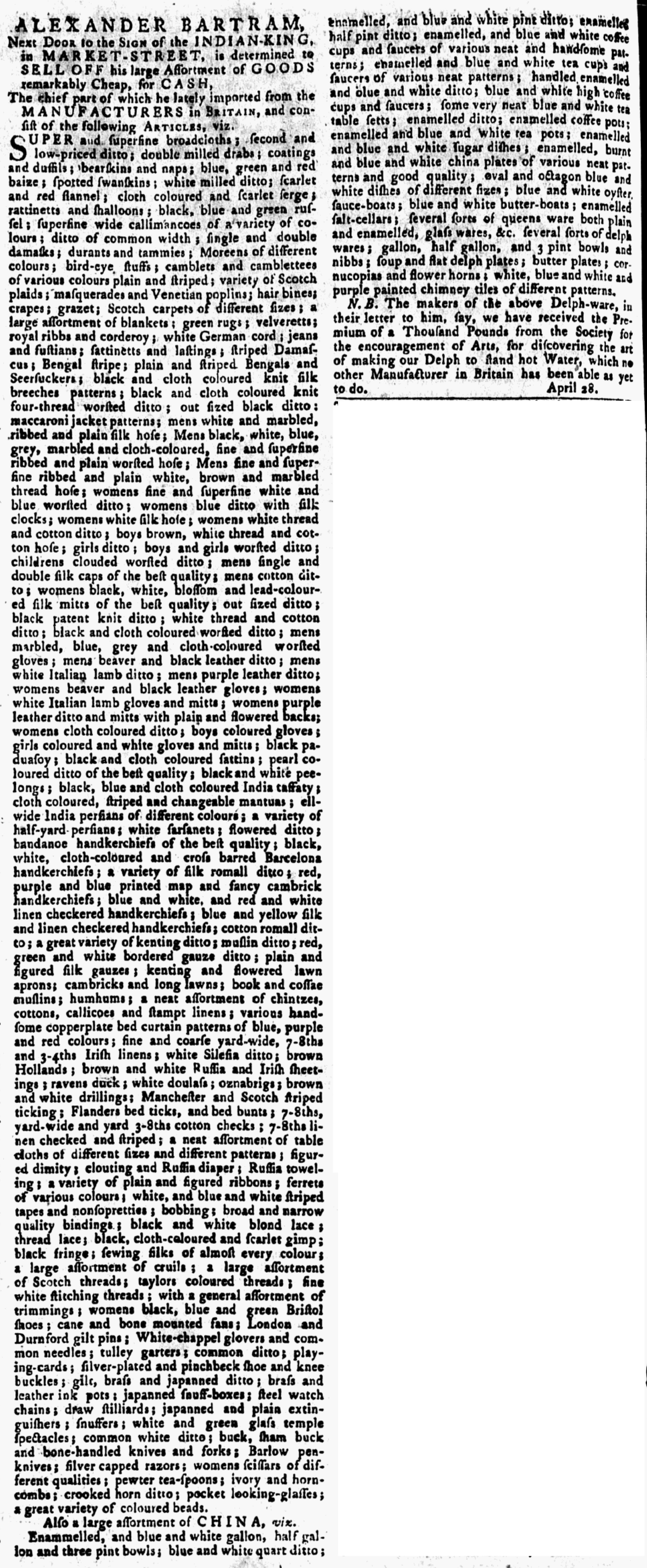
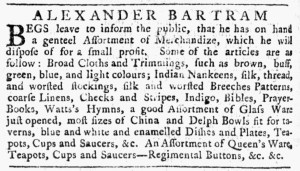
“Determined to SELL OFF his large Assortment of GOODS remarkably Cheap.”

The pages of American newspapers had a different appearance after the Continental Association went into effect on December 1, 1774.  While adherence to prior nonimportation agreements had been scattered, this one attracted much greater compliance.  As a result, the advertisements that featured lengthy lists of imported merchandise to be sold by local merchants and shopkeepers appeared in the public prints less often, but they did not disappear completely.  Notices that listed a few dozen items continued to appear in some newspapers.

Even so, Alexander Bartram’s advertisement for goods “lately imported from the MANUFACTURERS in BRITAIN” seemed extraordinary because of its length.  It did not fill only a portion of a column in Story and Humphreys’s Pennsylvania Mercury; instead, it extended an entire column and overflowed into another column.  It cataloged dozens of items available at his shop “Next Door to the SIGN of the INDIAN-KING, in MARKET-STREET” in Philadelphia.  Dated April 28, Bartram’s advertisement first appeared in the newspaper on that day in 1775 and then again in the supplement the following week.  The shopkeeper declared his intention to “SELL OFF his large Assortment of GOODS remarkably Cheap.”  He apparently acquired his wares prior to December 1, though he did not make a point of asserting that was the case.  The boycott presented an opportunity to clear his shelves of older merchandise since he would not have to compete with new arrivals.

Five months later, his advertisement ran in Story and Humphreys’s Pennsylvania Mercury once again.  The compositor had not broken down the type in that time.  With the Continental Association still in effect, Bartram saw another opportunity to clear the shelves in his shop … but how many of the items listed in his advertisement remained after his prior attempts to sell them “remarkably Cheap” over the summer?  That likely mattered little to Bartram, especially if he believed that such an extensive list would get customers looking for bargains through the doors.  A month later, he took to the Pennsylvania Journal with a much shorter advertisement that promoted a “General assortment of MERCHANDIZE, suitable for the season.”  Dated October 25 and scheduled to run for six weeks, that notice advised that Bartram “proposes to leave the city in a short time.”  If he already planned to depart Philadelphia at the time he republished his lengthy advertisement in late September, he may have considered it worth the expense of taking up so much column space if it might result in significant sales to liquidate his merchandise.

November 11

What was advertised in a colonial American newspaper 250 years ago today?

Nov 11 - 11:11:1767 Pennsylvania Chronicle Extraordinary
Pennsylvania Chronicle Extraordinary (November 11, 1767).

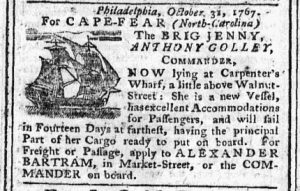
“She is a new Vessel, has excellent Accommodations for Passengers.”

The various commodities marketed in eighteenth-century newspapers testify to the networks of exchange that crisscrossed the Atlantic, but the advertisements also reveal the movement of people. Almost every advertisement in the November 11, 1767, extraordinary issue of the Pennsylvania Chronicle, for instance, featured some element of mobility.

Six advertisements offered passage from Philadelphia to faraway places, including Cape Fear, North Carolina; Grenada; Barbados; Londonderry; and London. Half simply stated that readers could arrange either “Freight or Passage,” but the others promoted their “excellent Accommodations for Passengers” to attract travelers. Due to the size of the port city, newspapers published in Philadelphia regularly carried such advertisements, but similar advertisements also appeared frequently in newspapers from smaller cities and towns.

Some colonists used advertisements to announce their arrival. For instance, one “YOUNG MAN … lately arrived from England” placed an employment notice in the Pennsylvania Chronicle, informing his new neighbors that he “would be glad to serve any Gentleman as Clerk.” The anonymous ‘YOUNG MAN” requested that anyone interested in hiring him “Inquire of the PRINTER.” He also indicated his willingness to extend his journey when he expressed interest in positions available “either in Town or Country.”

Three additional advertisements documented recent departures of indentured servants who absconded from their masters. One reported that Abraham Weaver, am English linen weaver who ran away from Amos Garrett in Swan Creek in Maryland, had been seen with a widow who might attempt to pass as his wife. Garrett suspected that “they may make for Philadelphia or the eastern-shore of Maryland.” John Odenheimer of Philadelphia indicated that his servant, a German named Eberhard Hirschman, had been “seen in Lancaster, at the Sign of the Highlander” the previous week. These runaways attempted to put considerable distance between themselves and their masters.

Newspaper advertisements like these depicted a flurry of movement of people, not just commodities, throughout the Atlantic world and beyond in the eighteenth century. Those who purchased passage on ships traveled for various reasons, commercial and personal. Some, like the “YOUNG MAN … lately arrived from England,” embraced mobility as a means of encountering new opportunities, but others, including many indentured servants, found that their experiences in new places did not live up to their expectations. They made new departures, frustrating masters who had bought their services for a period of years. American colonists lived in an extremely mobile society. Advertisements for consumer goods and services often insinuated social mobility, but other paid notices revealed significant geographic mobility as well.