
What was advertised in a revolutionary American newspaper 250 years ago this week?
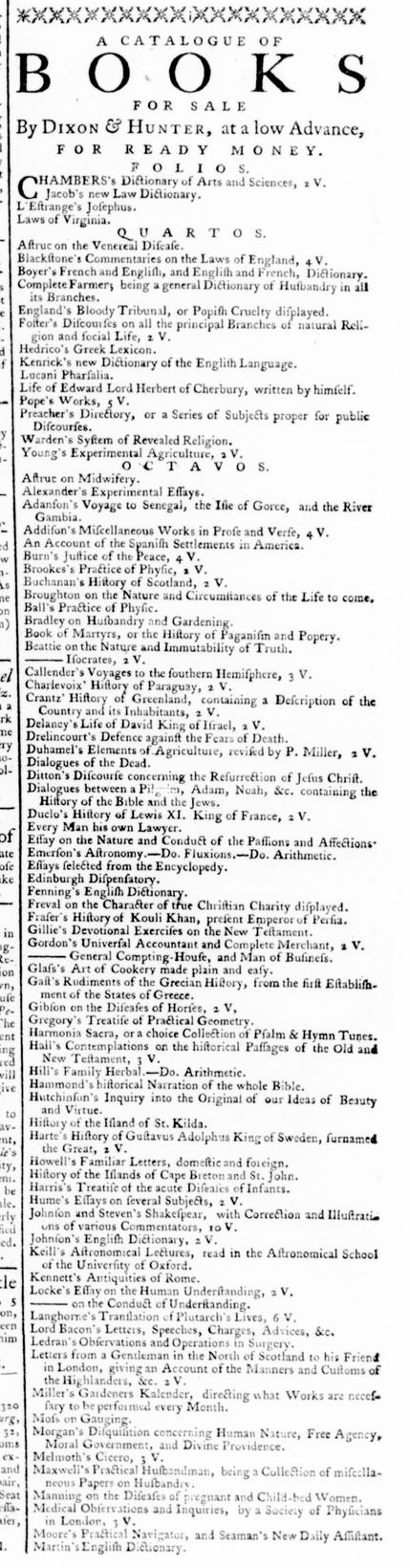
“A CATALOGUE OF BOOKS FOR SALE … By DIXON & HUNTER.”
The May 25, 1776, edition of John Dixon and William Hunter’s Virginia Gazette concluded with a “CATALOGUE OF BOOKS” for sale at their printing office. It filled most of the final column on the last page. An advertisement for a “VIEW of the late BATTLE at CHARLESTOWN,” now known as the Battle of Bunker Hill, appeared immediately above it. Dixon and Hunter also sold that print. While they certainly wished to generate revenue beyond newspaper subscriptions and advertisements, it appears that the printers also used these notices as filler to complete that edition of their newspaper.
Consider, for instance, the contents of the book catalogue. Dixon and Hunter updated a book catalogue that previously appeared in the Virginia Gazette six months earlier. That version classified books by size – folios, quartos, octavos, and duodecimos – and listed titles in alphabetical order by author. The printers made adjustments to the folios, quartos, and octavos listed in the new catalogue based on their current inventory. They did not, however, include any duodecimos. Indeed, the list of octavos ended abruptly with “Martin’s English Dictionary.” This indicates that Dixon and Hunter included as much of the catalogue as would fit in that final column but did not make it a priority to publish the entire catalogue in that issue. They may have been printing and distributing the catalogue as a separate broadside or pamphlet, taking advantage of type already set when they needed material for the last page of the May 25 issue.
When they did so, the printers did not attempt to highlight those titles that they thought most likely to attract customers, nor did they make any sales pitch except stating they sold the books “at a low Advance.” In other words, they charged reasonable prices with only a small markup from what they paid to acquire the imported books. They did expect customers to pay “READY MONEY” at the time of purchase rather than take away any of the titles on credit. In the masthead, Dixon and Hunter gave the prices for an annual subscription to the newspaper (twelve shillings and six pence) and running advertisements “of a moderate Length” (three shillings for the first insertion and two shilling for each subsequent insertion). They also stated that they did job printing “in the NEATEST Manner, with Care and Expedition.” Like most other newspaper printers, they supplemented revenue from printing with revenue from selling books. They hoped that the incomplete book catalogue would entice prospective customers to find out what other volumes they offered for sale.