May 14

What was advertised in a revolutionary American newspaper 250 years ago today?
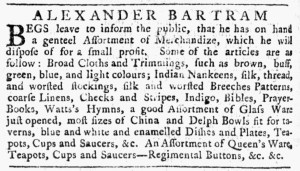
Pennsylvania Evening Post (May 14, 1776).

“Teapots, Cups and Saucers – Regimental Buttons, &c. &c.”

In the spring of 1776, Alexander Bartram “inform[ed] the public, that he has on hand a genteel Assortment of Merchandize.”  In an advertisement in the May 14 edition of the Pennsylvania Evening Post, he stated that he would sell his wares “for a small profit,” signaling to prospective customers that he would not take advantage of the disruptions to trade caused by the war to jack up prices.  Like any other shopkeeper, he needed to earn his livelihood, so a slight markup seemed reasonable under the circumstances.

Bartram devoted most of his advertisement to a list of some of his inventory, including “Broad Cloths and Trimmings, such as brown, buff, green, blue, and light colours, … a good Assortment of Glass Ware, … most sizes of China and Delph Bowls fit for taverns, blue and white and enamelled Dishes and Plates, [and] Teapots, Cups and Saucers.”  At what seemed to be the end of the list, he added “&c.” (the abbreviation for et cetera commonly used in the eighteenth century) to indicate that he had even more goods on hand at his shop.  Then he continued with shorter list that resonated with current events.  He declared that he also stocked “An Assortment of Queen’s Ware, Teapots, Cups and Saucers – Regimental Buttons, &c. &c.”  A month earlier, the Second Continental Congress relaxed the prohibition on buying and selling tea, so Bartram may have seen an opportunity to promote “Teapots, Cups and Saucers” more than once in his advertisement.  His reference to “Regimental Buttons” suggested that he sold other accessories for military uniforms.  Some men who refrained from other forms of conspicuous consumption during the imperial crisis welcomed the opportunity to outfit themselves in attire made fashionable by military service when the war began.  Bartram likely hoped that would work to his advantage.  By including “&c.” so many times, Bartram underscored that he carried so many more items than appeared in his short advertisement.  His extensive catalog of merchandise, after all, extended an entire column in an advertisement that appeared in Story and Humphreys’s Pennsylvania Mercury the previous fall.  While not nearly as long, his new advertisement spoke volumes to readers who perused it in the Pennsylvania Evening Post.
March 5

What was advertised in a revolutionary American newspaper 250 years ago today?

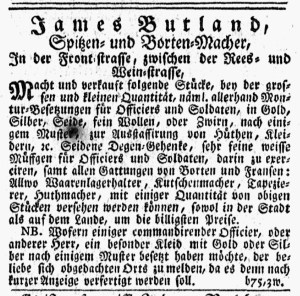
Henrich Millers Pennsylvanischer Staatsbote (March 5, 1776).

“Für Officiers und Soldaten.”

James Butland, a lacemaker who kept shop on Front Street in Philadelphia, placed his advertisements in several newspapers in 1775 and 1776.  Like many other entrepreneurs in urban ports, he inserted notices in multiple local newspapers, including the Pennsylvania Journal in February 1775 and the Pennsylvania Evening Post in July 1775.  Yet he did not confine his marketing solely to newspapers published in Philadelphia.  In December 1775, he ran an advertisement in the New-England Chronicle, published in Cambridge, Massachusetts.  With the Continental Army under the command of General George Washington continuing the siege of Boston, perhaps he thought that he could entice customers interested in “gold and silver epaulets for officers” and other adornments for military uniforms.

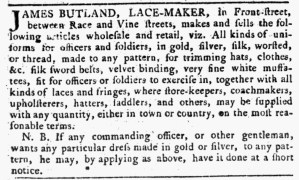
Pennsylvania Evening Post (February 10, 1776).

The lacemaker also continued seeking customers, including officers and soldiers, in Philadelphia.  In February 1776, he ran an advertisement for “All kinds of uniforms for officers and soldiers … made to any pattern,” “silk sword belts,” and “very fine white muffatees” (or fingerless gloves) “fit for officers or soldiers to exercise in.”  Butland added a nota bene, stating that “[i]f any commanding officer, or other gentleman, wants a particular dress made in gold or silver, to any pattern, he may … have it done at a short notice.”  Although he continued to make “all kinds of laces and fringes,” Butland took advantage of current events to cater to officers and soldiers.  He did so in two languages!  He inserted the same advertisement in Henrich Millers Pennsylvanischer Staatsbote, a newspaper published in Philadelphia to serve the community of German settlers that lived near the city and in the backcountry.  A nota bene in the masthead of that newspaper proclaimed, “All ADVERTISEMENTS to be inserted in this Paper, or printed single by HENRY MILLER, Publisher hereof, are by him translated gratis.”  Butland, who previously described himself as a “FRINGE and LACE-MAKER, from BRISTOL,” presumably availed himself of that service in his efforts to attract new customers.  He made bold decisions about where to place his newspaper advertisements as he sought to increase his share of the market.