June 27

What was advertised in a revolutionary American newspaper 250 years ago today?
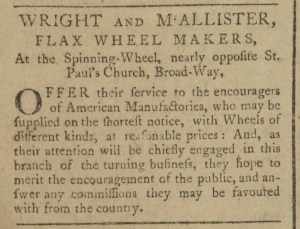
New York Packet (June 27, 1776).

“WRIGHT AND McALLISTER, FLAX WHEEL MAKERS, … OFFER their service to the encouragers of American Manufactories.”

Wright and McAllister, “FLAX WHEEL MAKERS,” marked their location “nearly opposite St. Paul’s Church, Broad-Way,” in New York with a sign depicting a spinning wheel.  The placed an advertisement in the June 27, 1776, edition of the New York Packet to “OFFER their service to the encouragers of American Manufactories.”  In so doing, they echoed the language that so often appeared in editorials about producing goods in the colonies rather than importing them from Great Britain, in advertisements that promoted such products, and in nonimportation agreements adopted as acts of resistance.  The eighth article of the Continental Association, the most significant of the nonimportation agreements, for instance, stated, “That we will, in our several Stations, encourage Frugality, Economy, and Industry; and promote Agriculture, Arts, and the Manufactures of this Country.”  That meant producing homespun textiles as alternatives to the array of imported fabrics that dominated newspaper advertisement for imported goods, yet colonizers could not focus solely on the final product.  Purchasing and wearing homespun depended on having the equipment necessary for producing it.

Wright and McAllister aimed to do their part in such a worthy endeavor.  They made “Wheels of different kinds” that they sold “at reasonable prices.”  Under other circumstances they might have described themselves as turners rather than “FLAX WHEEL MAKERS,” but they decided that “their attention will be chiefly engaged in this branch of the turning business” on the eve of the Second Continental Congress declaring independence.  They joined other entrepreneurs who marketed American-made equipment for producing textiles, including Robert White and David Poe, who both made spinning wheels, and Fergus McIllroy, who made looms.  Given the service that they undertook on behalf of the American cause, Wright and McAllister “hope[d] to merit the encouragement of the public” in New York as well as “answer any commissions they may be favoured with from the county.”  In turn, their work would enable others, especially women, to participate in politics through their activities in the marketplace, not only as consumers but also as producers of the thread necessary for producing homespun textiles.

August 13

What was advertised in a colonial American newspaper 250 years ago this week?

Aug 13 - 8:10:1769 Pennsylvania Gazette
Pennsylvania Gazette (August 10, 1769).

“At present it seems peculiarly the interest of America to encourage her own manufactories.”

In August 1769, Richard Wistar took to the pages of the Pennsylvania Gazette to advertise the products he manufactured at his “GLASS-WORKS” in Philadelphia. His inventory included “BOXES of WINDOW GLASS, consisting of the common sizes” as well as “most sorts of bottles,” containers for mustard and snuff, and other specialty glassware. Wistar also offered to cut glass windows of “uncommon sizes.”

To encourage prospective customers to purchase his wares, Wistar emphasized that “the abovementioned glass is of American manufactory” and then launched into a political lesson that matched the discourse circulating throughout the colonies in newspapers and in conversations in taverns, coffeehouses, and town squares. Glass produced in the colonies was “consequently clear of the duties the Americans so justly complain of,” duties imposed on certain imported goods by Parliament in the Townshend Acts. Wistar continued his lecture: “at present, it seems peculiarly the interest of America to encourage her own manufactories, more especially those upon which duties have been imposed, for the sole purpose of raising a revenue.” Those goods included paper, tea, lead, paints, and, most significantly for Wistar, glass.

In response, colonists revived a strategy they had previously pursued to resist the Stamp Act: merchants and shopkeepers vowed not to import goods from Britain. In order for their economic resistance to have greater political impact, they did not limit their boycott to only those goods indirectly taxed by the Townshend Acts. Instead, they enumerated a broad array of goods that they would not import or sell until the duties had been repealed. Simultaneously, they issued calls for the encouragement of “domestic manufactures” and argued that consumers could demonstrate their own politics in the marketplace by making a point of purchasing goods produced in the colonies. Neither producers nor consumers alone would have as much of an impact as both exercising their civic virtue through “encourage[ing] her own manufactories,” as Wistar reminded readers of the Pennsylvania Gazette.

Colonists certainly imbibed political arguments in news articles and editorials in newspapers, but they also encountered them in advertisements. In the service of selling goods and services, savvy entrepreneurs mobilized politics during the period of the imperial crisis that led to the American Revolution. They directed consumers away from some products in favor of purchasing others, challenging them to consider the ramifications of their activities in the marketplace.