
What was advertised in a revolutionary American newspaper 250 years ago today?
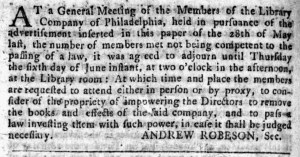
“Impowering the Directors to remove the books and effects of the said company.”
Andrew Robeson had an urgent message for members of the Library Company of Philadelphia. In an advertisement in the June 4, 1776, edition of the Pennsylvania Evening Post, he informed them that a “General Meeting” held on May 30 lacked a quorum for undertaking the important business of “impowering the Directors to remove the books and effects of the said company” if circumstances warranted. The directors apparently anticipated a possible attack on Philadelphia and occupation of the city by British forces. If such an event did occur, they wanted to see to the safety of the Library Company’s books. As Robeson explained in the call to the meeting that ran in the Pennsylvania Evening Post on May 28, the directors sought the advice of the members to “determine on the place where the [books and effects of the Library Company] shall be deposited in case any future event should render that measure necessary.”
Robeson, the secretary of the Library Company, lamented “the number of members met not being competent to the passing of a law” or a motion giving the directors the authority to make such decisions. Instead, those present “agreed to adjourn until Thursday the sixth day of June … when the members are requested to attend either in person or by proxy, to the consider of the propriety” of the matter. He hoped that a new round of advertisements and the increasing urgency of the situation would convince members to attend or arrange for others to cast votes on their behalf. To improve the chances of achieving a quorum at the next meeting, Robeson also inserted the notice in the June 1 edition of thePennsylvania Ledger, the June 3 edition of Dunlap’s Pennsylvania Packet, and the June 5 editions of the Pennsylvania Gazette and the Pennsylvania Journal. He did not run the notice in Henrich Millers Pennsylvanischer Staatsbote, but it did appear in every other newspaper printed in Philadelphia at the time. Robeson hoped that such a proliferation of notices would bring the meeting to the attention of members and convince them to attend. The directors exercised good foresight in making contingency plans. The following year, British forces began an occupation of the city on September 26, 1777, and remained until the spring of 1778.