November 21

What was advertised in a revolutionary American newspaper 250 years ago today?
New-Hampshire Gazette (November 21, 1775).

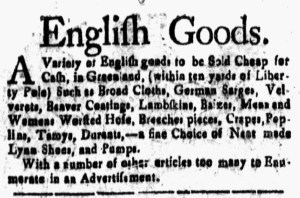
“English Goods … within ten yards of Liberty Pole.”

An anonymous advertiser hawked “A Variety of English goods” in the November 21, 1775, edition of the New-Hampshire Gazette.  The notice included a short list of imported items, mostly textiles, such as “Broad Cloths, … Velverets, … Poplins, Tamys, [and] Durants,” as well as “Mens and Womens Worsted Hose [and] Breeches pieces.”  That list apparently did not cover everything available for sale; the advertisement concluded with a note about “a number of other articles too many to Enumerate in an Advertisement.”

That may have been the advertiser’s choice since some merchants and shopkeepers did occasionally resort to similar language, though it may have been a decision influenced by the printer, Daniel Fowle.  That issue of the New-Hampshire Gazette consisted of only two pages instead of the usual four.  It was the first issue of the New-Hampshire Gazette since November 8.  The printer did not produce and circulate an issue the previous week.  The Adverts 250 Project has tracked apparent disruptions in the supply of paper that had an impact on the New-Hampshire Gazette, yet that was not the only difficulty the printer faced.  In the monumental History and Bibliography of American Newspapers, 1690-1820, Clarence S. Brigham notes that Fowle announced that he printed the November 2 edition “‘with great difficulty’ because of the threatened British attack on Portsmouth” and that the printer “stated that the press ‘is removed to Greenland, about six miles from Portsmouth.”[1]  Those circumstances may have played a role in the decision to publish an abbreviated advertisement that promised a greater selection of goods than appeared in print.

The advertisement presents other questions about consumer culture during the era of the American Revolution.  The Continental Association, a nonimportation and nonconsumption agreement devised by the First Continental Congress, was in effect, yet the unnamed advertiser boldly marketed imported goods.  The headline, “English Goods,” appeared in a larger font than anything else in that issue except for the title of the newspaper in the masthead.  The advertiser conveniently did not mention when the goods had arrived in the colonies, whether they had been transported and delivered before the boycott went into effect.  Yet the advertiser did acknowledge current events when giving the location to purchase the imported goods: “within ten yards of [the] Liberty Pole” in Greenland.  In his recent book on the consumption and politics of tea during the era of the American Revolution, James R. Fichter argues that many tea retailers did not face repercussions while tea importers certainly did.  He further contends that advertisements revealed the reality of local commerce compared to the propaganda that appeared in news articles and editorials about tea.[2]  Perhaps something similar occurred with these “English Goods” in Greenland in the late fall of 1775.

**********

[1] Clarence S. Brigham, History and Bibliography of American Newspapers, 1690-1820 (American Antiquarian Society, 1947), 471.

[2] James Fichter, “Truth in Advertising,” in Tea: Consumption, Politics, and Revolution, 1773-1776 (Cornell University Press, 2023), 132-157.
June 30

What was advertised in a revolutionary American newspaper 250 years ago today?

Connecticut Gazette (June 30, 1775).

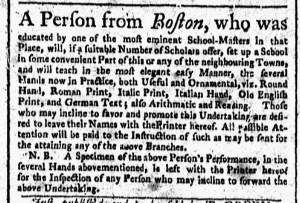
“A Person from Boston … will teach … the several Hands now in Practice.”

A “Person from Boston” sought to open a school in southwestern Connecticut in the summer of 1775.  He placed an advertisement in the Connecticut Gazette in hopes of reaching prospective pupils and their families, stating that he would commence instruction in New Haven “or any of the neighbouring Towns” if a sufficient number of “Scholars” signed up for lessons.  In addition to reading and arithmetic, he taught “the several Hands now in Practice, both Useful and Ornamental,” including “Round Hand, Roman Print, Italic Print, Italian Hand, Old English Print, and German Text.”

The schoolmaster did not give his name, instead merely identifying himself as a “Person from Boston, who was educated by one of the most eminent School-Masters in that Place.”  He asked that those “who may incline to favor and promote this Undertaking … leave their Names with the Printer” of the Connecticut Gazette.  Timothy Green, the printer, likely did more than keep a list of names of interested students.  He served as a surrogate for the anonymous schoolmaster.  Even though residents of New Haven and the vicinity did not know the “Person from Boston,” they did know Green and could ask him for his impressions of the man, whether he seemed reputable and capable of the instruction he proposed. Furthermore, the unnamed schoolmaster left “A Specimen of the above Person’s Performance, in the several Hands mentioned” at the printing office “for the Inspection of any Person who may incline the forward the Undertaking.”  Anyone who visited the printing office for that purpose could chat with Green about the “Person from Boston” as they examined the “Specimen.”

They might have learned that he was a refugee from Boston who left the city following the battles at Lexington and Concord.  When the siege of Boston commenced, Governor Thomas Gage and the Massachusetts Provincial Congress negotiated an agreement that allowed Loyalists to enter the city and Patriots and others to depart.  Other refugees from Boston resorted to newspapers advertisements to attract customers and clients after taking up residence in new towns.  It may have been a similar situation for the “Person from Boston” who found himself in New Haven at the beginning of the Revolutionary War.

December 17

What was advertised in a colonial American newspaper 250 years ago today?

Connecticut Gazette (December 17, 1773).

WANTED, A HUSBAND.”

Was it an advertisement or an editorial?  The December 17, 1773, edition of the Connecticut Gazette included an item that purported to be a “WANTED” advertisement.  The anonymous woman who placed it sought a husband who “can be warranted to possess the following agreeable Qualifications” and listed a “good Education,” “good Morals,” a mind “richly furnish’d with all useful Knowledge,” and “genteel, easy, and graceful” behavior.  That husband should be “free from Pride and Arrogance.”  Overall, he needed to demonstrate “the most distinguish’d Character.”  A nota bene indicated the circumstances that likely prompted this particular “Advertisement.”  The anonymous advertiser insisted that her prospective husband “should treat the Ladies with the Respect that their Merits require, considering that their Sex alone intitles them to his Esteem.”  To behave otherwise would not be “consistent with the Character of a Gentleman.”  Patriarchal structures defined and confined women’s status in colonial America, but the system was also supposed to bestow certain privileges and protections upon them, especially middling and elite white women.

This item included a salutation, unlike most paid notices that appeared in the Connecticut Gazette and other colonial newspapers.  “Mr. GREEN,” it addressed the printer, “Please to give the following Advertisement a Place in your Paper, and oblige one of your constant Readers.”  The anonymous advertiser likely did not intend to pay for this “Advertisement,” but rather used the word according to another common meaning in both England and America in the eighteenth century.  The Oxford English Dictionary provides this “now chiefly historical” definition: “a (written) statement calling attention to anything; a notification; esp. a notice to readers in a book (typically, a preface).”  Printers and authors also used “advertisement” in that manner in newspapers.  In this instance, the “Advertisement” appeared in a curious place in the Connecticut Gazette, on the final page immediately below the “POET’S CORNER,” a weekly feature, and above advertisements that were indeed paid notices.  The printer chose to place the “Advertisement” with paid notices rather than among the news and editorials on other pages, perhaps suggesting that even though he did not collect payment he still considered the piece artful, like that week’s poem, rather than a serious editorial.  The anonymous advertiser could demand “the Respect that [Ladies’] Merits require,” but that did not mean that the printer was obliged to respond in that manner.  Just as John Adams would mock Abigail’s admonitions to “Remember the Ladies” in their correspondence in the spring of 1776, the printer of the Connecticut Gazette gave this “Advertisement” a place in his newspaper that suggested he did not take it as seriously as the anonymous advertiser intended.

October 29

What was advertised in a colonial American newspaper 250years ago today?

Connecticut Journal (October 29, 1773).

“SIR, PLEASE to return with speed, for things are bad.  WR”

Among the several advertisements in the October 29, 1773, edition of the Connecticut Journal, Job Perit sold a “large Assortment of English & India GOODS,” Daniel Huntington peddled a “fresh Parcel of Drugs and Medicine,” and Amos Morrision, a “Wigg-Maker & Hair-Dresser,” presented his services to prospective clients.  John Danielson and John Row each placed real estate notices, while John Lothrop called on “all those that are any Ways indebted to him” to settle accounts or face legal action.  One notice announced a fair “for the Barter and Sale of all Kinds of Goods, homespun or other Manufactures, Horses, Sheep,” and other livestock.  Another announced a delay in drawing numbers for the New Haven Lottery.  Jonathan Brown and Ebenezer Townsend offered rewards for a strayed or stolen horses.  The printers, Thomas Green and Samuel Green, advertised “THE MACARONIE JESTER,” a book of jokes, and invited subscribers for the Royal American Magazine to submit their names to the printing office to be forwarded to Isaiah Thomas in Boston.

Some of these advertisements may have been of greater interest than others to various readers, but each of them addressed the public and clearly stated their purpose.  A more cryptic advertisement did not do so.  In its entirety, that brief notice stated, “SIR, PLEASE to return with speed, for things are bad.  WR.”  What did it mean?  Who placed the advertisement?  What was the relationship between “WR” and “SIR”?  What had happened to prompt “WR” to place this notice?  Why did “WR” choose to place an advertisement in the public prints along with whatever other means of contacting “SIR” they used?  Did some readers suspect that they knew the identities of “WR” and “SIR” and the circumstances that inspired the advertisement?  Did they gossip and share their suspicions with others?  How much did the printers know about “WR” and their situation?  Whatever the answers to these questions, the Greens surrendered a small bit of editorial control over the contents of their newspaper when they published the advertisement.  Every printer did so with every advertisement they published, allowing others to determine some of the contents of their publications while simultaneously exercising the prerogative to reject paid notices if they did not believe they matched the tone of the newspaper.  Each advertisement, like each news item, essay, and letter, told a story and disseminated information to the reading public.  In the case of “WR” and “SIR,” however, the advertisement obscured most of the relevant information and addressed a single reader.  In placing the notice, “WR” leveraged the power of the press for their own purposes, just as every advertiser did when they purchased space in newspapers.

September 27

What was advertised in a colonial American newspaper 250 years ago today?

New-Hampshire Gazette (September 27, 1771).

“As the Owner is returning immediately to ENGLAND, he will sell them on very low Terms.”

An anonymous advertiser informed readers of the New-Hampshire Gazette that he offered great bargains on an assortment of textiles and other imported goods because he planned to sail “Immediately to ENGLAND.”  On September 27, 1771, the advertiser encouraged prospective customers to act quickly because “he will stay but a Fortnight in Town.”  Since he was such a motivated seller, he was willing to part with his goods “on very low Terms,” so retailers and consumers alike would “find it to their Advantage in dealing with him.”  He did not give his name, instead merely stating that he offered the goods for sale “at Mr. Stavers’s Tavern in Portsmouth.”

To whet the appetites of potential buyers, the anonymous advertiser listed many of the items, including an “Assortment of strip’d and flower’d border’d Lawn Handkerchiefs,” a “variety of Gauze Handkerchiefs and flower’d Gauze Aprons,” and an “elegant Assortment of Fashionable Ribbons.”  Reiterating “assortment” and “variety” underscored that his customers benefited from an array of choices in addition to low prices.

At the end of the notice, the advertiser also listed “a few Setts of Doctor HEMET’s Famous Essence of Pearl and Pearl Dentifice for the Teeth, with proper Brushes and Directions.”  Readers encountered a more extensive advertisement for that product further down the column, though that advertisement indicated that Hemet, a dentist in England, had appointed William Scott in Boston and W. Bayley in London as local agents for wholesale and retail sales.  The advertiser did not indicate where he acquired Hemet’s dental care products, but he offered consumers in Portsmouth greater convenience than sending away to Scott in Boston.  Scott’s advertisement providing more detail about the products bolstered his own marketing without incurring additional expense.

The anonymous advertiser attempted to capture the attention of readers of the New-Hampshire Gazette with a “limited time only” offer, suggesting that his imminent departure for England put them in a good position to negotiate for low prices.  If that was not enough to entice prospective customers, he also promoted extensive choices and even the convenience of acquiring a product otherwise available only in Boston.  Appeals to price and choice were standard elements of eighteenth-century newspaper advertisements, but this anonymous advertiser further enhanced those strategies in his efforts to engage customers.

November 22

What was advertised in a colonial American newspaper 250 years ago today?

Nov 22 - 11:22:1769 Georgia Gazette
Georgia Gazette (November 22, 1769).

“These pills are an infallible cure.”

An unnamed advertiser placed a notice for “Dr. HAMMOND’s SPECIFICK PILL” in the November 22, 1769, edition of the Georgia Gazette, informing prospective customers that “Any person may be informed where these pills are to be sold by applying to the printer of this paper.” The advertisement listed a variety of maladies that the pills cured, including leprosy, scurvy, yaws, venereal disease, and even “pimpled faces.” The remedy was gentle, safe for “women with child, or persons of the most delicate constitutions.” The advertiser described this “new Medicine” as “one of the greatest ever offered to the Publick” and promised that they provided a “CERTAIN cure.”

All of this probably sounded too good to be true to many colonists. After all, readers regularly encountered advertisements for patent medicines in newspapers published throughout the colonies. Those who marketed pills and potions often claimed that they cured all kinds of diseases, deploying the most hyperbolic language in making their promises. To address some of the concerns of skeptics, this advertisement reported that the pills came with “printed directions, and signed by the author, Thomas Hammond, M.M. Bristol.” Furthermore, the advertisement directed “the dubious” to take into account “the great success this medicine has met with in Barbados, Jamaica, St. Kitts, and Granada,” apparently expecting that word of mouth recommendations from the Caribbean had reached colonists in Georgia. If that were not convincing enough, readers could also take into consideration “many great cures” attributed to Dr. Hammond’s pills in England “which have been continually inserted in the newspapers. Even if skeptical customers could not check those newspapers, the advertisement suggested that merely stating that such evidence existed should satisfy any concerns. Savvy customers likely remained suspicious of the claims made in the advertisement, despite the purported proof of the efficacy of Dr. Hammond’s pills, but some may have been eager enough to find some sort of relief for their symptoms that they allowed themselves to be convinced, or at least experience some hope, that the pills would indeed work for them. The many layers of claims made in the advertisement served to wear down any distrust by “the dubious,” just as similar repetitions of claims about miracle drugs sold via infomercials in the twenty-first century attempt to do for modern consumers.

July 26

What was advertised in a colonial American newspaper 250 years ago this week?

Jul 26 - 7:23:1767 Massachusetts Gazette
Massachusetts Gazette (July 23, 1767).

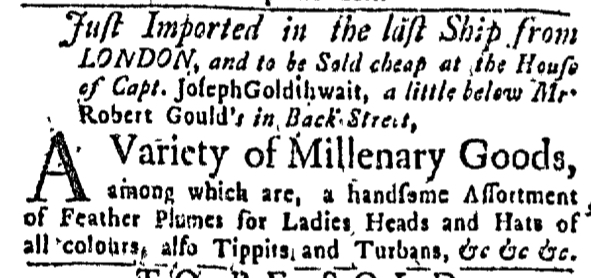
“A handsome Assortment of Feather Plumes for Ladies Heads.”

Unlike most advertisements for consumer goods published in eighteenth-century newspapers, this notice for a “Variety of Millenary Goods” did not indicate who sold the “handsome Assortment of Feather Plumes” or “Hats of all colours.” Instead, it simply stated that these items were “Sold cheap at the House of Capt. Joseph Goldthwait.”

Who placed this advertisement and ran a shop out of Goldthwait’s house? It may very well have been a female entrepreneur who did not wish to call widespread attention to her participation in the marketplace as a retailer rather than as a consumer. Women often operated small retail establishments out of their own homes or rooms they rented, especially in urban ports, but they were much less likely to advertise their commercial activities than their male counterparts. Female shopkeepers tended to be disproportionately underrepresented among the advertisements in the public prints.

That did not mean that women did not advertise at all. This advertisement for “Millenary Goods” appeared immediately below Jane Eustis’s own notice for a “Large and beautiful Assortment [of] Silks, Cap Laces,” and other millenary goods. Although she stocked “Mens and Womens silk Hose” and “Mens white silk Gloves,” Eustis promoted mostly textiles and adornments intended for female customers. Like the anonymous advertiser, she concluded by making special note of the “Tippets and Turbans” she sold “for less than the prime Cost.” The type of merchandise hawked by the anonymous advertiser increases the likelihood that a woman placed the notice and operated the shop “at the House of Capt. Joseph Goldthwait.”

This sort of anonymous advertisement was rather rare in colonial America. Certainly newspapers frequently carried notices that advised readers to “enquire of the printer,” but usually those regarded only one or a small number of commodities, not the “Variety” or “handsome Assortment” of imported goods marketed in this advertisement. It even ended with a teaser, “&c &c &c” (the eighteenth-century version of “etc. etc. etc.”), suggesting an even greater array of goods that rivaled what customers would find in the shops kept by Jane Eustis and other advertisers.

Women had a variety of reasons for not calling as much attention to their entrepreneurial activities as their male competitors, including assumptions about their appropriate roles in the household and marketplace. This advertisement may have been designed by a woman eking out a living who hoped to attract female customers yet remain shielded from other readers in colonial Boston.

January 6

What was advertised in a colonial newspaper 250 years ago today?

Jan 6 - 1:6:1766 New-York Gazette
New-York Gazette (January 6, 1766)

“Right Yorkshire MUFFINS, hot twice a Day.”

This anonymous advertiser most likely sold what is today known as Yorkshire Pudding.  These “muffins” were made from a batter of eggs, flour, and milk or water, cooked beneath meat (usually beef) roasting on a spit above a fire, thus allowing fats and juices to drip into the muffins and flavor them.  William Kenrick’s The Whole Duty of a Woman included a recipe, called “Dripping Pudding,” in 1737.  Hannah Glasse published a similar recipe in The Art of Cookery, Made Plain and Easy a decade later, bestowing the name “Yorkshire Pudding.”

Yorkshire_Pudding
It’s easy to see why Yorkshire Pudding could sometimes be called “Right Yorkshire MUFFINS.”

I would hazard to guess that Yorkshire Pudding is not a familiar food for most Americans today, though it seems to be quite common, even a traditional part of Sunday dinner, in England.  On both sides of the Atlantic, it is no longer known as “Right Yorkshire MUFFINS” or “Dripping Pudding.”  Today’s featured advertisement helps to evoke not only the smells and flavors of foods sold in colonial New York, but also the sounds of what they could have been called in the eighteenth century before “Yorkshire Pudding” became the standardized name.

Ellen Castelo offers this history of Yorkshire pudding, including a recipe.

*****

nypl.digitalcollections.510d47de-4a0b-a3d9-e040-e00a18064a99.001.w

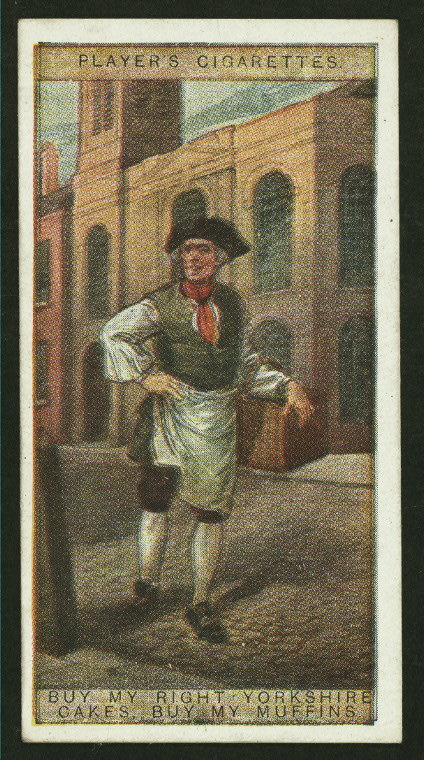
In researching this entry, I was delighted to discover that Yorkshire Muffins made an appearance in a late-nineteenth- or early-twentieth-century advertising campaign:  on a cigarette card included in the “Cries of London” series issued by John Player & Sons, a branch of the Imperial Tobacco Company of Great Britain and Ireland.  A street vendor hawked his wares, exclaiming, “Buy My Right Yorkshire Cakes.  Buy My Muffins.”

Visit the New York Public Library Digital Collections for more information and to view both sides of the cigarette card.