March 31

What was advertised in a colonial American newspaper 250 years ago today?
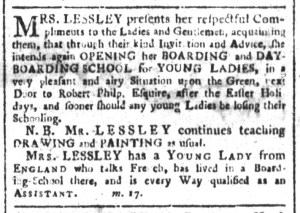
South-Carolina and American General Gazette (March 31, 1775).

“She intends again OPENING her BOARDING and DAY-BOARDING SCHOOL.”

Mrs. Lessley ran a “BOARDING and DAY-BOARDING SCHOOL for YOUNG LADIES” in Charleston in the 1770s. She closed the school for a while, as schoolmasters and schoolmistresses often did for various reasons, but, as spring arrived in 1775, she took to the pages of the South-Carolina and American General Gazette to announce that she planned on “again OPENING” her school “after the Easter Holiday.”  She decided to do so, she stated, at the “kind Invitation and Advice” of “Ladies and Gentlemen” familiar with her school, offering an implicit endorsement she hoped would convince prospective pupils and their families.

Lessley also gave information about others who worked at her school.  “MR. LESSLEY continues teaching DRAWING and PAINTING as usual,” enriching the curriculum offered by his wife.  Readers, especially former students, may have assumed that was the case, but they did not necessarily know about a new employee.  The schoolmistress reported that she “has a YOUNG LADY from ENGLAND who talks French, has lived in a Boarding-School there, and is every Way qualified as an ASSISTANT.”  Those cosmopolitan skills and experiences enhanced the education that Lessley provided for her charges.  Her assistant aided in teaching a language considered a marker of gentility among the gentry and those who aspired to join their ranks.  Perhaps she even served as the primary instructor for that subject.  She may have consulted with Lessley on replicating an English boarding school without students having to cross the Atlantic while also serving as a role model for how “YOUNG LADIES” should comport themselves at such a school.

The schoolmistress gave less attention to the amenities at her school, though she did mention that it was located “in a very pleasant and airy Situation upon the Green.”  With classes slated to begin sometime after April 16, she assured prospective students and their families that they would live and learn in a comfortable environment.  She also indicated that she would commence lessons “sooner should any young Ladies be losing their Schooling.”  In other words, if other schoolmasters and schoolmistresses closed or suspended their schools, Lessley would gladly accept their students.  She hoped that these additional appeals in combination with her description of those who taught at her school would help in encouraging prospective pupils and their families to enroll.

January 22

What was advertised in a colonial American newspaper 250 years ago today?

Connecticut Journal (January 22, 1773).

“By Reason of an ill State of Health, and other Misfortunes, he has been for some Time unable to attend his Business.”

Joseph Hopkins, a goldsmith and jeweler in Waterbury, took to the pages of the Connecticut Journal and New-Haven Post-Boy to raise interest in his business in January 1773. He pledged that he “will supply those who may want any Articles in either the Goldsmith or Jewelry Way, on the most reasonable Terms.”  Such appeals, however, were not the primary focus of his advertisement.

Instead, Hopkins sought to generate sympathy among prospective customers.  He reported that he reopened his shop after having been closed, stating that “by Reason of an ill State of Health, and other Misfortunes, he has been for some Time unable to attend his Business.”  The goldsmith did not go into detail about any of those “Misfortunes,” though some readers may have already been familiar with his situation.  He did declare that he “has of late, in some good Measure recovered his Health” and was ready to serve clients once again.

Hopkins offered other news to entice readers into his shop.  He announced that he “engaged an approved Workman,” presumably someone with training and experience as either a goldsmith or jeweler, to provide assistance.  He likely hoped that employing an associate would help alleviate any concerns about what kinds of service customers would experience now that his shop opened again.  Yet Hopkins did not want the public to have the mistaken impression that he merely entrusted orders to his new assistance.  He asserted that he gave “constant Attendance himself.”

In his efforts to attract customers to his shop, Hopkins balanced pleas for sympathy with assurances of competence.  He hoped that recovering from poor health and other unspecified “Misfortunes” would prompt prospective customers to give him their business, but he also realized that sympathy alone might not win them over.  Accordingly, he maintained that both he and his new assistant were qualified to produce “any Articles in either the Goldsmith or Jewelry Way” for customers who gave his shop a chance.

February 13

What was advertised in a colonial American newspaper 250 years ago today?

feb-13-2131767-south-carolina-and-american-general-gazette
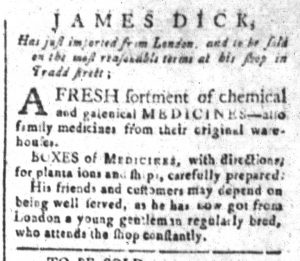
South-Carolina and American General Gazette (February 13, 1767).

“His friends and customers may depend on being well served.”

Apothecary James Dick sold “A FRESH sortment of chemical and galenical MEDICINES” imported from London. Like other druggists in the colonies in the 1760s, he assembled “BOXES of MEDICINES, with directions, for plantations and ships.” In providing this service, he likely also moved portions of his inventory that tended to sell more slowly, especially if given the discretion to fabricate these eighteenth-century first aid kits rather than including only items specified by purchasers.

In addition to the ease and convenience of these “BOXES of MEDICINES,” Dick wanted his “friends and customers” to know that he emphasized service in other ways. He made a fairly unique pitch when he concluded his advertisement by noting that “he has now got from London a young gentleman regularly bred, who attends the shop constantly.” Advertisers from a variety of occupations and professions frequently pledged to treat potential customers well, often promising to fulfill their duties with “care” or “dispatch.” When mobilizing such appeals, however, advertisers usually referred to their own demeanor and qualities. Dick, on the other hand, described possible interactions with his employee.

Very few advertisers mentioned employees, perhaps because many ran small operations limited to family members and maybe an apprentice.   Even shopkeepers and artisans who may have had assistants of various sorts deployed advertising in which they retained their role as the public face of the businesses they operated.

By promoting the contributions of his assistant, Dick made at least two appeals to prospective customers, one practical and one aspirational. When he noted that his assistant “attends the shop constantly,” the apothecary let readers know that someone would be available to assist them no matter when they visited. Given that the druggist provided medical services, he may have been called away from the shop on occasion. Rather than close his shop, he made arrangements for an assistant to be present even when he was not.

In addition, when he noted that his assistant not only came from London but was “a young gentleman regularly bred” the apothecary conjured images of a prosperous and genteel shop where customers would be met with courtesy and deference. Given his line of business, Dick rightly assumed that some customers visited his shop when feeling their worst. The image of a “young gentleman regularly bred” serving those customers suggested an atmosphere of pampering and authentic concern rather than a hurried transaction in a busy dispensary. Some retail pharmacies make similar appeals today, emphasizing interactions – even relationships built over time – with pharmacists and other staff.