May 1

What was advertised in a colonial American newspaper 250 years ago this week?

Massachusetts Spy (May 28, 1774).

“Medicine Boxes … are put up in the neatest Manner.”

The woodcut that adorned John Joy’s advertisement in the April 28, 1774, edition of the Massachusetts Spy alerted readers to the type of merchandise that the apothecary sold before they even read the copy.  It depicted a lion wearing a crown and working a mortar and pestle atop a column.  The woodcut ran the entire length of the advertisement, as if Joy or the compositor or perhaps the two working together intentionally designed the image and copy to fit together that way.  A sign with a similar image may or may not have marked Joy’s location at “the North-Corner of William’s Court, BOSTON,” but he did not make specific mention of a sign.  Other advertisers who commissioned woodcuts for their newspaper notices often did so when the image matched the device customers saw at their shop.  Whatever the case, the image made Joy’s advertisement much more visible to prospective customers than M.B. Goldthwait’s notice about a “fresh supply of DRUGS and MEDICINES” and “SURGEONS INSTRUMENTS, Of all Kinds.”

Massachusetts Spy (April 28, 1774).

The copy declared that Joy “Has just received from LONDON, A large and compleat Assortment of Drugs and Medicines, Of the best Quality.”  The lion with the crown asserted both those imperial connections and the quality of the remedies that Joy sold.  In addition, he stocked “Surgeons Instruments, of every Kind, finished in the neatest Manner” as well as “a full Assortment of Groceries and Dye Stuffs.”  Not unlike modern retail pharmacies, Joy diversified his enterprise to cultivate multiple revenue streams, including medicines, medical equipment, home health care supplies, and groceries.  To that end, he also prepared “Medicine Boxes of various Prices, for Ships or private Families,” pledging that they “are put up in the neatest Manner.”  Goldthwait also prepared “Doctor’s Boxes … for Masters of Vessels and private Families” and included “every necessary direction” for using the contents.  These first aid kits included both medicine and supplies.  Selling them allowed apothecaries to enhance their revenues since buyers acquired a variety of items that they did not yet need and might never use but purchased against the chance of injury or illness.  After all, it was better to have them on hand than not at all.  Joy also operated a precursor to the mail order pharmacy, alerting “Prac[ti]tioners and others” that they may be supplied with large or small Quantities, by Letter or otherwise [such as sending a servant enslaved messenger], as well as though they were present.”  Joy and other apothecaries frequently promoted such convenience as part of their marketing efforts.  Like the image of the crowned lion working a mortar and pestle, that appeal distinguished Joy’s advertisement from the notice placed by his competitor.

June 25

What was advertised in a colonial American newspaper 250 years ago today?

Supplement to the South-Carolina Gazette and Country Journal (June 25, 1771).

“Boxes of Medicines for Plantation Use … will also contain a Phial of his famous FEVER DROPS.”

When apothecary Thomas Stinson purchased the shop and inventory of another apothecary, he placed an advertisement in the South-Carolina Gazette and Country Journal to inform prospective customers.  He pledged that he gave “constant Attendance” at the shop, standing ready to serve their needs.  In addition, he provided assurances that “his DRUGS and MEDICINES … are all fresh and good.”  Stinson directed his advertisement to various kinds of customers.  He addressed “his Friends and the Public,” consumers making purchases for their households, but he also sought customers who bought in greater volume.  “Gentlemen Practitioners, both in Town and Country,” Stinson declared, “may be supplied with any Quantity of Medicines on the usual reasonable Terms.”

In addition, Stinson offered a service to plantation owners and overseers, “Boxes of Medicines for Plantation Use” that they could administer on their own.  He produced and marketed an eighteenth-century version of first aid kits.  Apothecaries often mentioned similar services in their advertisements, preparing boxes containing a variety of remedies for all sorts of symptoms for families, mariners, and plantations.  Buyers benefited from the convenience of having medicines and supplies on hand when need arose, while apothecaries augmented their revenues by moving inventory that customers did not yet need and, because they bought the boxes as a precaution, might not ever need.

Stinson devoted more attention to the contents of his medicine boxes than most apothecaries, describing two of the items they contained.  Each box contained a vial of “his ELIXIR for all Kinds of cholicky Complaints” and a vial of “his famous FEVER DROPS.”  Stinson proclaimed that this nostrum was already “well known in many Parts of this Province, where it has been found effectual.”  Stinson asserted that users would not experience negative side effects, having been “innocent even to sucking Babes” when administered to them.  Some readers may have been skeptical about both the reputation and effectiveness of Stinson’s “famous FEVER DROPS.”  Including his fever drops and his elixir in the medicine box as part of the package allowed the apothecary to boost sales of items that plantation owners and overseers might not have ordered separately.  In turn, he could make even more elaborate claims about how widely his distributed those medicines that competed with patent medicines imported from England.  While many apothecaries sold medicine boxes, Stinson adapted his medicine boxes for an additional purpose, marketing the potions and panaceas he produced.

October 8

What was advertised in a colonial American newspaper 250 years ago today?

Boston-Gazette (October 8, 1770).

“All the Patenteed Medicines, too many to be enumerated in an Advertisement.”

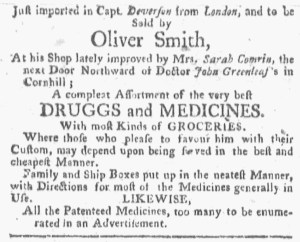
Oliver Smith advertised a “compleat Assortment of the very best DRUGGS and MEDICINES” in the October 8, 1770, edition of the Boston-Gazette.  He sold his remedies individually, but also offered “Family and Ship Boxes” that packaged together “most of the Medicines generally in Use” along with directions for administering them.  These eighteenth-century versions of first aid kits allowed apothecaries to increase their sales by asking consumers to anticipate possible future needs for a variety of medicines rather than wait until they had a specific need for any particular medicine.  Smith and others marketed “Family and Ship Boxes” as a convenience for their customers, but they also amounted to additional revenue for the sellers.

Smith also informed readers that he carried “All the Patenteed Medicines, too many to be enumerated in an Advertisement.”  Not listing those items saved Smith both space and money.  He expected that consumers were so familiar with the array of patent medicines on the market that he did not need to name them.  This strategy also indicated confidence that he had on hand a complete inventory.  They could depend on him carrying Turlington’s Original Balsam of Life, Godfrey’s General Cordial, Walker’s Jesuit Drops, Dr. Stoughton’s Elixir, Hooper’s Pills, Greenough’s Tincture for the Teeth and Gums, Bateman’s Pectoral Drops, and a variety of other patent medicines that apothecaries, shopkeepers, and even printers frequently listed in their advertisements.  One column over from Smith’s advertisement, William Jones did indeed name all of those nostrums and others.

Much of Smith’s advertisement focused on convenience.  In addition to selling “Family and Ship Boxes” and stocking a complete inventory of patent medicines, he operated his shop at a convenient location, “the next Door Northward of Doctor John Greenleaf’s in Cornhill.”  Prospective customers who had occasion to consult with Dr. Greenleaf could then visit Smith’s apothecary shop next door to select any medicines that the doctor recommended.  Smith also noted that the shop had been “lately improved” to make it more appealing to customers.  With the various conveniences he provided, Smith sought to make it as simple as possible for prospective customers to care for their health.

February 13

What was advertised in a colonial American newspaper 250 years ago today?

feb-13-2131767-south-carolina-and-american-general-gazette
South-Carolina and American General Gazette (February 13, 1767).

“His friends and customers may depend on being well served.”

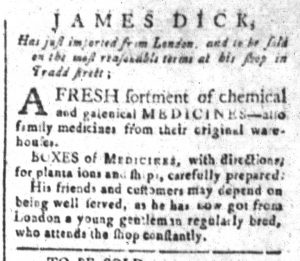
Apothecary James Dick sold “A FRESH sortment of chemical and galenical MEDICINES” imported from London. Like other druggists in the colonies in the 1760s, he assembled “BOXES of MEDICINES, with directions, for plantations and ships.” In providing this service, he likely also moved portions of his inventory that tended to sell more slowly, especially if given the discretion to fabricate these eighteenth-century first aid kits rather than including only items specified by purchasers.

In addition to the ease and convenience of these “BOXES of MEDICINES,” Dick wanted his “friends and customers” to know that he emphasized service in other ways. He made a fairly unique pitch when he concluded his advertisement by noting that “he has now got from London a young gentleman regularly bred, who attends the shop constantly.” Advertisers from a variety of occupations and professions frequently pledged to treat potential customers well, often promising to fulfill their duties with “care” or “dispatch.” When mobilizing such appeals, however, advertisers usually referred to their own demeanor and qualities. Dick, on the other hand, described possible interactions with his employee.

Very few advertisers mentioned employees, perhaps because many ran small operations limited to family members and maybe an apprentice.   Even shopkeepers and artisans who may have had assistants of various sorts deployed advertising in which they retained their role as the public face of the businesses they operated.

By promoting the contributions of his assistant, Dick made at least two appeals to prospective customers, one practical and one aspirational. When he noted that his assistant “attends the shop constantly,” the apothecary let readers know that someone would be available to assist them no matter when they visited. Given that the druggist provided medical services, he may have been called away from the shop on occasion. Rather than close his shop, he made arrangements for an assistant to be present even when he was not.

In addition, when he noted that his assistant not only came from London but was “a young gentleman regularly bred” the apothecary conjured images of a prosperous and genteel shop where customers would be met with courtesy and deference. Given his line of business, Dick rightly assumed that some customers visited his shop when feeling their worst. The image of a “young gentleman regularly bred” serving those customers suggested an atmosphere of pampering and authentic concern rather than a hurried transaction in a busy dispensary. Some retail pharmacies make similar appeals today, emphasizing interactions – even relationships built over time – with pharmacists and other staff.