November 18

What was advertised in a revolutionary American newspaper 250 years ago today?
Pennsylvania Evening Post (November 18, 1775).

“The Provedore to the Sentimentalists will exhibit food for the mind.”

Readers of the November 18, 1775, edition of the Pennsylvania Evening Post encountered two advertisements promoting an “AUCTION of BOOKS,” one placed by Charles Mouse, “auctionier,” and the other by Robert Bell, “bookseller and auctionier.”  Mouse operated a “vendue store,” a combination of an auction house and a flea market, where he had a “large and choice collection of the most useful and entertaining [books].”  He invited those who had books to sell and “will[ing] to take their chance by auction” to deliver them to his vendue store on Second Street in Philadelphia.  The auctions would begin “precisely at six each evening” and “continue till the whole are sold.”  Mouse provided a straightforward account of this endeavor.

Robert Bell, on the other hand, crafted a more elaborate advertisement.  One of the most prominent American booksellers in the second half of the eighteenth century, Bell already established a reputation throughout the colonies by the time he advertised an auction “at the large Auction-Room next door to St. Paul’s Church in Third-street, Philadelphia,” scheduled for November 23.  He colorfully referred to himself in the third person as “the Provedore to the Sentimentalists” who would “exhibit food for the mind” to bidders and curious observers.  Those who made purchases, Bell declared, “may reap substantial advantage, because he that readeth much ought to know much.”  He further mused that “we may, with propriety, ask the sages of antient and modern times, What is it that riches can afford equal to the profit and pleasure of books?  Are they not the most rational and lasting enjoyment the human mind is capable of possessing?”  Mouse’s description of his “large and choice collection of the most useful and entertaining [books]” paled in comparison to the appeals that Bell made to readers.

Bell deployed another strategy to entice prospective bidders.  In a nota bene, he informed them that “[p]rinted catalogues of the new and old books will be ready to be given to all who choose to call or send for them.”  Those catalogues gave a preview of the sale and allowed Bell to disseminate information about the books up for bids more widely.  Those who visited his “Auction-Room” to collect a catalogue likely had an opportunity to browse the books, yet they could take their time going through the entries in the catalogue in the comfort of their own homes or offices or even at a coffeehouse with friends.  Those who sent for catalogues enjoyed the same benefit.  By distributing catalogs, Bell encouraged interest and prompted readers to imagine themselves bidding on the books they selected in advance.  He may have believed that prospective bidders were more likely to bid higher prices if they had spent time with the catalogue in advance and, as a result, became more committed to acquiring the books that interested them.
April 25

What was advertised in a colonial American newspaper 250 years ago today?

Supplement to the Boston-Gazette (April 25, 1774).

“A Bell … which is erected over his Auction-Room Door.”

Martin Bicker’s neighbors were not happy with him.  As the auctioneer explained in an advertisement addressed “To thePUBLIC” in the Boston-Gazette in the spring of 1774, some of them objected to one of the methods he deployed to get bidders into his “Auction-Room.”  Bicker had hired someone to stand “at his Door to invite Gentlemen and others to his public Sales.”  In other words, he stationed an employee at the entrance to engage passersby in hopes of convincing them to check out the items going up for bid.  That innovation supplemented other marketing efforts undertaken by auctioneers, including newspaper notices, catalogs, handbills, and previews of goods in advance of auctions.

Other colonizers in the vicinity of Bicker’s auction house apparently did not care for this innovation.  He reported that it “has given Dissatisfaction to some” and singled out “Gentlemen Shopkeepers in particular.”  Perhaps those shopkeepers claimed that they did not like the noise or the constant presence of Bicker’s employee on the street outside the auction house, but most likely they really opposed the competition that potentially affected their own sales.  After all, both consumers and retailers who bought to sell again could often find better bargains at auctions than they could get at local shops and stores.  Bicker underscored in his advertisement that the public should attend his auctions “for their own Advantage.”  An employee outside his door could have made that point to prospective bidders in greater detail repeatedly throughout the day and within earshot of nearby “Gentlemen Shopkeepers.”  They may have worried that someone lurking on the street made their customers anxious about becoming the target of unwanted appeals or having to extricate themselves from uncomfortable conversations as they sought to go about their business, but concerns about losing those customers to the auction house probably motivated their complaints just as much.

Bicker devised a solution that he “flatters himself cannot fail giving universal Satisfaction, as he sincerely wishes so to do,” though the tone suggested that he was not sincere nor that he cared much about the “Satisfaction” of the “Gentlemen Shopkeepers.”  He may very well have been thumbing his nose at them when he installed a bell “over his Auction-Room Door.”  In an earlier advertisement, he noted that a red flag marked his location.  The bell, a new enhancement, likely attracted as much notice, drawing attention to his auction house and calling prospective bidders to his sales from an even greater distance than the employee stationed at the door.  Bicker’s concern for the “Gentlemen Shopkeepers” may have been a polite fiction considering that he concocted a solution with so much potential to cause just as much “Dissatisfaction.”

March 17

GUEST CURATOR:  Adam Ide

What was advertised in a colonial American newspaper 250 years ago today?

Massachusetts Gazette and Boston Weekly News-Letter (March 17, 1774).

“Will be Sold by PUBLIC VENDUE, at the Auction-Room in Queen-Street.”

In this advertisement, the auctioneer Joseph Russell was advertising an auction that he was running in which the property of “a Gentleman lately deceased” would be sold off. The practice of auctioning made its way into the colonies through its popularity in England in the seventeenth and eighteenth centuries.

This advertisement originally caught my eye because they were selling off the property of a dead man. I wondered it that could be seen as disrespectful to the family and the memory of whoever’s items were being auctioned off. However, upon further research, I learned that “for most residents [of the British colonies], it was at local auctions—estate auctions, sheriffs’ sales, and discount vendues—that bidders, sellers, and observers created a body of knowledge that established a link between price and value.”[1]

Ellen Hartigan-O’Connor writes about the ways in which colonists interacted with each other and took part in consumer culture by participating in public auctions. Hartigan-O’Connor claims that “[w]ith each exchange, people reflected on what goods were worth” since there was no easy-to-come-by comparative price information.[2] Many were left “to wonder how much they should pay for tools, teapots, or thread if the prices fluctuated with market availability.”[3]

Thankfully for colonists, auctions or “vendues” or “public sales” offered a solution. Unlike regular retail, which relied on the fluctuation of the markets and the importation of new goods, auctions allowed the price that someone was willing to pay to determine the value. Through this method, “it was only at the end, when the hammer strike closed the bidding at a final price, that the assembled community learned what they really considered to be the value of an object.”[4] So despite my initial hesitance toward an estate sale, having one’s items sold at “PUBLIC VENDUE” after one died not only gave people an opportunity to purchase goods outside of the fluctuating markets of the time, but it also allowed the community to determine for themselves the value of the items being sold.

**********

ADDITIONAL COMMENTARY:  Carl Robert Keyes

Adam chose one of many auction notices that appeared in Boston’s newspapers during the week in March 1774 that he examined for his duties as guest curator of the Adverts 250 Project and the Slavery Adverts 250 Project.  As he notes in his examination of Joseph Russell’s advertisement for an upcoming “PUBLIC VENDUE,” auctions were a popular means of buying and selling goods in eighteenth-century America.  Russell’s notice in the Massachusetts Gazette and Boston Weekly News-Letter appeared immediately below another one about a sale the following day “At GOULD’S Auction-Office.”

The compositor for that newspaper often placed auction notices, with sales that took place at a particular time on a particular date, first among advertisements, following the shipping news from the custom house.  Sales in shops, stores, and warehouses did not operate on such regimented schedules, so the printing office, readers, and, especially, auctioneers likely considered it less important to have a dedicated place to find other advertisements.  In contrast, Gould’s auction would happen “TO-MORROW” and at no other time and Russell’s auction was scheduled for “Wednesday next.”

Not every compositor in every printing office took that approach, demonstrating that early American printers did not devise universal methods of classifying and organizing the contents of their newspapers.  When Russell’s advertisement ran in the Boston-Gazette later in the week, it appeared among notices placed for a variety of purposes.  It did not have a privileged place on the page, nor did Benjamin Church’s advertisement, one column over, for a “PUBLICK AUCTION … On THURSDAY NEXT.”  M. Deshon, “AUCTIONEER,” placed his own notice that appeared further down the column.

The Boston Evening-Post and the Massachusetts Gazette and Boston Post-Boy each carried advertisements about auctions that week.  Among the newspapers published in Boston, only the Massachusetts Spy did not disseminate notices about public vendues, though several appeared in its pages the following week.  Merchants and shopkeepers certainly competed with auctioneers when it came to finding buyers in Boston on the eve of the American Revolution.

**********

[1] Ellen Hartigan-O’Connor, “Public Sales and Public Values in Eighteenth-Century North America,” Early American Studies 13, no. 4 (Fall 2015): 749.

[2] Hartigan-O’Connor, “Public Sales and Public Values,” 751.

[3] Hartigan-O’Connor, “Public Sales and Public Values,” 751.

[4] Hartigan-O’Connor, “Public Sales and Public Values,” 752.

February 6

What was advertised in a colonial American newspaper 250 years ago this week?

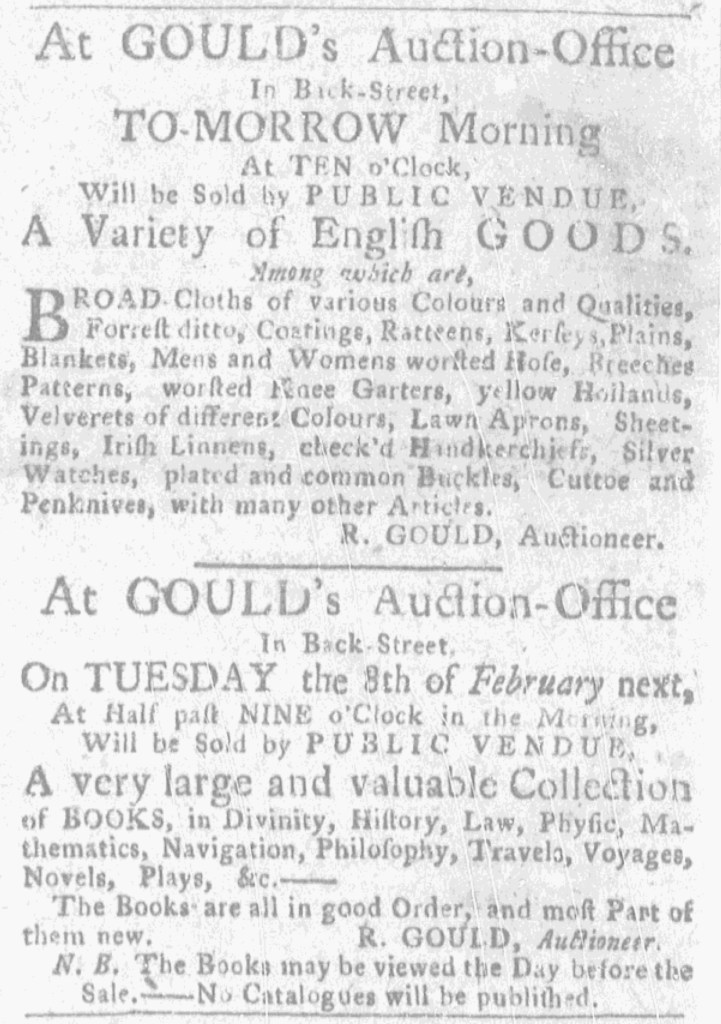
Massachusetts Gazette and Boston Weekly News-Letter (February 3, 1774).

“The largest & compleatest Collection of Books, that ever was sold at this Office.”

A note at the end of auctioneer Robert Gould’s advertisement in the February 3, 1774, edition of the Massachusetts Gazette and Boston Weekly News-Letter seemed incongruous with the content of the rest of the notice.  Gould announced that he would auction a “Variety of genteel House-Furniture” the next morning “At TEN o’Clock.”  He listed many of the items going up for bids, including “Mahogany dining Tea & Bureau Tables,” “Looking-Glasses,” and “a few Sets genteel Pictures.”  In addition, the sale would include “a great Variety of English GOODS.”

The note that followed his signature, however, stated, “No Catalogues will be published, and as this is by far the largest & compleatest Collection of Books, that ever was sold at this Office, therefore they will be exposed to View on Saturday and Monday next.”  That reference made little sense since the auction of the furniture, housewares, and other goods was scheduled for the next day, a Friday.  In addition, a coy aside directed readers, “Pray Remember the Sale begins half past 9 Precisely,” a different time than the auction discussed earlier in the advertisement would begin.

Massachusetts Gazette and Boston Weekly News-Letter (January 27, 1774).

It appears that these inconsistencies resulted from a miscommunication between the auctioneer and the printing office or an error in the printing office.  In the previous issue of the Massachusetts Gazette and Boston Weekly News-Letter, Gould ran an advertisement in two parts, both of which could have appeared separately.  The first part included an introduction identical to the one in the notice published on February 3.  The compositor likely did not even reset type for the introduction, instead updating the headline from “A Variety of English GOODS” to “A Variety of genteel House-Furniture” and inserting a new list of items for sale.  The second part described an auction for a “very large and valuable Collection of BOOKS” that would take place “On TUESDAY the 8th of February next, At Half past NINE o’Clock in the Morning.”  Gould explained that the books “are all in good Order, and most Part of them new.”  In addition, he appended a nota bene advising that the books “may be viewed the Day before the Sale.—No Catalogues will be published.”

Gould probably attempted to update both parts of the advertisement, providing new information about the weekly sale at his auction office and an update about an upcoming special auction for books, but some confusion ensued.  Gould may not have been clear about how much of the previous advertisement should carry over to the new one.  Alternately, the compositor may not have paid sufficient attention to the instructions submitted to the printing office.  Either way, the strange note at the end of the advertisement could have piqued interest among readers.  After all, proclaiming the sale featured “by far the largest and compleatest Collection of Books, that was ever sold at this Office” was intended to attract attention.  To learn more, they only had to contact Gould or take note of advertisements he already published in the Boston-Gazette and the Massachusetts Gazette and Boston Weekly News-Letter.

November 18

What was advertised in a colonial American newspaper 250 years ago today?

Massachusetts Gazette and Boston Weekly News-Letter (November 18, 1773).

“[The Particulars we have not Time nor Room to insert.]”

Robert Gould, an auctioneer in Boston, planned to hold an auction of a “valuable Assortment of English Goods” on the morning of November 19, 1773.  Like many other auctioneers in the busy port, he attempted to drum up interest by placing advertisements in the local newspapers, including the Massachusetts Gazette and Boston Weekly News-Letter.  His advertisement that appeared in that newspaper on the day before the sale, however, featured an unusual note from the printer or compositor.  Gould apparently submitted a lengthy list of items going up for bid, but someone in the printing office inserted this comment instead: “[The Particulars we have not Time nor Room to insert.]”  A truncated list that included several textiles and “Silver Watches” followed that note, concluding with “&c. &c. &c.”  Repeating the abbreviation for et cetera three times suggested how many other items Gould planned to auction that would not fit in that edition of the newspaper.

The auctioneer may have been a victim of his own negligence in submitting his advertising copy to the printing office too late to include all of it.  The November 18 edition of the Massachusetts Gazette and Boston Weekly News-Letteroverflowed with content, so much so that Richard Draper, the printer, distributed a two-page supplement for news and advertisements that did not otherwise fit.  Draper may have anticipated needing to publish a supplement and set about printing it even as he worked on the standard four-page issue.  Like other printers, he printed the first and fourth pages on one side of a broadsheet and, while they dried, set type for the second and third pages, reserving that space for the latest news as it arrived at the printing office and new advertisements.  Gould’s advertisement appeared on the third page, indicating it was among the last of the type set for that issue.  Printers sometimes inserted instructions for advertisers to submit their notices by a particular time if they wanted them to appear in the next edition of the newspaper.  Perhaps if Gould had budgeted more time in delivering his advertising copy to the printing office, Draper and the compositor would have had the time to accommodate him by making room to include it in its entirety.  If Gould habitually made late submissions, the unusual note in the middle of his advertisement may have been an attempt to modify that behavior.  Two weeks later, the Massachusetts Gazette and Boston Weekly News-Letter carried another advertisement from Gould, that one apparently received early enough to print in its entirety.

July 26

What was advertised in a colonial American newspaper 250 years ago today?

Boston Evening-Post (July 26, 1773).

“Upon the whole, Justice and Equity, Law, Reason and Necessity urges me to draw the following Conclusion.”

A. Bowman defiantly advertised that he would sell a “Large Assortment of ENGLISH, SCOTCH and IRISH GOODS” at his “AUCTION-ROOM” on the “North Side of the Market” in Boston on August 6, 1773. He prefaced the details of the “PUBLIC VENDUE” with a lengthy address “To the PUBLIC” in the July 26 edition of the Boston Evening-Post, providing an overview of recent events involving the General Court and an Act for the Regulation and Limitation of Auctioneers.

Bowman explained that when the Court initially passed the act in February “Seven Persons officiated daily in that Business.”  However, “when the time came that this Act was to be in force, and the Select Men gave out Licences according to the Letter of the Law, Five were set aside.”  Bowman was among the auctioneers that did not receive a license, as he previously lamented in a series of advertisements in several newspapers published in Boston.  In May, those five auctioneers presented petitions to the Court in hopes that “we might be reinstated in our former Business.”  In turn, the Court exercised “Wisdom and Goodness” and passed a new act that permitted the selectmen to bestow six more licenses.  The intention of the Court, according to Bowman, had been to provide relief to the former auctioneers, but when the selectmen appointed six additional auctioneers Bowman learned that he was not among them.  “Cruel Fate!”

Bowman considered his options, “revolving and re-revolving the whole Matter in my Mind,” and decided to “go on with my Business in form as the Law directs,” though lacking a license.  In other words, he intended to obey every aspect of the law except for holding a license granted by the selectmen, asserting that it “is not my fault” and “no Reason has ever been assigned to me” why he did not receive a license.”  Bowman contented that “every Inhabitant of the Town of Boston” knew that the “additional Act was framed & enacted for the sole purpose of relieving me and my fellow Sufferers.”  He therefore upheld “the very Spirit of the Law” by resuming business as an auction, even if he did not adhere to the letter of the law.  He had been forced into that position when the selectmen neglected to act according to the intention of the legislature in passing the new act.

In addition, Bowman argued that he had a right to earn his livelihood, especially since the colony assessed taxes on him.  “Early after my Arrival in this Province,” he explained, “the Laws of it soon found me out and commanded me to contribute for their Support.”  He had paid his share “all along,” but a few weeks earlier “a large Demand was made upon me from that Quarter, and considering my hard Fate of late I was very unable to answer.”  To his chagrin, “this Creditor takes no denial, and tome made no Abatement.”  On the one hand, the law demanded that Bowman pay taxes, but, on the other, a law passed with the intention of allowing him to pursue his occupation instead prevented him from doing so.  Such injustice did not represent the “Genius of America.”

Instead, it demanded a response.  Bowman resolved to resume his business as an auctioneer, realizing that he risked prosecution “for a supposed Breach of a Law.”  In that case, he anticipated that a “Jury of my Peers” would hear his case and acknowledge what had actually happened.  He also encouraged the “Compassionate Legislative Body who have already exerted their Authority for my Relief” would once again address his predicament and “adhere to the same human Principles on which they founded the late Act.”

The community also had an opportunity to respond when Bowman once again “contend[ed] for my daily Bread” according to the “honour and fidelity with which I conducted my business in former times.”  With a flourish at the end of his lengthy account, Bowman declared that “Justice and Equity, Law, Reason and Necessity” prompted him to hold an auction at the end of the following week.  “A. BOWMAN, Auctioneer,” had no choice but to follow that path.  He knew it and so did the public, at least once he published an advertisement that framed the narrative to demonstrate how much he had been wronged throughout the entire ordeal.

June 13

What was advertised in a colonial American newspaper 250 years ago this week?

Massachusetts Spy (June 10, 1773).

“(The particulars in Monday’s papers.)”

After opening the “New Auction-Room” in Boston in 1773, auctioneer William Greenleaf sometimes deployed a two-step strategy for promoting upcoming sales in the public prints.  Consider the notice that he placed in the Massachusetts Spyon Thursday, June 10.  Greenleaf advised readers that a “great variety of English GOODS” “Will be sold by PUBLIC VENDUE” on the following Tuesday.  Rather than publish a roster of those items, he encouraged colonizers to look for subsequent advertisements with “The particulars in Monday’s papers.”  That meant that readers had to consult newspapers other than the Massachusetts Spy.  All five newspapers published in Boston in 1773 were weeklies, the Massachusetts Gazette and Boston Weekly News-Letter and the Massachusetts Spy appearing on Thursdays and the Boston Evening-Post, the Boston-Gazette, and the Massachusetts Gazette and Boston Post-Boy on Mondays.  The auction would be over by the time the printer published the next edition of the Massachusetts Spy.

Readers who turned to the Massachusetts Gazette and Boston Post-Boy for “The particulars” on the following Monday did not encounter any additional information, but those who perused the Boston Evening-Post and the Boston-Gazette did indeed discover a more complete preview of Greenleaf’s next auction.  In nearly identical advertisements, the auctioneer listed dozens of items, including “a fine Assortment of Chints, Callicoes and Printed Linens,” “a Number of Silver Watches,” and “a suit of Green Bed Curtains.”  The sale would begin “precisely at Ten o’clock” the next morning, so readers interested in bidding on any of the items needed to arrive in time that they did not miss that part of the sale.  Those advertisements likely contained information that had not yet been finalized the previous Thursday, yet given that Greenleaf competed with several other auctioneers in Boston he wished to generate some level of visibility for his next vendue, especially since those other auctioneers regularly advertised in multiple newspapers as well.  As advertisements placed by merchants and shopkeepers came and went in the public prints, notices from auctioneers, updated weekly, remained a constant feature in the city’s many newspapers.  In this instance, Greenleaf oversaw an advertising campaign that he updated more than once a week, coordinating with multiple printing offices.

April 11

What was advertised in a colonial American newspaper 250 years ago this week?

Massachusetts Gazette and Boston Weekly News-Letter (April 8, 1773).

“He will open a Place for Sale of Goods to be known by the Name of The Silent Auction-Room.”

When he established the “Silent Auction-Room” in Boston in the spring of 1773, A. Bowman did not even pretend politeness toward his competitors in his advertisements.  In a notice that he placed in the April 8 edition of the Massachusetts Gazette and Boston Weekly News-Letter, he mocked the advertisements placed by three of his competitors.  All three advertisements appeared in that issue, making for easy reference for readers, though Bowman previously encountered them in other newspapers.

The auctioneer stated that he would “receive and sell all Sorts of Merchandise, House-Furniture,” and other goods.  However, “‘Houses, Lands and Shipping,’ he does not pretend to sell,” he snidely comments, “because he is apprehensive it would be very difficult to get them up Stairs.”  Bowman quoted directly from William Greenleaf’s advertisement.  His rival stated, “In the Sale of Houses, Lands, Shipping, Merchandize, Household Furniture, &c. &c. my Employers may depend on my exerting myself for their Interest.”

The cantankerous auctioneer then declared that “Goods from ‘Servants and Minors’ will be received if they are properly authorized to deliver them.”  In this instance, he taunted Martin Bicker, a broker who handled “all sorts of English and Scotch Goods [and] Household Furniture … to as good Advantage as can be done at any Auction whatever.”  Bicker proclaimed that “the Public may rest assured, that no Goods will be received by him of any Servants or Minors.”  Bowman established a different policy for his “Silent Auction-Room.”  He took another jab at Bicker when he asserted that “His ‘Books’ shall be kept in good Order, so that it gives him no Concern whether they are ‘liable to Inspection,’ or not.”  Before noting that he did not accept goods from servants or minors, presumably to avoid peddling stolen items, Bicker confided that “his Books are not liable to Inspection.”  Bowman treated such lack of transparency with skepticism.

The final portion of Bowman’s advertisement, a short poem, most directly addressed the source of his anger and frustration.  Joseph Russell, the proprietor of an auction room on Queen Street, previously published an advertisement that concluded with a poem that promoted his own business and mocked the demise of Bowman’s auction house.  In addition to the poem, Russell announced that he “received a License from the Gentlemen Select-Men, to be an Auctioneer for the Town of Boston, conformable to the late Act for that Purpose.”  Similarly, Greenleaf trumpeted that the “Gentlemen Select-Men … approbated me to officiate as one of the Vendue-Masters [or auctioneers] for this Town.”  Bicker carefully described himself as a broker and made clear to prospective clients that his services rivaled those offered by auctioneers.

Boston Evening-Post (March 29, 1773).

Bowman apparently did not receive a license.  In advertisements in the Boston Evening-Post and the Boston-Gazette on March 22 and in the Massachusetts Gazette and Boston Weekly News-Letter on March 25, he referred to his business as “BOWMAN’s Dying Auction-Room.”  His advertisement in the March 29 edition of the Boston Evening-Post featured a thick black border, a symbol of death and mourning in early American print culture.  Bowman lamented that his auction room “is soon to be sacrificed for the Good of the Province” and that he will be legally dead, (the taking away a Man’s Bread or his Life being synonymous) before another News-Paper comes out.”  That advertisement appeared in the Boston-Gazette on the same day, though without the mourning border that clearly indicated how Bowman felt about the situation.  That explains why Bowman described himself as the “late Auctioneer” at the “Dead Auction-Room” in his advertisement in the Massachusetts Gazette and Boston Weekly News-Letter on April 8.  That he proposed opening a “Silent Auction-Room” suggests he identified some sort of loophole to defy the licensing act, perhaps as a broker rather than an auctioneer.  In subsequent advertisements, he noted that he sold goods on commission.

Russell observed Bowman’s commentary in his advertisements, prompting him to allude to it in the poem he included in his own notice: “While some this Stage of Action quit, / And Dying advertise; / For Cash the Buyers here may meet / With constant fresh Supplies.”  Not done with his own editorializing about his competitor, Russell added another stanza: “For Favors past, due Thanks return’d; / New Bargains, cheap and dear, / At the Old Place may still be found / J. RUSSELL, Auctioneer.”  Russell pointedly declared that his business continued at a location familiar to residents of Boston.

In response, Bowman published his own poem at the end of his advertisement.  “A License granted! pray for what? / To show their Parts in Rhyme; / But hear the Tale the Dead will rise, / And that in proper Time.”  Bowman did not think much of Russell’s poetry nor his abilities as an auctioneer.  At the same time, he pledged to revive his business, a footnote indicating that the public could anticipate that happening “When the expected Ships discharge their Cargoes.” Bowman critiqued the licensing act in a final stanza: “Fair LIBERTY thou Idol great, / How narrow is thy Sphere! / Ye Men of Sense say where she dwells, / For sure she reigns not here.”  As colonizers in Boston debated the extent that Parliament infringed on their liberties, Bowman asserted that the new act, a local ordinance, curtailed liberty in the city.

By and large, auctioneers and other advertisers usually ignored their competitors.  The angry and defiant Bowman, however, did not do so.  Instead, he mocked several of the auctioneers and brokers who advertised in Boston’s newspapers, parroting their notices when he taunted them.  He also continued to protest the new licensing act that caused him to close his auction room.  In addition to promoting his next endeavor, the “Silent Auction-Room,” he used advertisements as a means of disseminating his commentary on the state of affairs in Boston.

July 16

What was advertised in a colonial American newspaper 250 years ago today?

Massachusetts Gazette and Boston Weekly News-Letter (July 16, 1772).

“Printed Catalogues may be had at the Auction-Room.”

In the summer of 1772, Joseph Russell, the proprietor of the “Auction-Room in Queen street” in Boston,” advertised a sale of a “very Large and Valuable Collection of BOOKS, in almost every Branch of polite Literature” scheduled for July 17.  In anticipation of the auction, he offered “Printed Catalogues” for customers to peruse and mark.  Some historians of the book have suggested that many catalogs mentioned in newspaper advertisements never existed.  Some booksellers and auctioneers may have promised catalogs as a means of increasing foot traffic, achieving their goal whether or not they passed out any catalogs to anyone who visited their shops or auction halls.  Others may have had the best intentions of supplying catalogs, but lack of time or lack of resources worked against them.

Revisions to Russell’s advertisement as the day of the auction approached suggest that he did indeed distribute catalogs.  In an advertisement in the July 6 edition of the Boston-Evening Post July 9 edition of the Massachusetts Gazette and Boston Weekly News-Letter, Russell informed the public that “Printed Catalogues may be had at the Auction-Room in Queen-street, the Monday preceding the Time of Sale.”  On Monday, July 13, the Boston Evening-Post ran the same advertisement again, but a new advertisement in the Massachusetts Gazette and Boston Post-Boy stated that “Printed Catalogues may be had at the Auction-Room in Queen-street.”  A few days later, the advertisement in the Massachusetts Gazette and Boston Weekly News-Letter featured some new copy.  Instead of opening with “On Friday 17th July,” the new headline proclaimed “TO-MORROW.”  Russell also removed reference to “the Monday preceding the Time of Sale,” asserting that “Printed Catalogues may be had at the Auction-Room in Queen-street.”  That brought his advertisement in line with the one recently placed in the Massachusetts Gazette and Post-Boy.  Even though Russell neglected to update the advertisement in the Boston Evening-Post, he altered the notice in the Massachusetts Gazette and Boston Weekly News-Letter, suggesting that he sought to bring it into conformity with new developments.

February 14

What was advertised in a colonial American newspaper 250 years ago today?

Pennsylvania Journal (February 14, 1771).

“HART and PATTERSON … opened a VENDUE-STORE.”

Unlike the vast majority of eighteenth-century newspaper advertisements composed primarily of text, a visual image dominated the notice that Hart and Patterson placed in the February 14, 1771, edition of the Pennsylvania Journal to announce that they “opened a VENDUE-STORE, in Front-street, below the Draw-bridge.”  The partners pledged that “ALL those who please to favour them with their custom, may depend on their best endeavours to render satisfaction,” but a woodcut depicting a hand holding a bell enclosed in a frame occupied far more space than the copy of the advertisement.  With the exception of the masthead, Hart and Patterson’s notice featured the only visual image in that edition of the Pennsylvania Journal.  Both its size and its uniqueness surely demanded attention from readers.

When images did accompany newspaper advertisements, they were usually a fraction of the size of Hart and Patterson’s woodcut.  They tended to depict ships at sea, houses, horses, and enslaved people, a small number of standard images that could adorn any relevant advertisement.  Printers provided those woodcuts for advertisers interested in including them in their notices.  For other images, those associated with specific businesses, advertisers commissioned woodcuts that then belonged to them.  Such woodcuts often replicated shop signs or represented some aspect of the business featured in the advertisement.  For Hart and Patterson, the hand and bell suggested that they vigorously called attention to the items available for sale and auction after their “VENDUE-STORE.”

The previous publication history of that woodcut makes clear that it belonged to the advertisers rather than printers of the Pennsylvania Journal.  A year earlier, Hart included it in an advertisement he placed in the Pennsylvania Chronicle on January 8, 1770.  Irregularities in the border, perhaps due to damage sustained from making so many impressions on a hand-operated press, demonstrate that the same woodcut appeared in both newspapers.  Hart originally provided it to William Goddard and Benjamin Towne, the printers of the Pennsylvania Chronicle, but later reclaimed it.  After Hart formed a new partnership with Patterson, the auctioneers supplied William Bradford and Thomas Bradford with the woodcut when they submitted their advertising copy to the Pennsylvania Journal.

A year after first including the woodcut in an advertisement, Hart aimed to achieve a greater return on the investment he made in commissioning it.  He used the image of the hand and bell once again when he launched a new advertising campaign after embarking on a new enterprise with a new partner.  That the woodcut ran in a different newspaper than the one that first published it demonstrates that advertisers, not printers, usually owned any specialized images that appeared in eighteenth-century newspaper advertisements.