June 28

What was advertised in a revolutionary American newspaper 250 years ago today?
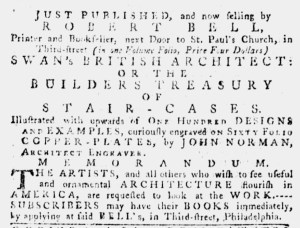
Pennsylvania Gazette (June 28, 1775).

“JUST PUBLISHED … SWAN’s BRITISH ARCHITECT … Illustrated with upwards of ONE HUNDRED DESIGNS AND EXAMPLES.”

At the end of June 1775, Robert Bell, “Printer and Bookseller,” and John Norman, “Architect Engraver,” published an American edition of Abraham Swan’s British Architect: Or, the Builders Treasury of Staircases.  Norman had previously promoted the work with newspaper advertisements and proposals “with a specimen of the plates and letter press” that prospective subscribers could examine.  When the volume was ready for sale and for subscribers to collect the copies they reserved, Bell and Norman ran advertisements in the Pennsylvania Gazette and the Pennsylvania Journal on June 28.  The following day they placed the same advertisement in the Pennsylvania Evening Post.  On July 1, it appeared in the Pennsylvania Ledger and in Story and Humphreys’s Pennsylvania Mercury on July 7.  Of the newspapers printed in English in Philadelphia at the time, only Dunlap’s Pennsylvania Packet did not carry the advertisement.  Bell and Norman made a significant investment in marketing their edition of Swan’s British Architect.
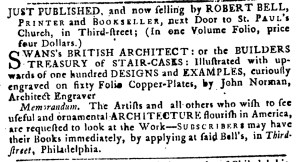
Pennsylvania Journal (June 28, 1775).

To entice prospective customers, they specified that the book was “Illustrated with upwards of one hundred DESIGNS and EXAMPLES, curiously engraved on sixty Folio Copper-Plates” bound into the volume.  They also appended a “Memorandum” requesting that the “Artists and all others who wish to see useful and ornamental ARCHITECTURE flourish … look at the Work.”  If residents of the largest and most cosmopolitan urban port in the colonies wanted their city to maintain and enhance its level of sophistication, Bell and Norman implied, they needed to consider architecture and design important cultural pursuits.  To that end, they also marketed similar publications to those who purchased Swan’s British Architect.  Readers found to subscription proposals bound into the book.  The first one, advertising The Gentleman and Cabinet-Maker’s Assistant with drawings by John Folwell, a local cabinetmaker, and engravings by Norman (dated June 20), faced the title page.  The other, advertising an American edition of Swan’s Collection of Designs in Architecture, Containing New Plans and Elevations of Houses, for General Use (dated June 26), appeared immediately after the letterpress explanations of the engraved illustrations.  The dates on the subscription proposals suggest that they might have circulated separately, yet Bell and Norman made certain to place them before customers who already confirmed an interest in the subject matter.

June 20

What was advertised via subscription proposals in revolutionary American 250 years ago today?

Subscription proposals bound in Abraham Swan, The British Architect: Or, the Builders Treasury of Stair-Cases (Philadelphia: Robert Bell, Bookseller, for John Norman, Architect Engraver, 1775). Courtesy Library of Congress.

“THE GENTLEMAN AND CABINET-MAKER’s ASSISTANT.”

As the summer of 1775 approached, Robert Bell, the prominent bookseller and auctioneer, partnered with John Norman, an architect engraver, in publishing an American edition of Abraham Swan’s British Architect: Or, the Builders Treasury of Stair-Cases.  Norman, who had arrived in Philadelphia just a year earlier, advertised the forthcoming volume in the Pennsylvania Journal in March and advised that prospective subscribers who considered supporting the project could examine printed proposals “with a specimen of the plates and letter press” at his house on Second Street.  He also pledged that the “names of the subscribers to this useful and ornamental work will be published.”  The book eventually included, according to its title page, “upwards of One Hundred DESIGNS and EXAMPLES, curiously engraved on Sixty FolioCopper-Plates,” some of them previously on view.  The “NAMES OF THE ENCOURAGERS,” as promised, appeared on four pages, clustered together by the first letter of their last names.  In the copy in the collections of the American Antiquarian Society, the list of nearly two hundred subscribers had a prominent place immediately after the title page and before the introduction, though binders may have placed the list at the end in other copies.

The copies at the American Antiquarian Society, the Getty Research Institute, and the Library of Congress also include subscription proposals for The Gentleman and Cabinet-Maker’s Assistant with the “DRAWINGS by the ingenious JOHN FOLWELL, Cabinet-Maker; and the ENGRAVINGS by JOHN NORMAN,” bound to face the title page.  While the proposals may have also circulated separately as a broadside, it seems that Bell and Norman seized an opportunity to market a similar book to subscribers and other readers of their edition of British Architecture, an audience that already demonstrated interest in the subject matter.  The proposals carried a date – June 20, 1775 – but could have been paired with British Architecture any time after that.  The proposed volume would feature even more illustrations, “Two Hundred Designs and Examples … with proper Explanations in Letter Press,” at a cost of fifty shillings.  Subscribers were expected to pay fifteen shillings in advance and the remainder “on the Delivery of the Book.”  Folwell and Norman intended to take it to press as soon as subscribers ordered three hundred copies.  As with the British Architect, “The Names of the SUBSCRIBERS to this useful WORK will be printed” as an acknowledgment of their support.  Folwell and Norman accepted subscriptions in Philadelphia, as did Bell and Thomas Nevell “at the Sign of the CARPENTERS-HALL,” but so did local agents in Annapolis, Baltimore, Charleston, and New York.  The list of associates in other towns further suggests that the subscription proposals did indeed circulate separately in an effort to enhance demand.

March 1

What was advertised in a colonial American newspaper 250 years ago today?

Pennsylvania Journal (March 1, 1775).

“THE American Edition of Swan’s British Architect.”

Less than a year after arriving in Philadelphia from London, John Norman, an engraver, embarked on producing an “American Edition of Swan’s British Architect” in the spring of 1775.  He unveiled the project with an advertisement in the March 1 edition of the Pennsylvania Journal, advising the public that he was “Now PUBLISHING” the volume “by SUBSCRIPTION” and seeking supporters to reserve their copies.  He asked those who did so to make a deposit and pay the remainder “at the delivery of the book,” noting that the total price “is Ten Shillings less than the London edition.”

The Continental Association, a nonimportation, nonconsumption, and nonexportation agreement devised by the First Continental Congress in response to the Coercive Acts, was in effect at the time that Norman advertised his American edition of Swan’s British Architect.  His project adhered to the eighth article, which called for “promot[ing] Agriculture, Arts, and the Manufacturers of this Country,” while the subject matter, all sorts of architectural elements in fashion in England, suggested that colonizers continued to value transatlantic cultural ties and their identity as members of the British empire.  The dispute with Parliament had intensified, but most still hoped for a redress of grievances and return to amiable relations.

In addition to the newspaper advertisement, Norman printed more extensive “proposals, with a specimen of the plates and letter press,” that interested parties could view at his house.  Prospective subscribers could learn more about the project and assess the quality of the engravings before placing their orders.  To further entice them, Norman declared that the “names of the subscribers to this useful and ornamental work will be published.”  Just as disseminating subscription proposals was a common marketing strategy in eighteenth-century America, so was publishing the list of subscribers.  In other circumstances, the “gentlemen” who subscribed wanted to see their names alongside those of other genteel members of their community.  That was still the case for this book, yet they likely also wished to see their names in print as they for supporting for an American edition.  Norman offered an opportunity to simultaneously demonstrate their commitment to both the arts and the Continental Association.

May 11

What was advertised in a colonial American newspaper 250 years ago today?

Pennsylvania Journal (May 11, 1774).

“Booksellers, in any part of America, may be supplied with frontispieces of any kind.”

When John Norman, an “ARCHITECT and LANDSCAPE-ENGRAVER, from London,” arrived in Philadelphia in the spring of 1774, he introduced himself to the public with an advertisement in the May 11 edition of the Pennsylvania Journal.  He offered his services to “Any Gentlemen, who please to favour him their commands,” promising that they “may depend on having their work carefully and expeditiously executed on the lowest terms and in the best manner.”  The newcomer promised quality engravings at the best prices.  In addition to local customers, he also sought clients in other cities and towns.  In a nota bene, he addressed “Booksellers, in any part of America,” informing them that they “may be supplied with frontispieces of any kind.”  He produced such work “as reasonable as in England,” while also pledging to meet the schedules of his clients.  For those marketing books with frontispieces by subscription, Norman would invest “great care … to dispatch [the engravings] at the time they are wanted.”

Norman experienced success, first in Philadelphia and later in Boston.  He eventually became “one of the significant cartographic engravers and publishers of the early Republic.”  In 1775, he published an American edition of Abraham Swan’s The British Architect: or, the Builder’s Treasury of Staircases, printed by Robert Bell.  The copies in the collections of the American Antiquarian Society and the Library of Congress have two subscription proposals and a list of “ENCOURAGERS” (or subscribers) bound into them.  The engraver hoped that after recruiting nearly two hundred subscribers for The British Architect that the “generous ARTISTS, who encouraged this AMERICAN EDITION, and all others who wish to see useful and ornamental ARCHITECTURE flourish in AMERICA” would reserve one or more copies of “THE GENTLEMAN AND CABINET-MAKERS’S ASSISTANT” and “A COLLECTION OF DESIGNS IN ARCHITECTURE.”  For both volumes, “SUBSCRIPTIONS are gratefully received” by Norman and Bell in Philadelphia and local agents in Annapolis, Baltimore, Charleston, and New York.

The engraver relocated to Boston during the Revolutionary War.  In the final years of the war, he produced portraits of patriot leaders, including His Excellency George Washington, Esqr., General and Commander in Chief of the Allied Armies, Supporting the Independence of America; The Honorable Samuel Adams, Esqr., First Delegate to Congress from Massachusetts; and His Excellency Nathaniel Green, Esqr., Major General of the American Army.  In 1782, Norman engraved, published, and advertised Plan of the Town of Boston, with the ATTACK on BUNKERS-HILL, in the Peninsula of CHARLESTOWN, the 17th of June, 1775.  His engravings, both portraits and maps, contributed to the commodification of patriotism during the era of the American Revolution, a different sort of project than the “ARCHITECT and LANDSCAPE-ENGRAVER” first envisioned in his advertisement in the Pennsylvania Journal.