August 5

What was advertised in a revolutionary American newspaper 250 years ago today?
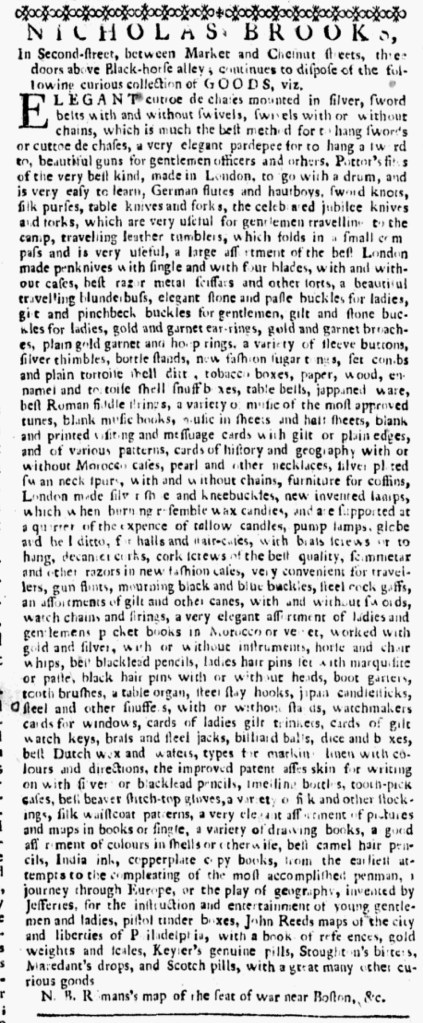
Pennsylvania Ledger (August 5, 1775).

“Romans’s map of the seat of war near Boston.”

At the end of July 1775, Nicholas Brooks began running a new advertisement in the Pennsylvania Ledger.  It first appeared on July 29 and then again in the next two issues.  In it, Brooks hawked a “curious collection of GOODS” that he sold at his shop on Second Street in Philadelphia.  He listed everything from sword belts and “beautiful guns for gentlemen officers” and “gilt and stone buckles for ladies” to “razors in new fashion cases, very convenient for traveling” and “cork screws of the best quality” to “a very elegant assortment of ladies and gentlemans pocket books in Morocco velvet, worked with gold and silver” and “a variety of music of the most approved tunes.”  He also stocked “a very elegant assortment of pictures and maps in books or single.”  Brooks had already established “PRINTS and PICTURES” as a specialty.

He concluded this advertisement with a nota bene that indicated he sold “Romans’s map of the seat of war near Boston,” but he did not say anything more about that item.  In addition, neither Brooks nor Bernard Romans, the cartographer and “AUTHOR” of the map, previously advertised the project in the Pennsylvania Ledger or any of the other newspapers printed in Philadelphia at the time.  Perhaps Brooks expected that readers were familiar with a broadside subscription proposal, dated July 12, that had been circulating or posted around town and beyond.  The subscription proposal featured the same copy as the advertisement for the map that ran in the August 3 edition of Rivington’s New-York Gazetteer, though the newspaper notice listed only local agents while the broadside gave a much more extensive list of printers, booksellers, and others who collected subscriptions in towns from New England to South Carolina.  James Rivington apparently adapted the broadside rather than composing copy for the advertisement when he inserted it in his newspaper.  That broadside documented a sophisticated network for inciting demand for the map and distributing it to subscribers.  In addition to the five printers and booksellers who collected subscriptions in Philadelphia, twenty-two local agents in eighteen towns in ten colonies collaborated with Brooks and Romans.  That list represented an “imagined community,” a concept developed by Benedict Anderson, of readers and consumers near and far who simultaneously examined the same map “Shewing the SEAT of the present unhappy CIVIL WAR in NORTH-AMERICA.”

Brooks did not limit his marketing of the map to the broadside subscription proposal and the nota bene at the end of an advertisement that cataloged dozens of items available at his shop.  He eventually ran newspaper advertisements devoted exclusively to the map, seeking to generate more interest and demand for such a timely and important work.
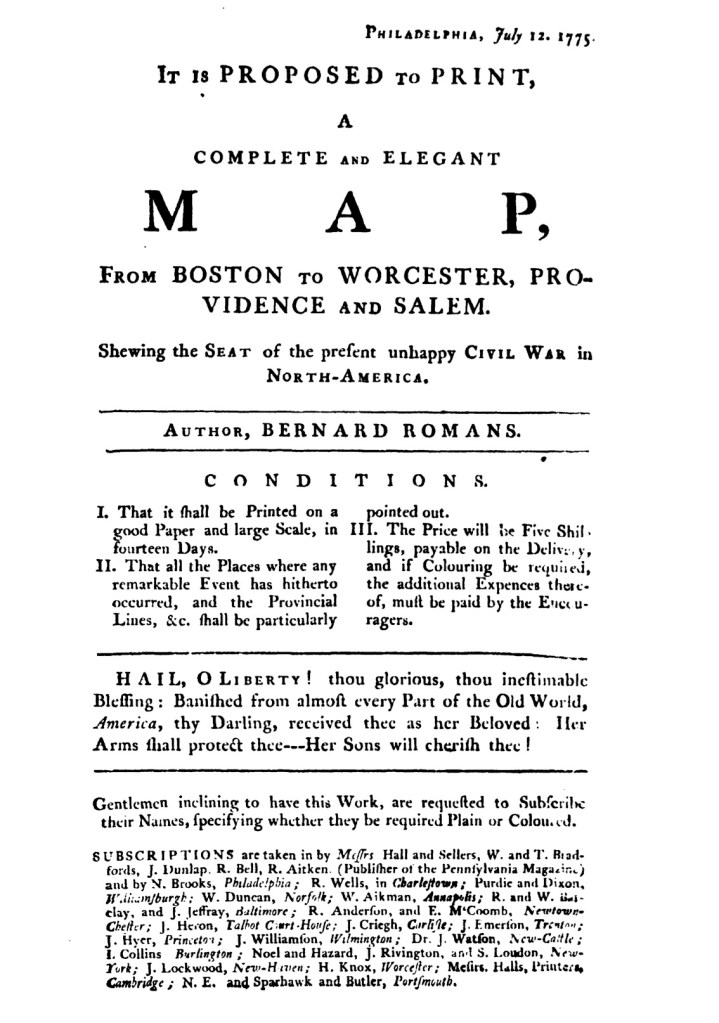
Broadside Subscription Proposal: “It Is Proposed to Print, A Complete and Elegant Map” (Philadelphia, 1775). Courtesy Library Company of Philadelphia.

**********

The Massachusetts Historical Society has digitized Romans’s map, accompanied by a brief overview of its significance and a short essay about Romans and other cartographers active during the era of the American Revolution.

June 20

What was advertised via subscription proposals in revolutionary American 250 years ago today?

Subscription proposals bound in Abraham Swan, The British Architect: Or, the Builders Treasury of Stair-Cases (Philadelphia: Robert Bell, Bookseller, for John Norman, Architect Engraver, 1775). Courtesy Library of Congress.

“THE GENTLEMAN AND CABINET-MAKER’s ASSISTANT.”

As the summer of 1775 approached, Robert Bell, the prominent bookseller and auctioneer, partnered with John Norman, an architect engraver, in publishing an American edition of Abraham Swan’s British Architect: Or, the Builders Treasury of Stair-Cases.  Norman, who had arrived in Philadelphia just a year earlier, advertised the forthcoming volume in the Pennsylvania Journal in March and advised that prospective subscribers who considered supporting the project could examine printed proposals “with a specimen of the plates and letter press” at his house on Second Street.  He also pledged that the “names of the subscribers to this useful and ornamental work will be published.”  The book eventually included, according to its title page, “upwards of One Hundred DESIGNS and EXAMPLES, curiously engraved on Sixty FolioCopper-Plates,” some of them previously on view.  The “NAMES OF THE ENCOURAGERS,” as promised, appeared on four pages, clustered together by the first letter of their last names.  In the copy in the collections of the American Antiquarian Society, the list of nearly two hundred subscribers had a prominent place immediately after the title page and before the introduction, though binders may have placed the list at the end in other copies.

The copies at the American Antiquarian Society, the Getty Research Institute, and the Library of Congress also include subscription proposals for The Gentleman and Cabinet-Maker’s Assistant with the “DRAWINGS by the ingenious JOHN FOLWELL, Cabinet-Maker; and the ENGRAVINGS by JOHN NORMAN,” bound to face the title page.  While the proposals may have also circulated separately as a broadside, it seems that Bell and Norman seized an opportunity to market a similar book to subscribers and other readers of their edition of British Architecture, an audience that already demonstrated interest in the subject matter.  The proposals carried a date – June 20, 1775 – but could have been paired with British Architecture any time after that.  The proposed volume would feature even more illustrations, “Two Hundred Designs and Examples … with proper Explanations in Letter Press,” at a cost of fifty shillings.  Subscribers were expected to pay fifteen shillings in advance and the remainder “on the Delivery of the Book.”  Folwell and Norman intended to take it to press as soon as subscribers ordered three hundred copies.  As with the British Architect, “The Names of the SUBSCRIBERS to this useful WORK will be printed” as an acknowledgment of their support.  Folwell and Norman accepted subscriptions in Philadelphia, as did Bell and Thomas Nevell “at the Sign of the CARPENTERS-HALL,” but so did local agents in Annapolis, Baltimore, Charleston, and New York.  The list of associates in other towns further suggests that the subscription proposals did indeed circulate separately in an effort to enhance demand.

June 28

What was advertised in a colonial American newspaper 250 years ago today?

New-York Gazette and Weekly Mercury (June 28, 1773).

I have not yet been favoured with a sufficiency of subscribers to enable me to carry it into immediate execution.”

Samuel Gale, the author of The Complete Surveyor, looked for subscribers to publish his work for more than a year.  He distributed a handbill with the dateline “PHILADELPHIA, MARCH 12th, 1772,” to advise those who already subscribed for copies of the book that even though he already collected two hundred subscribers on his own and expected to receive others from local agents in other cities and towns “the number in the whole falls considerably short of my expectations.”  Furthermore, he anticipated that “this work will be large, and the expence of printing it considerably greater than would be defrayed by the present number of subscribers.”  Accordingly, others had advised him “to delay the printing of it a little longer” out of concerns that he “might perhaps be a loser by proceeding too hastily.”  In other words, Gale received sound advice that he would likely incur expenses that he could not pay if he took the book to press without enough subscribers to defray the costs.

To that end, he hoped “for many Gentlemen in America, to encourage this publication” by becoming subscribers or, if they had already subscribed, recruiting other subscribers.  To reassure prospective subscribers of the quality of The Complete Surveyor, Gale asserted that the “Manuscript Copy has met with the approbation of some of the best judges of these matters in America,” including William Alexander, the Earl of Stirling, a member of the American Philosophical Society in Philadelphia; Alexander Colden, the Surveyor General of New York; David Rittenhouse, a prominent astronomer, mathematician, and surveyor in Philadelphia; and John Lukens, the Surveyor General of Pennsylvania.  Gale inserted short testimonials from each of these supports below a heading that called attention to “RECOMMENDATIONS OF THE ABOVE WORK.”  In addition, he hoped to entice subscribers by promising to insert an “Essay on the Variation of the Needle, written by the late Mr. LEWIS EVANS,” a renowned Welsh surveyor and geographer who published the General Map of the Middle British Colonies in America in 1755.  Gale concluded the handbill with a list of local agents who accepted subscriptions in a dozen towns from Boston to Savannah.  In addition, he declared that “all the Booksellers and Printers in America” accepted subscriptions.

Apparently, such an extensive network did not yield a sufficient number of subscribers.  At the end of June 1773, more than fifteen months later, Gale ran an advertisement in the New-York Gazette and Weekly Mercury.  He once again stated that the “manuscript copy has met with the greatest approbation,” yet “I have not yet been favoured with a sufficiency of subscribers to enable me to carry it into execution, without running too great a hazard.”  He requested that those who already subscribed give him a few more months to solicit subscribers among “the other well-wishers to mathematical learning among the public.”  He included the endorsements that previously appeared on the handbill and an even more extensive list of local agents, concluding with a note that “all the Booksellers and Printers in America and the West-India Islands” forwarded subscriptions to him.

Despite his best efforts, Gale never managed to attract enough subscribers to publish the book.  A note in the American Antiquarian Society’s catalog entry for the handbill states that “an insufficient number of subscriptions were received to encourage publication.”  Gale circulated advertising materials in more than one format, deployed testimonials from prominent experts in his field, offered a bonus essay as a premium, and made it convenient to subscribe via local agents throughout the colonies.  He developed a sophisticated marketing campaign, but it ultimately fell short of inciting sufficient demand for the book he wished to published.

Samuel Gale’s handbill promoting The Complete Surveyor. Courtesy Historical Society of Pennsylvania.

May 24

What was advertised in a colonial American newspaper 250 years ago this week?

Supplement to the South-Carolina Gazette (May 21, 1772).

“Send their names to the Printers of this Paper.”

The supplement that accompanied the May 21, 1772, edition of the South-Carolina Gazette included “PROPOSALS FOR PUBLISHING BY SUBSCRIPTION, A MAP of the INTERIOR PARTS OF NORTH-AMERICA.  By THOMAS HUTCHINS, Lieutenant in His Majesty’s Royal American Regiment, and Engineer.”  Hutchins explained that the map depicted a region “which must soon become a most important and very interesting part of the British empire in America.”  It included “the great rivers of Missisippi and Ohio, with the newest smaller streams which empty into them” as well as “Lakes Erie, Huron, and Michigan.”  Hutchins asserted that the map “accurately delineated” the region, “a great part of the country and most of the rivers and lakes … laid down from surveys, corrected by the observation of latitudes, carefully executed by himself” during the Seven Years War and “since the final treaty with the western and northern Indians in 1764.”  The map also incorporated “every considerable town of the various Indian Nations, who inhabit these regions.”  The “extent of their respective claims,” Hutchins noted, “are also particularly pointed out.”  Land speculators and settler colonizers certainly had their eyes on those “respective claims,” despite the Proclamation Line of 1763 that reserved that territory for indigenous peoples.

Hutchins declared that he would publish and deliver the map “as soon as the Subscribers amount to a number adequate to defray the unavoidable expence of the publication.”  Like so many others who wished to publish books and maps, he did not intend to assume the financial risk without assurances that the project would meet with success.  To that end, he invited “those in SOUTH-CAROLINA who may think proper to encourage” publishing the map to “as soon as possible, send their names to the Printers of this Paper.”  Powell, Hughes and Company acted as local agents for subscribers.  Hutching did not, however, restrict his marketing efforts to newspaper notices.  He also distributed broadside subscription proposals that featured almost identical text.  Measuring approximately thirteen inches by eight inches, a copy at the Historical Society of Pennsylvania includes blank space to insert the name of a local agent who could have posted the subscription notice in a retail shop or printing office.  That accounts for the first variation in the text compared to the advertisement in the South-Carolina Gazette, an invitation for subscribers to “send their names to [blank]” rather than “send their names to the Printers of this Paper.”  A short paragraph unique to the broadside notice followed that blank: “WE the Subscribers do agree to pay Lieutenant THOMAS HUTCHINS, or Order, for the above-mentioned Map and Analysis, ONE PISTOLE, on the receipt thereof, according to the Number affixed to our respective Names.”  Additional blank space provided room for subscribers to add their names and indicate how many copies they wished to order.  The Historical Society of Pennsylvania’s copy does not have any manuscript additions; no subscribers signed it to reserve their maps.

Newspaper advertisements provided the best opportunity to circulate subscription notices to the greatest number of prospective customers, but they were not the only means of inciting interest in books and maps.  Hutchins and other entrepreneurs also distributed broadsides to local agents to facilitate recording the names of subscribers.  I suspect that a greater number of those broadsides circulated in early America than survive today, increasing the frequency that colonizers encountered advertising media.

Broadside Subscription Proposal with Space for Subscribers to Add Names. Courtesy Historical Society of Pennsylvania.