December 25

What was advertised in a colonial American newspaper 250 years ago today?
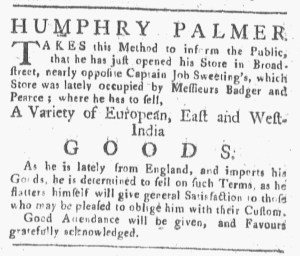
Providence Gazette (December 25, 1773).

“Good Attendance will be given, and Favours gratefully acknowledged.”

Unlike modern marketing, the advertisements disseminated during December in the eighteenth century did not take note of Christmas or associate consumerism with the holiday.  In the December 25, 1773, edition of the Providence Gazette, John Carter, the printer, did insert “A CHRISTMAS CAROL,” consisting of four stanzas, in the upper left corner of the final page of the newspaper.  In several other colonial newspapers, the “Poet’s Corner,” a weekly feature, occupied that space, a verse for that week’s issue appearing alongside the advertisements that filled the rest of the page.  Carter’s carol appeared in proximity to advertisements for consumer goods and services, but also apart.  Marketers did not yet widely depict Christmas as an occasion for making purchases.

That being the case, Humphry Palmer’s advertisement for a “Variety of European, East and West-India GOODS” did not make any special appeals that would not have appeared in the notice had he published it at some other time of the year.  Instead, he tended to some of the mechanics of shopping, describing the location of his store for prospective customers, and attempted to incite demand with promises of a broad selection and good prices.  He confided that he recently arrived in Providence, noting that worked to the advantage of his customers.  “As he is lately from England, and imports his goods,” Palmer declared, “he is determined to sell on such Terms, as he flatters himself will give general Satisfaction to those who may be pleased to oblige him with their Custom.”  His connections in England may have helped him acquire his inventory at low costs.  Perhaps more importantly, his status as a newcomer in town made him realize that the first impression that he made on consumers would become a lasting impression in the community.  He wanted the public to think of good bargains rather than unreasonably high prices when considered shopping at his store.  Palmer also noted that “Good Attendance will be given,” emphasizing customer service.  None of those appeals concerned Christmas or shopping and giving gifts as a holiday pastime.  None of the other advertisements published in the Providence Gazette on Christmas Day or the weeks leading up to it did so either.

December 10

What was advertised in a colonial American newspaper 250 years ago today?

New-York Journal (December 10, 1772).

“Christmas pieces.”

In December 1772, John Holt, printer of the New-York Journal, ran an advertisement that listed a variety of stationery wares imported via the Lady Gage and other vessels recently arrived from London and now available for sale at his printing office.  Holt’s inventory included “ACCOUNT, and blank books of all sorts and sizes,” “Writing paper of all kinds from the lowest to the highest prices … with black, or gilt edges, or plain,” “Receipt books of all sorts and sizes, with and without clasps, some interleaved with blotting paper,” and “Very best red and black wax of all Sorts, and wafers in boxes.”

Given the time of the year, Holt stocked “Almanacks of several sorts for the Year 1773.”  In a nod to the holiday that would take place just a week before the new year, the printer also listed “Christmas pieces” among the pamphlets he carried.  He did not, however, suggest that any of his other merchandise, such as “Newberry’s children’s books of all sorts” and “Best Merry Andrew and Harry’s playing cards,” might make for good Christmas gifts.

That Holt even mentioned “Christmas pieces” in December did distinguish him from other merchants and shopkeepers.  In stark contrast to today’s association of Christmas with marketing and consumerism, colonizers did not make the same connections.  Only rarely did retailers attempt to make sale by encouraging consumers to purchase gifts.  The appropriately named Garrat Noel, a bookseller and stationer in New York, did so in December 1765 when he “offer[ed] to the Public, the following List of Books, as proper for Christmas Presents and New-Year’s Gifts.”  He confided that he set “extraordinary low Prices” as “an Encouragement to those who are willing to be generous on the Occasion.”  He described that holiday sale as “his annual Custom.”  Most other retailers did not adopt or expand that custom.  John Mein, a bookseller in Boston, marketed a “Large Assortment of entertaining and instructive Books for Children, very proper for Christmas and New Year’s Gifts,” the following year, but throughout the colonies such examples were rare.

Marketing and Christmas were not yet synonymous in eighteenth-century America, despite the efforts of a few booksellers to connect purchasing gifts, especially for children, and the holiday.  Holt’s “Christmas pieces” may very well have been devotional literature not intended as gifts.  The pages of colonial newspapers carried very different messages about Christmas and consumerism than newspapers, radios, televisions, and the internet would disseminate in December in later centurires.

January 8

What was advertised in a colonial American newspaper 250 years ago today?

jan-8-181767-massachusetts-gazette
Massachusetts Gazette (January 8, 1767).

“Books for Children, very proper for Christmas and New Year’s Gifts.”

John Mein made a fairly unique appeal to potential customers when he advertised “A Large Assortment of entertaining and instructive Books for Children, very proper for Christmas and New Year’s Gifts.” The bookseller tied consumerism to the holidays in a way that few other advertisers did in late 1766 and early 1767, which differs significantly from marketing practices in the twentieth and twenty-first centuries. Very few advertisers acknowledged Christmas as a holiday, much less used it to promote purchases from their shops. Recognition of the new year manifested itself in advertising mostly through calls for those who previously bought on credit to settle accounts. Indeed, only a handful of advertisers linked the holidays to making purchases and giving gifts.

As with many other aspects of marketing, members of the book trade seemed to be at the forefront of this innovation. Throughout all of the advertisements placed in newspapers during December 1766 and early January 1767, booksellers alone encouraged customers to think of their wares as gifts for others. In an advertisement in the January 8, 1767, issue of the New-York Journal bookseller Garrat Noel listed “A very large Parcel of Mr. Newberry’s beautiful gilt Picture Books, for the Entertainment of his old Friends the pretty Masters and Misses of New-York, at Christmas and New-York.” The appropriately named Noel was a veteran of promoting holiday gifts, having noted in his advertisements a year earlier that it was “his annual Custom … to offer to the Public, the following List of Books, as proper for Christmas Presents and New-Year’s Gifts.”

John Mein further advanced this innovation, anticipating marketing strategies of the late nineteenth century and beyond. He announced that potential customers could pick up free “Printed Catalogues” listing the books he considered especially suited to be given as gifts. Retailers of all sorts eventually resorted to catalogs, especially Christmas catalogs, to drive sales during a season increasingly associated with consumerism.

In the 1760s, however, the media – both printers and advertisers – took little notice of the Christmas season. On the same day that Mein’s advertisement appeared in Boston and Noel’s in New York, the first page of the Virginia Gazette featured “An ODE upon CHRISTMAS” on the front page. It was dated December 4, 1766, but the printers did not consider it pressing enough to make room for it in their newspaper until five weeks later. The Christmas holiday did not dominate December in the 1760s to the extent it does in modern America.

December 25

Who was the subject of an advertisement in a colonial American newspaper 250 years ago today?

dec-25-12251766-massachusetts-gazette
Massachusetts Gazette (December 25, 1766).

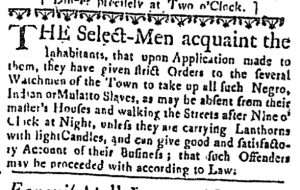
“Slaves, as may be absent from their master’s Houses and walking the Streets.”

Only one advertisement concerning slaves appeared in the December 25, 1766, issue of the Massachusetts Gazette. Rather than seeking to buy or sell slaves or offering rewards for runaway slaves, it aimed to regulate the activities and movements of “Negro, Indian or Mulatto Slaves” in Boston.

Apparently the selectmen of the town received complaints about slaves “absent from their master’s Houses and walking the streets” in the evenings and into the night. In response, they issued “strict Orders to the Watchmen of the Town” to detain any slaves they encountered on the street “after Nine o’Clock at Night.” The watchmen were permitted to make exceptions, provided slaves made “good and satisfactory Account of their Business.” In order to demonstrate that they were not up to some sort of skullduggery, slaves traversing the streets at that hour needed to carry lanterns with lit candles, making it easier to spot them and preventing them from seeming to sneak from place to place. The advertisement concluded with a threat against masters and slaves: “such Offenders may be proceeded with according to Law.” Advertisements for runaway slaves were intended to regulate the movements of enslaved men and women, to return them to the authority and oversight of their masters. This advertisement, on the other hand, regulated both slaves and masters, instructing slaveholders who had been lax in supervising their slaves to become more vigilant and strict.

**********

As an aside, it might seem especially appropriate today to examine the marketing aspects of an advertisement for consumer goods and services that appeared 250 years ago. After all, Christmas has increasingly become a celebration of consumerism in modern America. Isn’t this advertisement regulating the movement of slaves a missed opportunity considering all of the advertisements more explicitly linked to consumer culture?!

The Christmas holiday, however, did not garner the same attention in colonial America, especially not in New England among the descendants of Puritans. (Observing Christmas had been banned in New England in the seventeenth century.) Colonists certainly did not indulge in rampant exchanges of gifts and all of the buying and selling associated with giving presents. Accordingly, in choosing an advertisement for today I have refrained from hyping consumerism and imagining Christmas celebrations that did not exist in colonial New England. Instead, I have selected an advertisement that reveals one of the more pressing concerns in Boston on December 25, 1766.

January 1

What was advertised in a colonial newspaper 250 years ago this week?

Jan 1 - 12:30:1765 New-York Gazette
New-York Gazette (December 30, 1765)

“GARRAT NOEL, BOOKSELLER and STATIONER; According to his annual Custom, begs Leave to offer to the Public, the following List of Books, as proper for Christmas Presents and New-Year’s Gifts.”

At this time of the year we often hear laments that Christmas has become too secularized, evidenced in particular by the commercialization of the holiday.  The appropriately-named Noel, however, demonstrates that some advertisers developed a marketing strategy that linked consumption and Christmas in the eighteenth century.

And, since everyone loves a bargain at Christmas and New Year, Noel promised “extraordinray low Prices” to “those who are willing to be generous on the Occasion.”  For those who may not have considered giving gifts during the season, Noel planted the idea that they could confirm their benevolence and thoughtfulness by presenting books and stationery wares to family and friends.