
What was advertised in a revolutionary American newspaper 250 years ago today?
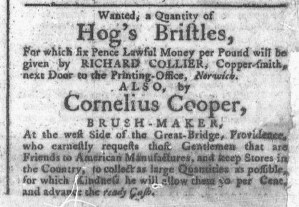
“Wanted, a Quantity of Hog’s Bristles [from] Friends to American Manufactures.”
Cornelius Cooper, a brushmaker who had relocated from Philadelphia to Providence, needed materials to continue operating his business in the fall of 1775. He ran an advertisement to that effect in the Providence Gazette, but his efforts did not end there. He also enlisted the help of Richard Collier, a coppersmith, in Norwich, Connecticut. An advertisement in the November 13, 1775, edition of the Norwich Packet proclaimed, “Wanted, a Quantity of Hog’s Bristles, For which six Pence Lawful Money per Pound will be given.” The notice listed Collier as the local agent who collected the bristles and paid the premium, yet it did not end there.
Instead, it also advised that “Cornelius Cooper,” his name in a font as large as “Hog’s Bristles,” offered the same price. After giving directions to his shop on “the west Side of the Great-Bridge, Providence,” the “BRUSH-MAKER” declared that he “earnestly requests those Gentlemen that are Friends to American Manufactures, and keep Stores in the Country, to collect as large Quantities as possible.” In his advertisement that simultaneously ran in the Providence Gazette, he indicated that he wished to acquire “Five Thousand Weight of Hog’s Bristles,” a considerable quantity. In making an appeal to “Friends to American Manufactures,” he invoked the Continental Association and efforts to replace goods imported from England with items produced in the colonies. That became more important than ever after the battles at Lexington and Concord. Decisions in the marketplace, including collecting hog’s bristles and purchasing brushes made from them, had political implications. Collier supported the cause by serving as a local agent for Cooper; the brushmaker presented an opportunity for others to do the same, especially shopkeepers in the countryside who collected bristles from their patrons. In return for that “Kindness,” Cooper not only paid “ready Cash” but also “allow[ed] them 30 per Cent.” It seems that he offered a discount to retailers who collected bristles if they purchased his brushes to stock in their stores. That strategy meant acquiring supplies and making sales at the same time, a neat arrangement for a brushmaker seeking to establish himself in New England.

