November 13

What was advertised in a revolutionary American newspaper 250 years ago today?
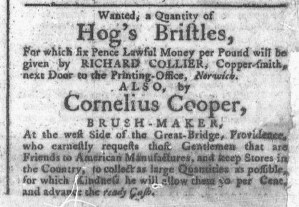
Norwich Packet (November 13, 1775).

“Wanted, a Quantity of Hog’s Bristles [from] Friends to American Manufactures.”

Cornelius Cooper, a brushmaker who had relocated from Philadelphia to Providence, needed materials to continue operating his business in the fall of 1775.  He ran an advertisement to that effect in the Providence Gazette, but his efforts did not end there.  He also enlisted the help of Richard Collier, a coppersmith, in Norwich, Connecticut.  An advertisement in the November 13, 1775, edition of the Norwich Packet proclaimed, “Wanted, a Quantity of Hog’s Bristles, For which six Pence Lawful Money per Pound will be given.”  The notice listed Collier as the local agent who collected the bristles and paid the premium, yet it did not end there.

Instead, it also advised that “Cornelius Cooper,” his name in a font as large as “Hog’s Bristles,” offered the same price.  After giving directions to his shop on “the west Side of the Great-Bridge, Providence,” the “BRUSH-MAKER” declared that he “earnestly requests those Gentlemen that are Friends to American Manufactures, and keep Stores in the Country, to collect as large Quantities as possible.”  In his advertisement that simultaneously ran in the Providence Gazette, he indicated that he wished to acquire “Five Thousand Weight of Hog’s Bristles,” a considerable quantity.  In making an appeal to “Friends to American Manufactures,” he invoked the Continental Association and efforts to replace goods imported from England with items produced in the colonies.  That became more important than ever after the battles at Lexington and Concord.  Decisions in the marketplace, including collecting hog’s bristles and purchasing brushes made from them, had political implications.  Collier supported the cause by serving as a local agent for Cooper; the brushmaker presented an opportunity for others to do the same, especially shopkeepers in the countryside who collected bristles from their patrons.  In return for that “Kindness,” Cooper not only paid “ready Cash” but also “allow[ed] them 30 per Cent.”  It seems that he offered a discount to retailers who collected bristles if they purchased his brushes to stock in their stores.  That strategy meant acquiring supplies and making sales at the same time, a neat arrangement for a brushmaker seeking to establish himself in New England.

November 12

What was advertised in a revolutionary American newspaper 250 years ago this week?

Providence Gazette (November 11, 1775).

“WANTED to purchase, Five Thousand Weight of Hog’s Bristles, long and good.”

Cornelius Cooper, a “Brush Maker, from Philadelphia,” experimented with various marketing strategies when he relocated to Providence and placed advertisements in the Providence Gazette in the fall of 1775.  In an advertisement that ran for several weeks, he announced that the “makes and sells, Wholesale and Retail, Sweeping, Hearth, Cloaths, Shoe and Buckle-Brushes, and every other Article in the Brush Way.”  In other words, he produced every sort of brush for any sort of purpose that his customers needed.  He also made a pitch for local consumers to “Buy American,” asking that “every Friend to America, both in Town and Country, will encourage him occasionally” by making a purchase from his shop.  Only in the nota bene that concluded his advertisement did Cooper issue a call that “People will be careful to save their Hogs Bristles,” an essential material for making brushes, “for which he will give a good Price in Cash.”

In a subsequent advertisement, Cooper put his request for hog bristles front and center.  A headline in capital letters proclaimed, “READY CASH.”  The brushmaker explained that he sought to purchase “Five Thousand Weight of Hog’s Bristles, long and good,” and would pay six pence per pound.  Only after he caught readers’ attention with that offer did he list the inventory available at his shop in Providence.  Rather than name general categories of brushes, he made a display of the many kinds of brushes that he made and sold, including “Tanner’s and Currier’s Scouring and Blacking Brushes, Hatter’s Stopping and Planking Brushes, [and] best Weaver’s Sizing or Look Brushes.”  In addition to supplying consumers with brushes to use in their homes, Cooper aimed to supply artisans with brushes specific to their trades.  He also renewed his appeal for “a Lad about 14 Years of Age” to serve as an apprentice, but added that he “wanted, a smart active Negro Boy, about 14 Years of Age.”  Whether the enslaved youth would also learn how to make brushes or instead do other tasks in the workshop, Cooper did not specify.  He dropped the appeal to “every Friend in America,” though likely not because he noticed any discrepancy in advocating for the liberties of white colonizers and seeking to purchase an enslaved youth.  After all, acquiring bristles so he could stay in business seemed to be Cooper’s primary focus in his new advertisement.

October 8

What was advertised in a revolutionary American newspaper 250 years ago this week?

Providence Gazette (October 7, 1775).

“He presumes every Friend to America, both in Town and Country, will encourage him occasionally.”

When Cornelius Cooper, a “BRUSH-MAKER, from Philadelphia,” relocated to Providence, he ran an advertisement in the October 7, 1775, edition of the Providence Gazette to introduce himself to his new neighbors and prospective customers.  The newcomer announced that he “makes and sells, Wholesale and Retail, Sweeping, Hearth, Cloaths, Shoe and Buckle Brushes, and every other Article in the Brush Way.”

Realizing that he was unknown to the residents of Providence, Cooper realized that he might increase sales by giving them sound reasons to purchase his brushes, either to use themselves or to stock in their shops to sell to others.  “As our own Fabrications, of every Kind, hold forth their Utility, in a most conspicuous Manner,” the brushmaker declared, “he presumes every Friend to America, both in Town and Country, will encourage him occasionally.”  Cooper did not need to rehearse current events for readers to understand his meaning.  They knew that the siege of Boston continued, following the battles at Lexington and Concord in April and the Battle of Bunker Hill in June.  They also knew that the Continental Association, a nonimportation agreement devised by the First Continental Congress, went into effect on December 1, 1774, in response to the Coercive Acts.  Colonizers sought to use commerce, especially their choices about consumption, as political leverage to convince Parliament to repeal the Boston Port Bill, the Massachusetts Government Act, and other legislation.  The Continental Association also called on colonizers to encourage domestic manufactures or the production of goods in the colonies as replacements or substitutes for imported ones.  Cooper did his part in making brushes.  Now “every Friend to America” needed to do their part by supporting his enterprise.

Making purchases was not the only way they could do so.  In a nota bene, Cooper requested “that People will be careful to save their Hogs Bristles, for which he will give a good Price in Cash.”  Consuming goods made in the colonies was important, but colonizers could also participate in the production of those goods by collecting materials, delivering them to Cooper, and earning some cash for their efforts.  The brushmaker also noted that he sought an apprentice, “a discreet, active Lad, about 14 Years of Age.”  He would pass along knowledge of his trade and make help the next generation contribute to the local economy.  Readers understood the inspiration and political ramifications without Cooper going into detail in his advertisement.  He presented them with a patriotic obligation and encouraged them to do their civic duty in the marketplace.

June 17

What was advertised in a colonial American newspaper 250 years ago this week?

Supplement to the Pennsylvania Packet (June 15, 1772).

“Sweeping brushes as 19 s. per dozen, and lower by the half or whole gross.”

John Hannah described himself as a “WHOLESALE AND RETAIL BRUSHMAKER” in an advertisement that appeared in the supplement that accompanied the June 15, 1772, edition of the Pennsylvania Packet.  Although he stocked “a good assortment of painting brushes” and “a general assortment of bone brushes” that he “imported in the last vessels from England and Holland,” he focused on the items that he produced in his own shop “AT THE HOG, … At the north-east corner of Second and Chestnut Streets” in Philadelphia.  A woodcut depicting a boar, the bristles on the crest of its back evident, adorned his advertisement.

Hannah declared that he “made and manufactured” all kinds of brushes “in the best manner” at his shop, assisted by “the best hands in the city.”  The quality of his brushes derived from both the materials, “a large and general assortment of Bristles” imported from Europe, and the skills of those who worked in his shop.  In addition to quality, Hannah promoted low prices, especially for wholesale transactions.  He proclaimed that he “can sell on as reasonable terms as any manufacturer in the province,” challenging prospective customers to compare his prices to those set by his competitors. To demonstrate that he did indeed offer good bargains, he listed some of his prices.  Hannah sold a dozen sweeping brushes for nineteen shillings.  He offered discounts to buyers who purchased in greater volume.  Similarly, he charged four shilling for a dozen “weavers brushes” and “lower by the half or whole gross.”  That he did not specify how deeply he discounted such purchases suggested that customers could negotiate the prices.

Hannah incorporated several appeals into his advertisement.  He emphasized the quality of his finished product as well as the skills of the workers who labored in his shop.  He promoted the range of choices available to customers.  He also promised the lowest prices in the colony, listing his prices and offering discounts to retailers and others who purchased large quantities of brushes.  To draw attention to his advertisement, he included a woodcut that resembled the sign that marked the location of his shop, a rudimentary form of branding his business.

August 14

What was advertised in a colonial American newspaper 250 years ago this week?

Aug 14 - 8:11:1768 Pennsylvania Gazette
Postscript to the Pennsylvania Gazette (August 11, 1768).

“He has of late stamped his name on his brushes.”

John Hanna made and sold all sorts of brushes “At the corner of Chestnut and Second-streets” in Philadelphia in the late 1760s. He produced brushes intended for every sort of purpose, from “sweeping, scrubbing, hearth and white-wash brushes” to “weavers, tanners, hatters, painters and furniture brushes of all kinds.” In his advertisements in the Pennsylvania Gazette he emphasized price and, especially, customer satisfaction. In making an appeal to price, the brushmaker proclaimed that he “sells by wholesale or retail, as low, if not lower, than any in this city.”

He expended much more effort on convincing potential customers that they would be satisfied if they purchased their brushes from him. He began with standardized language about quality, noting that he made brushes “in the neatest and best manner.” Hanna then backed up this pronouncement by offering a return policy should any of his brushes not meet the expectations of his customers. To that end, he asserted “that if the bristles come out in any reasonable time, with fair usage, he will give new ones for nothing.” This guarantee depended in part on the honesty of customers, but it did offer some sort of recourse should any of Hanna’s brushes fall short of the quality he promised.

The return policy likely extended to consumers who obtained Hanna’s brushes from other retailers. In a nota bene he explained that he “has of late stamped his name on his brushes, so that if they should fail, people may know where to bring them to be exchanged.” This removed retailers from having to address potential complaints about customer satisfaction. Instead, they could point out Hanna’s name on the brushes at the time of sale and instruct their own customers to contact the manufacturer directly with any concerns, anticipating a policy widely adopted in the twenty-first century.

Like many other artisans and shopkeepers, Hanna pledged that “Those who are pleased to favour him with their custom, may depend on being supplied to their satisfaction.” He enhanced his advertisement, however, with a mechanism for following through on those assurances. Stamping his name on his brushes not only branded them to encourage additional sales; it also marked them as eligible for the return policy he devised to cultivate customer satisfaction.

October 18

What was advertised in a colonial American newspaper 250 years ago this week?

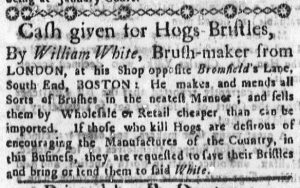
Oct 18 - 10:15:1767 Massachusetts Gazette
Massachusetts Gazette (October 15, 1767).

“Desirous of encouraging the Manufactures of the Country.”

During the imperial crisis that led to the American Revolution colonists resisted Parliamentary overreach with several non-importation and non-consumption agreements, each coinciding with particular legislative acts. The first round occurred in response to the Stamp Act, ceasing with the repeal of that hated measure. Colonists once again resorted to non-importation and non-consumption of British goods in response to the Townshend Acts, scheduled to take effect on November 20, 1767.

Throughout the last third of the eighteenth century, as colonists moved from resistance to revolution to independence, American advertisers developed marketing appeals that encouraged consumers to “Buy American.” Over time advertisers became much more explicit in their efforts linking consumption to political participation. A notice that appeared in the Massachusetts Gazette five weeks before the Townshend Acts took effect shows an early attempt. William White, a “Brush-maker from LONDON,” did not mention Parliament or the impending legislation, but readers would have made the connection on their own thanks to news items and opinion pieces elsewhere in Boston’s newspapers as well as conversations taking place throughout the city and beyond.

White encouraged potential customers to support domestic production rather than purchase imported wares. He noted that he made and sold brushes “Wholesale or Retail cheaper than can be imported,” prompting consumers to think about the origins of all the goods they acquired, not just the brushes they purchased from him. He also implicitly issued a challenge to retailers to acquire and distribute locally produced goods: presumably those who purchased brushes “Wholesale” did so with the intention of selling them in their own shops.

White framed his comments about the cost of his brushes with a statement even more overtly political. He made an appeal to colonists who were “desirous of encouraging the Manufactures of the Country” rather than continued importation of goods from England. Here he addressed colonists who could supply him with the bristles he needed to make “all Sorts of Brushes.” Not just consumers but producers as well had a duty to support local production over importation. In addition, even though White described his potential suppliers as “desirous of encouraging the Manufacturers of the Country” he implied that consumers should adopt the same attitude and opt to purchase their brushes from him.

William White did not invoke Parliament or the Townshend Acts by name in his advertisement, but contemporary politics still influenced how he structured his appeal to potential customers and how colonists interpreted his advertisement. He did not need to make his case any more explicitly because his advertisement was part of an ongoing conversation – in print and in person – among residents of Boston and throughout the colonies.