What was advertised in a revolutionary American newspaper 250 years ago today?
New-York Gazette and Weekly Mercury (January 15, 1776).
“Dr. Hill’s American Balsam; whose great efficacy is so well known.”
Nine months after his advertisements first appeared in newspapers in New York, shopkeeper Michael Hoffman continued receiving shipments of “DOCTOR HILL’s newly improved great STOMACHIC TINCTURE” and “Dr. Hill’s American Balsam” from an associate in Philadelphia. His advertisement in the January 15, 1776, edition of the New-York Gazette and Weekly Mercury echoed the one he previously placed in the May 4, 1775, edition of the New-York Journal, though it featured slightly different copy. Hoffman reminded prospective customers that the tincture was “a very excellent medicine for all weak stomach, as it procures a good healthy appetite, and a sound digestion.” In addition, it supposedly prevented all sorts of diseases since most, according to the advertisement, “have their origin contracted in a weak stomach.” The balsam, on the other hand, “is so well known to cure the most inveterate disorder in the breast, as shortness of breath, colds, coughs, and whooping coughs in children.” Yet that was not all! Through “a proper use and continuing the same a reasonable time,” the balsam “effectually cured … the most painful rhumatisms, cholic, gravel [kidney stones] and consumption.”
Yet Hoffman did not promote just the efficacy of these patent medicines. In his effort to attract customers, he assured them that “Doctor Hill’s own directions, printed in London, are wrapt about each bottle” to prevent confusion about the dosage once they took the medicines home. Those directions, however, included the price in “sterling money,” but Hoffman’s customers could ignore that. He had worked out a deal for bargain pricing for the benefit of “the poor and indigent” in New York. In that city, the medicines sold for four shilling and ten pence per bottle. Even better, those who bought a dozen bottles received a discount, only four shillings and four pence per bottle. Those customers saved ten percent, a good deal for those who intended to follow Hoffman’s directions to continue taking the medicine for “a reasonable time.” As had been the case all along, Hoffman had an exclusive appointment to sell Dr. Hill’s tincture and balsam in New York. He directed customers to his shop “in the Broad-Way, near the Oswego-Market” so they could avoid counterfeits peddled elsewhere.
What was advertised in a colonial American newspaper 250 years ago today?
Pennsylvania Journal (November 9, 1774).
“Dr. Hill’s own direction is wrapped about each bottle.”
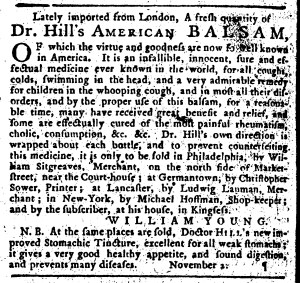
In the fall of 1774, William Young and his associates offered consumers exclusive access to “Dr. Hill’s AMERICAN BALSAM.” According to an advertisement in the November 9 edition of the Pennsylvania Journal, this patent medicine “is an infallible, innocent, sure and effectual” cure for “coughs, colds, [and] swimming in the head” as well as a “very admirable remedy for children in the whooping cough, and in most all their disorders.” Young implied that such recommendations may not have been necessary since the “virtue and goodness” of the medicine “are now so well known in America,” yet figured that trumpeting the efficacy of Dr. Hill’s American Balsam would aid in convincing consumers not yet familiar with this product.
As a means of guarding the reputation of this medicine and “to prevent counterfeiting,” a limited number of local agents stocked and sold this medicine. Young made it available in Kingsess (or Kingsessing), just outside of Philadelphia. William Sitgreaves, a merchant in Philadelphia, Christoper Sower, a printer in Germantown, and Ludwig Lauman, a merchant in Lancaster, each sold it as well. Young also distributed Dr. Hill’s American Balsam to Michael Hoffman, a shopkeeper in New York, to sell there. He had relied on that method for some time, having placed similar advertisement in May and October 1772. Unlike some popular patent medicines widely stocked by apothecaries, merchants, shopkeepers, printers, booksellers, and other retailers throughout the colonies, only a select few carried Dr. Hill’s American Balsam. The medicine came with “Dr. Hill’s own direction … wrapped about each bottle” to instruct patients how to use it to relieve or even cure “the most painful rheumatism, cholic, consumption,” and other maladies. Such packaging represented another layer of marketing for this product, continuing to promote it to customers after they purchased it and took it home.
Young apparently considered these various strategies effective given that he invested in them on several occasions. His marketing of Dr. Hill’s American Balsam incorporated the same elements in November 1774 that he deployed two and a half years earlier in May 1772. That does not demonstrate the impact those methods had on consumers yet does suggest that Young considered them successful enough to repeat when he advertised once again.
What was advertised in a colonial American newspaper 250 years ago today?
Pennsylvania Journal (November 3, 1773).
“Dr. Keyser’s Pills … warranted genuine.”
Townsend Speakman and Christopher Carter, “CHYMISTS and DRUGGISTS,” advertised widely in October and November 1773. They placed advertisements simultaneously in the Pennsylvania Chronicle, the Pennsylvania Gazette, the Pennsylvania Journal, and the Pennsylvania Packet. Each of those advertisements promoted raisins, figs, and currants as well as “an Assortment of the freshest DRUGS and PATENT MEDICINES.” They offered the “most saleable Articles in large Quantities” to shopkeepers and others who planned to retail them. Printers, for instance, often supplemented revenues from other sources by peddling patent medicines.
On November 1, the Pennsylvania Packet ran an abbreviated version of Speakman and Carter’s advertisement. In notices in the other three newspapers during that week, the apothecaries highlighted a “Parcel of Keyser’s famous Pills, from the Importer in London, with full Directions for their Use.” They pledged that “the Public may be assured these Pills are the genuine Sort,” and to demonstrate that was indeed the case “they have inserted the Copy of a Certificate received with [the pills], the Original of which may be seen by any Purchaser.” The copy of that certificate comprised the final third of the advertisement. In it, James Cowper, “Doctor of Physic,” declared himself “the only legal Proprietor of a Medicine, called KEYSER’S PILLS, in England.” Furthermore, he certified that Speakman and Carter, “Chymists and Druggists, in Philadelphia, are my only Correspondents to whom I send the above Pills in that Part of the World.” Consumers did not need to worry about purchasing counterfeit pills if they acquired them from Speakman and Carter.
According to another advertisement in the Pennsylvania Journal, however, customers in Philadelphia had another option for obtaining Keyser’s Pills without worrying about getting duped by unscrupulous sellers. That advertisement appeared immediately below Speakman and Carter’s advertisement, a rather cheeky placement considering that it listed William Bradford and Thomas Bradford, printers of the Pennsylvania Journal, as local agents who sold the pills. Speakman and Carter paid the Bradfords to run their advertisement, complete with the certificate, and they may have expected competition but not efforts to outright undermine their marketing strategy. The advertisement replicated James Rivington’s “Every One their own Physician” notice from Rivington’s New-York Gazetteer, along with a few additions. In addition to listing the Bradfords as local agents, a letter from Rivington to the Bradfords followed the testimonials.
Just as Speakman and Carter reprinted Cowper’s certificate in its entirety, the Bradfords published Rivington’s entire letter. He noted that he saw “an advertisement in the Philadelphia Papers, relating to Dr. Keyser’s Pills, importing that they were procured from Dr. Cowper, of London, and warranted genuine.” Rivington could do one better. “I think it very proper the Public should be assured,” he trumpeted, “that the Pills, which you have had from me, and now advertize for sale, were imported by me, immediately from Mr. Keyser himself, at Paris.” In addition, Rivington offered to show Keyser’s “letters and correspondence for some years past … to any person, who may require a sight of them.” Furthermore, Rivington was also vigilant about counterfeits, reporting that he “detected a counterfeit sort, exposed to sale in New-York, of which Mr. Keyser has sent me a written declaration.” Rivington concluded by inviting the Bradfords to insert his letter in their newspaper so “the Public may be once more informed you have the Pills sent directly from Mr. Keyser” to New York and then forwarded to Philadelphia.
It was not the first time that printers who sold Keyser’s Pills became embroiled in disputes over who stocked authentic medicines. In the summer of 1772, printers in South Carolina pursued a feud in their newspapers, sometimes alluding to notices placed by their competitors and sometimes responding to them directly. Among the many purveyors of Keyser’s Pills, a great many claimed that they carried genuine medicines and possessed some sort of exclusive right to market them in their town.
What was advertised in a colonial American newspaper 250 years ago today?
South-Carolina Gazette (July 30, 1772).
“WHO … can doubt of the amazing Effects of that powerful and invaluable Medicine?”
A feud between Charles Crouch, printer of the South-Carolina Gazette, and Powell, Hughes, and Company, printers of the South-Carolina Gazette and Country Journal, played out in the pages of their newspapers in the summer of 1772. This feud did not concern their work as printers, nor did it appear in editorials. Instead, they sniped at each other in advertisements hawking a popular patent medicine, “Dr. KEYSER’S famous PILLS.”
According to advertisements that frequently appeared in newspapers from New England to South Carolina, colonial printers often supplemented their revenues from newspaper subscriptions, advertising, job printing, books, and stationery by selling patent medicines. Doing so required no specialized knowledge of the cures. The printers merely needed to supply the directions that often accompanied the nostrums they peddled. In addition, many consumers were already familiar with the most popular patent medicines, the eighteenth-century equivalent of over-the-counter medications.
Powell, Hughes, and Company ran a lengthy advertisement for “Dr. Keyser’s GENUINE Pills” in the July 9 edition of the South-Carolina Gazette. They opened by stating that “numerous Trials have proved [the pills] to be the safest, best, mildest, and most agreeable Medicine ever discovered, for the Cure of the VENEREAL DISEASE, from the slightest Infection to the most inveterate State of that dreadful and almost unconquerable Disorder.” They provided a long history of the medicine and its efficacy, concluding with a guarantee “to return the Money, if a complete Cure is not performed, provided the Patient adheres to the Manner of taking [the pills], as is given in the printed Directions.”
In the next issue of the South-Carolina Gazette and Country Journal, distributed on July 14, Crouch positioned his own extensive advertisement for “A CONSIGNMENT” of patent medicines on the front page. The list of medicines began with “A FRESH PARCEL of Dr. KEYSER’s FAMOUS PILLS, With FULL DIRECTIONS for their Use in all CASES.” Rather than publish the history of that medicine in his advertisement, Crouch alerted readers that they could read “A NARRATIVE of the Effects of Dr. KESYER’s MEDICINE, with an Account of its ANALYSIS, by the Members of the Royal Academy of Sciences.” He further elaborated, “It were needless to trouble the public with more Encomiums on the Effects of this Remedy.”
That statement, as well as competition for customers, raised the ire of Powell, Hughes, and Company. Two days later, they updated their previous advertisement, inserting an introductory paragraph that directly addressed Crouch’s advertisement. The partners, “far from thinking ‘it NEEDLESS to trouble the Public with more Encomiums of the Effects of this Remedy,’ look upon it as their Duty to insert the following Particulars of Keyser’s invaluable Medicine, in order that the Afflicted in this Province, may, in some Respects be made acquainted with the Virtues of the most efficacious Medicine ever discovered, and know where to apply for Relief, without the Danger of having other Pills imposed on them instead the GENUINE.” Powell, Hughes, and Company implied that Crouch carried counterfeit pills before inserting their original advertisement in its entirety.
Crouch objected to that insinuation. In the July 21 edition of the South-Carolina Gazette and Country Journal, he added a short note to his previous advertisement. Crouch now stated that he carried “A FRESH PARCEL of Dr. KEYSER’s FAMOUS PILLS, (perhaps the only REAL ONES that can be had in the Province at present) With FULL DIRECTIONS for their Use in all CASES.” He turned the accusation back to Powell, Hughes, and Company, suggesting that it was they, not he, who attempted to dupe the public with counterfeit and ineffective medicines.
That prompted Powell, Hughes, and Company to double down on their insistence that Crouch peddled counterfeits. On July 23, they expanded the new introduction of their advertisement, reiterating the “NEEDLESS to trouble the Public” quotation and adding a note about “the Danger of having a spurious Sort imposed on them, notwithstanding any forcible ‘PERHAPS’ to the Contrary.” Furthermore, they “assured” prospective customers that the pills they carried “were received from Mr. Keyser, therefore there can be no ‘Perhaps’ entertained of THEIR not being the GENUINE, unless it is by such who are naturally Obstinate and Conceited, without one good Quality to entitle them to be either.”
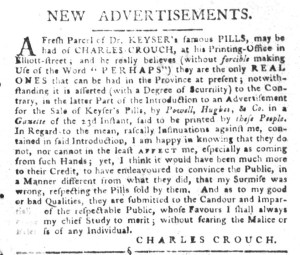
The back-and-forth continued in the next edition of the South-Carolina Gazette and Country Journal. Crouch and his competitors carefully monitored what each said about the other in their new advertisements. Crouch placed “NEW ADVERTISEMENTS” on the first page of the July 28 edition, leading with a new advertisement for “Dr. KEYSER’s famous PILLS” limited to a single paragraph that focused primarily on the controversy that had been brewing for the past few weeks. He once again stated that he sold the pills and declared that “he really believes (without forcible making Use of the Word “PERHAPS”) they are the only REAL ONES that can be had in the Province at present.” For the first time, he named his competitors, noting that “it is asserted (with a Degree of Scurrility) to the Contrary, in the latter Part of the Introduction to an Advertisement for the Sale of Keyser’s Pills, by Powell, Hughes, & Co. in a Gazette of the 23d Instant, said to be printed by these People.
Crouch devoted the remainder of his advertisement to upbraiding his competitors and defending his reputation. “In regard to the mean, rascally Insinuations against men, contained in said Introduction,” the printer stated, “I am happy in knowing that they do not, nor cannot in the least AFFECT me, especially as coming from such Hands.” He then suggested, “I think it would have been much more to their Credit, to have endeavoured to convince the Public, in a Manner different from what they did, that my Surmise was wrong, respecting the Pills sold by them.” He concluded with an assertion that “as to my good or bad Qualities, they are submitted to Candour and Impartiality of the respectable Public, whose Favours I shall always make my chief Study to merit; without fearing the Malice or Baseness of any Individual.”
South-Carolina Gazette and Country Journal (July 28, 1772).
Powell, Hughes, and Company did not interpret that as an overture to make peace or change their tone. On July 30, they began with the “New Advertisements” in the South-Carolina Gazette by reprinting Crouch’s advertisement “From the South-Carolina GAZETTE, AND Country Journal, of July 28, 1772. [No. 348.]” in its entirety. They made sure that readers could examine the original, though they also added “(t b c t f.)” to the final line, a notation that signaled to the compositor to continue inserting the advertisement until instructed to remove it. In so doing, they implied that Crouch intended to publicly shame them indefinitely. Yet they felt no remorse. Instead, they implied that Crouch suffered from the effects of venereal disease himself, especially cognitive deterioration, composing his latest advertisement only after taking a pill he acquired from Powell, Hughes, and Company. “WHO,” they asked, “after perusing the foregoing masterly Piece, produced by a SINGLE Dose of Dr. Keyser’s GENUINE Pills, sold by POWELL, HUSGHES, & Co. … can doubt of the amazing Effects of that powerful and invaluable Medicine?” They further intimated that Crouch suffered from venereal disease by asking, “After so copious a Discharge by ONE Dose, what may not be expected from a SECOND, or should THAT Patient take a WHOLE BOX?” Powell, Hughes, and Company snidely asserted that Crouch’s mental faculties were so far gone due to venereal disease that a single dose managed to give him only a few moments of clarity but he needed much more medicine to cease ranting and raving.
Powell, Hughes, and Company compounded the insult in a short paragraph that commented on Crouch’s grammar, further imputing that the effects of venereal disease made it difficult for him to string together coherent sentences. “In the mean Time,” they proclaimed, “the Reader is desired to correct TWO egregious Blunder, by inserting FORCIBLY for forcible, and THOSE PEOPLE instead of these People. The Word RASCALLY may stand, as ONE distinguishing Mark of the happy Talents and Abilities of the ingenious Author, as a —.” Pettiness descended into other insults unfit to print in the newspaper.
These exchanges demonstrate that Crouch and Powell, Hughes, and Company did not peruse each other’s publications solely in search of news items to reprint in their own. They also paid attention to advertisements, especially when their competitors marketed ancillary goods, like patent medicines, to supplement their revenues. These printers found themselves in competition to sell “Dr. KEYSER’S famous PILLS.” Rather than pursue their own marketing efforts, they chose to take umbrage at the strategies deployed by the other. Many purveyors of patent medicines stated in their advertisements that they did not need to offer additional information because the public was already so familiar with the product. Crouch may or may not have intended such an observation as a critique of Powell, Hughes, and Company’s advertisement. Whatever his intention, that was enough to garner a response that further escalated into a feud between rival printers hawking patent medicines.
What was advertised in a colonial American newspaper 250 years ago this week?
Pennsylvania Packet (May 14, 1772).
“Enquire only for Dr Hill’s American Balsam.”
Advertisements for patent medicines frequently appeared in early American newspapers. In the spring of 1772, William Young took to the pages of the Pennsylvania Journal to promote “Dr. HILL’s AMERICAN BALSAM, LATELY imported from London.” For those unfamiliar with this remedy, Young explained that “Experience has fully testified, that by the proper use of this excellent medicine, great numbers of people in America have been relieved in the consumption, gravel [or kidney stones] and rheumatic pains.” In addition, it helped with colds, coughs, and “swimmings in the head.”
Many consumers may have been more familiar with popular patent medicines commonly sold by apothecaries, merchants, shopkeepers, and even printers and booksellers. Newspaper advertisements suggest that colonizers could easily acquire Bateman’s Drops, Godfrey’s Cordial, Hooper’s Pills, Turlington’s Balsam, and a variety of other patent medicines in shops from New England to Georgia. Hill’s American Balsam, in contrast, was not as readily available. Instead, a small number of sellers in the colonies exclusively handled the distribution, including merchants in Baltimore, Philadelphia, and Wilmington, North Carolina; shopkeepers in New York and Lancaster, Pennsylvania; a printer in Germantown, Pennsylvania; and a goldsmith in Wilmington, Delaware. Young proclaimed that consumers would find this patent medicine “no where else.”
Such exclusivity had the potential to lead to confusion or even counterfeits. In a nota bene, Young warned that “People, in buying this so highly esteemed medicine, should be careful not to get a wrong one and be deceived.” To prevent that from happening, he gave instructions “to enquire only for Dr. Hill’s American Balsam.” Consumers could confirm that they obtained the correct product by looking for Hill’s “direction wraped about each bottle.” Printed materials played an important role in marketing this patent medicine, via the advertisements that appeared in the Pennsylvania Journal and via the ancillary materials that accompanied each bottle of Dr. Hill’s American Balsam.
What was advertised in a colonial American newspaper 250 years ago this week?
Massachusetts Spy (March 19, 1772).
“To prevent deception, the paper which contains the Hooks is marked ABRAHAM CORNISH.”
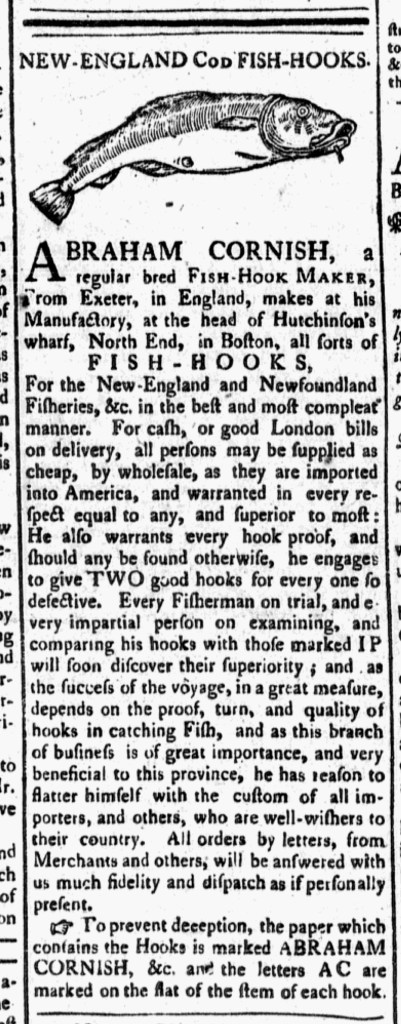
Abraham Cornish deployed a variety of marketing strategies for the “NEW ENGLAND COD FISH-HOOKS” that he made in the North End of Boston. In an advertisement that appeared in the March 19, 1772, edition of the Massachusetts Spy, he described himself as “a regular bred FISH-HOOK MAKER, From Exeter, in England,” who produced “all sorts of FISH-HOOKS … warranted in every respect equal to any, and superior to most,” whether imported or made in the colonies. Cornish was so certain of the quality of his hooks that offered a guarantee, stating that he “warrants every hook proof, and should any be found otherwise, he engages to give TWO good hooks for every one so defective.” That two-for-one replacement policy testified to his confidence in the quality of his product.
Cornish also challenged prospective customers to compare his hooks to those of a competitor who marked hooks with the initials “IP.” He asserted that “Every Fisherman” who did such a “trial” as well as “every impartial person” who performed a similar examination “would soon discover” the “superiority” of his hooks. The success of voyages to New England and Newfoundland fisheries depended in part on the “quality of hooks in catching Fish,” so “Every Fisherman” should outfit themselves with hooks that Cornish made “in the best and most compleat manner.”
Cornish also cautioned buyers to be cautious about counterfeits, especially if they acquired hooks from retailers rather than directly from him. “To prevent deception,” he instructed, “the paper which contains the Hooks is marked ABRAHAM CORNISH, &c. and the letters AC are marked on the flat of the stem of each hook.” Both the hooks and the packaging attributed the hooks to Cornish. Marking each hook with “AC” served as an enduring advertisement for his work, even after buyers separated the hooks from their package. Cornish used “&c.” (an abbreviation for et cetera) in describing the packaging. What else did it include? His newspaper advertisement featured a woodcut depicting a fish. Did the packaging also have a visual image to make it distinctive and memorable? Did the packaging include Cornish’s location? Did it include the guarantee that he promoted in the newspaper? Whatever might have appeared on the packaging, Cornish used it as an additional means of marketing his product.
What was advertised in a colonial American newspaper 250 years ago today?
Pennsylvania Packet (February 17, 1772).
“The only true and genuine sort … is sealed with my seal and coat of arms.”
Beware of counterfeiters! So warned Thomas Anderton in his advertisement for “TURLINGTON’s BALSAM OF LIFE; OR THE TRUE AMERICAN BALSAM.” Anderton proclaimed that this patent medicine was recognized among Europeans, Americans, and “West-Indians” for its “true merit, of universal experience, utility and reputation,” superior to “all the other known Balsams.” Continuing with the superlatives, Anderton trumpeted that Turlington’s Balsam of Life was “the best adapted in all cases, in every climate, to relieve the various ailments and diseases of the human body … that pharmacy, since the creation of the world, has produced.” Tending to the quality of the product he marketed, Anderton asserted that he “faithfully prepared” the balsam “from a true copy of the original receipt, taken out of the Chancery-office, in London, where it is recorded on oath, when the patent was granted.”
Anderton claimed an exclusive right to produce and sell this extraordinary medicine in the colonies, yet that did not prevent others from distributing counterfeits. He explained how consumers could distinguish the authentic balsam from imposters “which are to be met with every where.” Those produced by Anderton were “sealed with my seal and coat of arms, and the direction bill given with each bottle is signed with my name in my own hand writing.” Armed with that information, discerning customers could avoid being fooled by unscrupulous vendors who passed off inferior medicines as authentic Turlington’s Balsam of Life. Some “very modest counterfeiters,” like Martha Wray and Mary Sopp, provided “direction bills” with the medicines they sold, but, according to Anderton, they “conscientiously avoid forging the proprietors names.” Others, however, were more sophisticated in their efforts to hoodwink consumers. They engaged in “forgery in a gross degree,” aided by “Printers and Engravers that have been employed to counterfeit the direction and seals.” Anderton pledged to expose everyone involved, including “venders of such counterfeit rubbish,” at a later time, but for the moment warned consumers to be wary of products purported to be authentic Turlington’s Balsam of Life. In exercising caution, consumers could safeguard their own purchases to their own benefit as well as prevent further injustices to the producer of the “TRUE AMERICAN BALSAM.”
What was advertised in a colonial American newspaper 250 years ago today?
Massachusetts Gazette and Boston Post-Boy (December 23, 1771).
“Give him the Preference of buying his Ames’s Genuine Almanack before any PIRATED Edition.”
Ezekiel Russell claimed that he published “The Original Copy of Ames’s Almanack, For the Year 1772.” On December 9, 1771, he announced that he would print the almanac the following week, as well as disseminate new advertisements that included the “Particulars of the above curious Almanack with the Places where the Original are sold.” True to his word, he placed much more extensive advertisements in the Massachusetts Gazette and Boston Post-Boy on December 16 and 23. Those notices included an overview of the contents, such as “Eclipses” and “Courts in the Massachusetts-Bay, New-Hampshire, Connecticut, and Rhode-Island,” as well as a list of nearly twenty printers and booksellers who carried copies, many of them in Boston, but others in Salem, Newburyport, and Portsmouth.
Russell also took an opportunity to air a grievance with other printers in hopes of convincing consumers to purchase his edition of Ames’s Almanack. He asserted that he “purchased of Doctor AMES, at a great Expence, the true Original Copy of his Almanack.” That being the case, he hoped that “the Publick, with their usual Impartiality,” would buy “hisAmes’s Genuine Almanack before any PIRATED Edition.” Furthermore, he accused “some of his Elder Typographical Brethren,” other printers in Boston, of attempting to “prejudice the Interest of a YOUNGER BROTHER.” In other words, Russell declared that his competitors, men with much greater experience as printers, unfairly attempted to sabotage his endeavor and ruin his business. It was not the first time that residents of Boston witnessed disputes over which printers published the “Original” or the most accurate version of Ames’s Almanack. In a crowded marketplace, several printers aimed to profit from the popular title. Russell sought to convince consumers that the character of the printer mattered as much as the contents of the almanac. At the very least, he wanted those who purchased copies of Ames’s Almanack to make informed decisions about what kind of behavior they were willing to tolerate from printers who produced and sold the almanac.
What was advertised in a colonial American newspaper 250 years ago this week?
Supplement to the Pennsylvania Gazette (June 21, 1770).
“Large quantities of sickles, stamped S. PACHALL, in imitation … of my stamp.”
For several months in the spring and summer of 1770, Stephen Paschall ran an advertisement for scythes, sickles, knives, and similar items in the Pennsylvania Gazette. Paschall made all of his wares and sold them, appropriately enough, “at the sign of the Scythe and Sickle” on Market Street in Philadelphia. Paschall was confident in his skill, declaring that the products of his workshop “will prove as good as any made elsewhere.”
Others apparently shared this assessment, so much so that for several years counterfeit sickles attributed to Paschall circulated in Philadelphia. He devoted half of his advertisement to describing the fraud and instructing prospective customers how to recognize authentic Paschall sickles. He lamented that “some merchants of this city have … imported from Great Britain … and sold great quantities” of sickles “stamped S. PACHALL.” Paschall marked his own sickles with his name, “S. PASCHALL.” The difference could be easy to overlook: “the letter S, between the A and C, is left out in the stamp on the English sickle.” He deplored the unscrupulous purveyors of the counterfeit sickles for profiting off of his name and reputation when selling inferior goods, “many of which have been brought to me by farmers to alter.” To add insult to injury, Paschall often found himself in the position of repairing sickles after farmers purchased them because they had been duped by the counterfeit mark. He experienced some chagrin that those farmers confided that they “bought them for my make” only to discover “the workmanship is by no means equal to those formerly made by me.”
In addition to rehabilitating his own reputation, Paschall considered it important to bring this deception to public notice because he was in the process of “establishing my son in the same business (who is an apprentice to me).” He defended his work not only for his own benefit but to safeguard the prospects of the next generation following the family business.
Labels, stamps, and other means of marking goods played an important role in marketing some products in the eighteenth century, but they could also be abused, adapted, and deployed to confuse consumers. Paschall and others used newspaper advertisements to inform the public of this trickery, simultaneously protecting their own business interests and providing a service to unsuspecting consumers.
What was advertised in a colonial American newspaper 250 years ago today?
Pennsylvania Journal (March 22, 1770).
“My customers are therefore requested to be upon their guard against such deceptions.”
Counterfeit hams! In an advertisement that ran in the March 22, 1770, edition of the Pennsylvania Journal, Joseph Borden warned consumers against purchasing hams that unscrupulous retailers passed off as his product. That warning comprised half of his advertisement.
Borden opened his notice by advising prospective customers that he supplied the “best Salt-peter’d HAMS, flitch BACON, or JOWELS.” He did not give his location, only that he raised hogs outside of Philadelphia. Francis Hopkinson in Front Street accepted orders on his behalf and then communicated them to Borden. In turn, Borden delivered the hams, bacon, and jowls to customers “as soon as the distance will permit.”
Below his signature, Borden inserted a nota bene to advise consumers to beware of counterfeit hams. “I have not this year, not any preceeding year,” he asserted, “sent Hams to Philadelphia to be stor’d and retail’d. Whoever, therefore, offers any for sale as mine, would impose upon the public – my customers are therefore requested to be upon their guard against such deceptions.”
Borden’s notice suggests two possibilities. Others may have been trafficking in counterfeit hams, hoping to benefit from Borden’s reputation. If that was the case, Borden sought to protect both his reputation and his share of the market by insisting that consumers accept no substitutes. Alternately, neither Borden nor consumers had been victims of such trickery. Instead, Borden may have invented the tale of hams being sold as his, intending to enhance his reputation and incite demand by suggesting that his hams were so widely recognized for their quality that his business became a casualty of counterfeiters. Borden did not actually accuse any merchants and shopkeepers in Philadelphia of attaching his name to their hams, but he did present the scenario for consumers to contemplate.
Whether or not counterfeit hams were circulating in Philadelphia in the late 1760s and early 1770s, Borden apparently believed that consumers would consider such a scheme plausible. After all, manufacturers of patent medicines sometimes warned against imitations in their advertisements. Artisans occasionally did so as well. Borden followed their lead in declaring that pork was also a product subject to counterfeiting.