January 14

What was advertised in a revolutionary American newspaper 250 years ago this week?
New-Hampshire Gazette (January 9, 1776).

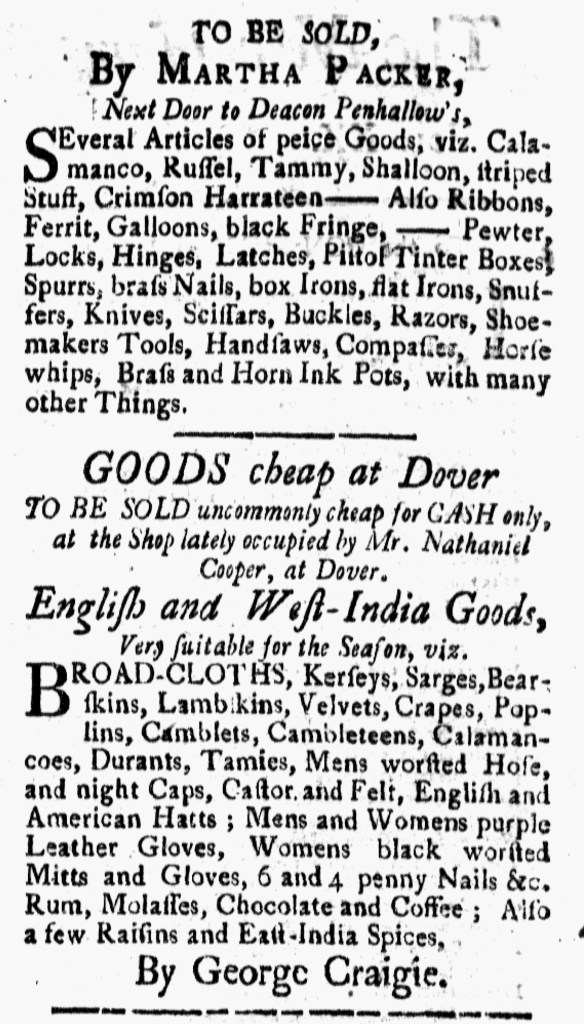
English and West-India Goods, Very suitable for the Season.”

In January 1776, Martha Packer ran a shop “Next Door to Deacon Penhallow’s” in Portsmouth.  According to her advertisement in the January 9 edition of the New-Hampshire Gazette, she stocked several kinds of textiles, ribbons, hardware, horse whips, ink pots, and “many other things.”  Immediately below her notice, George Craigie promoted “GOODS cheap at Dover TO BE SOLD uncommonly cheap.”  His inventory of “English and West-India Goods” included textiles, hats, gloves, rum, molasses, chocolate, and coffee.  Both advertisements looked much like those that ran in the New-Hampshire Gazette and other colonial newspapers before the Revolutionary War began.

Although those advertisements looked like business as usual, that was far from the case for the New-Hampshire Gazette.  Daniel Fowle, the printer, experienced disruptions in his supply of paper and, for a brief period in the fall of 1775, moved the press to Greenland when rumors circulated about a possible British attack on Portsmouth.  The issue that carried Packer’s and Craigie’s advertisements was the last one published for more than two years.  Edward Connery Lathem gives a brief overview in his Chronological Tables of American Newspapers, 1690-1820, noting that the New-Hampshire Gazette was suspended on January 9, 1776, and resumed on June 16, 1778.[1]  In his History and Bibliography of American Newspapers, 1690-1820, Clarence S. Brigham offers a more complete overview.[2]  He states that the January 9, 1776, issue featured “a communication strongly attacking independency.”  In turn, on January 17, “the New Hampshire House of Representatives ‘Voted that Daniel Fowle Esqr the Supposed Printer of said Paper be forthwith Sent for and ordered to Appear before this house and give an account of the Author of said Piece, and further to answer for his Printing said piece.’”  Brigham does not, however, indicate that displeasure with that editorial caused the suspension.  For his part, Isaiah Thomas, a Patriot printer and contemporary of Fowle, thought that the New-Hampshire Gazette “was not remarkable in its political features; but its general complexion was favorable to the cause of the country” when he discussed the newspaper in his History of Printing in America in 1810.[3]  Neither Thomas nor Brigham reported why Fowle suspended the New-Hampshire Gazette.  It may have simply been the difficulty of continuing the newspaper during the war.  Whatever the reason, the New-Hampshire Gazette, which has sometimes been disproportionately represented in this project, will disappear from the Adverts 250 Project for a while, but it will not be long before the project features advertisements from other newspapers established in New-Hampshire during the war.  For instance, Benjamin Dearborn commenced publishing the Freeman’s Journal, or New-Hampshire Gazette in Portsmouth on May 25, 1776.

**********

[1] Edward Connery Lathem, Chronological Tables of American Newspapers, 1690-1802 (American Antiquarian Society and Barre Publishers, 1972), 11.

[2] Clarence S. Brigham, History and Bibliography of American Newspapers, 1690-1820 (American Antiquarian Society, 1947), 471-473.

[3] Isaiah Thomas, The History of Printing in America: With a Biography of Printers and an Account of Newspapers (1810; Weathervane Books, 1970), 335.
October 17

Who was the subject of an advertisement in a revolutionary American newspaper 250 years ago today?

New-Hampshire Gazette (October 17, 1775).

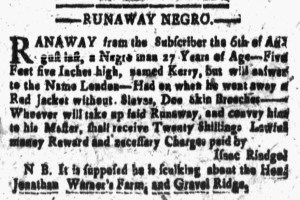
“RUNAWAY NEGRO … named Kerry, but will answer to the Name London.”

During the first year of the Revolutionary War, Daniel Fowle, the printer of the New-Hampshire Gazette, sometimes experienced disruptions to his paper supply that forced him to resort to broadsheets of alternate sizes.  His newspaper carried less content, both news and advertising, on such occasions.  That was the case on October 3, 1775, when he inserted an “Apology” that stated that “he could not procure any other” paper.  Compared to the usual three columns on each of four pages, that issue had only two columns on each of two pages.  Fowle did not include any advertisements.

The following week, Fowle managed to acquire broadsheets of the usual size, but apparently not enough of them for a four-page issue.  Instead, he published a half sheet edition that had three columns on each of two pages.  He found room for advertisements and even a poem, “On LIBERTY.”  On October 17, however, the New-Hampshire Gazette returned to the smaller sheet from two weeks earlier, but he had enough to publish four pages instead of two.  With twice as much space compared to the October 3 edition, he had room for five advertisements, including one by Mrs. Hooper, a milliner, and another for John Williams’s “House of Entertainment … at the Sign of the SALUTATION.”

Another advertisement featured a headline that proclaimed, “RUNAWAY NEGRO.”  Isaac Rindgel described a “Negro man 27 Years of Age … named Kerry, [who] will answer to the Name London.”  Kerry liberated himself by escaping from his enslaver on August 6.  For two and a half months he managed to elude capture, though Rindgel suspected that Kerry “is sculking about Hon. Jonathan Warner’s Farm, and Gravel Ridge.”  He did not indicate why he thought Kerry might be in that area.  Perhaps Kerry had a wife, a parent, a sibling, or a friend at Warner’s farm.  The advertisement, composed by an enslaver seeking to recover his human property, did not include the details about Kerry’s life and experiences that mattered most to the fugitive seeking freedom.  In addition to not explaining why Kerry may have been in the proximity of Warner’s farm, Rindgel did not speculate on why the enslaved man departed when he did.  Kerry was likely aware of the disruptions caused by the battles at Lexington and Concord in April, the ensuing siege of Boston, and the Battle of Bunker Hill in June.  The same events that affected Fowle’s access to paper created an opportunity for Kerry to liberate himself by running away.  It is impossible to know for certain that was the case since the newspaper advertisement reflected his enslaver’s perspective and included only the details Rindgel chose.  Kerry certainly would have told a different and more complete story had he been given the opportunity.

October 3

What was advertised in a revolutionary American newspaper 250 years ago today?

New-Hampshire Gazette (October 3, 1775).

“Brown Bread with Liberty, will please more, than white with Slavery.”

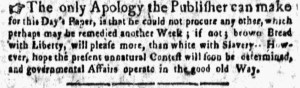
No advertisements appeared in the October 3, 1775, edition of the New-Hampshire Gazette, though the printer, Daniel Fowle, inserted a notice addressing why that was the case.  “The only Apology the Publisher can make for this Day’s Paper,” he stated, is that he could not procure any other.”  He referred to the size of the broadsheet.  The newspaper usually consisted of four pages with three columns on each page, but since hostilities commenced at Lexington and Concord Fowle’s paper supply had been disrupted.  Many issues consisted of only two pages, including the one from the previous week.  Despite having fewer pages, the masthead for the September 26 edition featured an additional note that proudly exclaimed, “This Paper compleats the 19th Year of the New-Hampshire GAZETTE, AND HISTORICAL CHRONICLE.”  The newspaper began its twentieth year with a two-page edition that had only two columns on each page.  Given the limited space, Fowle published news and excluded advertisements.

Fowle hoped that the problem “may be remedied another Week,” but “if not; brown Bread with Liberty, will please more, than white with Slavery.”  Like many other printers, he had been a consistent supporter of the American cause.  Even so, he added his “hope [that] the present unnatural Contest will soon be determine, and governmental Affairs operate in the good old Way.”  In the fall of 1775, most colonizers still sought a redress of grievances from Parliament.  Within a year, however, the Continental Congress would declare independence and the war that started at Lexington and Concord would not end until 1783.  Those “governmental Affairs” would never again “operate in the good old Way.”  Fowle did, however, manage to acquire paper for the next issue of the New-Hampshire Gazette.  The October 10 edition once again had advertisements, including one from Mrs. Hooper, a milliner, and another insertion of John Williams’s invitation to his “House of Entertainment … at the Sign of the SALUTATION.”  It was not the last time, however, that Fowle would experience a disruption in his paper supply during the war.

June 27

What was advertised in a revolutionary American newspaper 250 years ago today?

New-Hampshire Gazette (June 27, 1775).

Warrantee and Quitclaim Deeds, Justices Writs, Shipping Papers, Bail Bonds, &c Sold at the Printing Office.”

Daniel Fowle, the printer of the New-Hampshire Gazette, managed to keep publishing his newspaper after the battles of Lexington and Concord, though he warned readers that they could not depend on him doing so.  On April 28, 1775, just over a week after the battles, he asked for those who owed money to settle accounts.  “The Boston News Papers we hear are all stopt, and no more will be printed for the present,” Fowle noted, “and that must be done here unless the Customers attend to this call.”  Two weeks later, he stated, “The publisher of this Paper Designs, if possible, to continue it a while longer, provided the Customers who are in Arrear pay off Immediately, to enable him to purchase Paper.”  Fowle asserted that he had to price paper “at a great Distance and Charge.”  Disruptions in his paper supply and “the disorder’d State of the Continent” (as Fowle described the aftermath of the battles at Lexington and Concord) led him to reduce the size of many issues to two pages instead of the usual four.

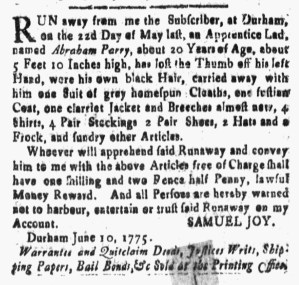
The June 27 edition was one of those, the third consecutive one.  Fowle squeezed in as much news as he could, including updates from the Continental Congress meeting in Philadelphia, the Massachusetts Provincial Congress in Watertown, and the New Hampshire Provincial Congress in Exeter.  He also published an account of the Battle of Bunker Hill that occurred ten days earlier.  The printer found one space for a couple of advertisements, including one that described Abraham Parry, an apprentice who ran away from Samuel Joy of Durham on May 22.  The young man took advantage of the “disorder’d State” to get away from his master, though Joy offered a reward to “Whoever will apprehend said Runaway and convey him to me.”  As the very last item on the second (and final) page, Fowle inserted an advertisement, just two lines, for printed blanks: “Warrantee and Quitclaim Deeds, Justices Writs, Shipping Papers, Bail Bonds, &c Sold at the Printing Office.”  Such notices often appeared in newspapers during the era of the American Revolution, perhaps more frequently in the New-Hampshire Gazette than most others, because printers sought to diversity their revenue streams.  Many of them printed and sold “blanks,” blank forms used for common legal and commercial transactions.  In this instance, Fowle did not have enough space to insert a line to separate his notice from the advertisement above it, though he did use italics to distinguish it from Joy’s notice.  More than ever, the printer needed whatever revenue he could get.  He made sure to remind readers that he stocked and sold blanks.

May 14

What was advertised in a revolutionary American newspaper 250 years ago this week?

New-Hampshire Gazette (May 12, 1775).

Those who send Advertisements, are also desired to send the Pay at the same Time.”

On April 28, 1775, a little over a week after the battles at Lexington and Concord, Daniel Fowle, the printer of the New-Hampshire Gazette placed a notice calling on subscribers and other customers “to discharge what they may be in Arrears” and to do so “immediately, otherwise he shall be obliged to discontinue [the newspaper] for some Time.”  He added that all the newspapers published in Boston “are all stopt, and no more will be printed for the present.”  Fowle warned, “that must be done here unless the Customers attend to this call.”  He could not continue publishing the New-Hampshire Gazette without receiving payments for it.

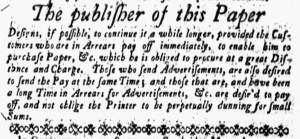
Just two weeks later, he inserted another notice, declaring that he “Designs, if possible, to continue [the newspaper] a while longer, provided the Customers who are in Arrears pay off immediately, to enable him to purchase Paper, &c. which he is obliged to procure at a great Distance and Charge.”  This time he singled out advertisers, a cohort of customers that he had not explicitly mentioned in his previous notice.  “Those who send Advertisements,” Fowle instructed, “are also desired to send the Pay at the same Time.”  Furthermore, “those that are, and have been a long Time in Arrears for Advertisements, &c. are desir’d to pay off, and not oblige the Printer to be perpetually dunning for small Sums.”

In that notice, Fowle revealed an important aspect of his business practices.  Most printers extended credit to subscribers.  Fowle certainly did so, prompting his notices in late April and early May 1775, as well as other notices that he frequently inserted in the New-Hampshire Gazette over the years.  Many historians of the early American press posit that printers allowed for generous credit for subscriptions, permitting subscribers to avoid paying for years, because they generated significant revenue from advertisements.  Doing so, depended on advertisers having confidence in the circulation of newspapers, explaining why printers allowed some subscribers to fall years behind on making payments.  Accordingly, printers supposedly required advertisers to pay for their notices when they submitted them for publication.

Fowle’s notice in the May 12, 1775, edition of the New-Hampshire Gazette suggests that he did not demand payment before publishing advertisements in his newspaper.  The Adverts 250 Project has collected other notices in which printers called on customers to pay for advertisements, though in many cases the use of the word “advertisements” was ambiguous.  It could have meant newspapers notices or it could have referred to printing handbills and broadsides (especially for printers who asserted that they could print “advertisements” with only an hour’s notice).  In this case, however, it seems clear that Fowle meant newspaper notices when he stated, “Those who send Advertisements, are also desired to send the Pay at the same Time.”  Fowle and other printers very well may have adopted practices different from the usual narrative about printers uniformly requiring advertisers to pay in advance.

April 28

What was advertised in a revolutionary American newspaper 250 years ago today?

New-Hampshire Gazette (April 28, 1775).

“The Boston News Papers we hear are all stopt.”

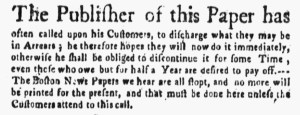
It was the sort of notice that printers throughout the colonies regularly inserted in their newspapers, though Daniel Fowle, the printer of the New-Hampshire Gazette in Portsmouth, may have done so with greater frequency than some of his counterparts in other towns.  “The Publisher of this Paper,” he declared on April 28, 1775, “has often called upon his Customers, to discharge what they may be in Arrears.”  This time, however, he did not threaten to stop sending copies to delinquent subscribers who did not pay their bills.  Instead, he suggested that the entire enterprise was at stake, that if he did not receive those payments “immediately” then “he shall be obliged to discontinue [the newspaper] for some Time.”  In other instances, printers addressed subscribers who had not paid in several years, but, again, this time was different.  Fowle proclaimed that “even those who owe but for half a Year are desired to pay off.”

To demonstrate the gravity of the situation, he reported that the “Boston News Papers we hear are all stopt, and no more will be printed for the present.”  Indeed, Fowle had heard correctly.  Five newspapers were published in Boston at the beginning of the month, but none continued uninterrupted by the end of April.  Isaiah Thomas removed the Massachusetts Spy to Worcester before the battles at Lexington and Concord on April 19.  Other printers suspended publication of their newspapers, believing that they would do so only “till Matters are in a more settled State.”  Yet it was the end for the Boston Evening-Post and the Massachusetts Gazette and Boston Post-Boy.  The Boston-Gazette and the Massachusetts Gazette and Boston Weekly News-Letter did eventually resume publication, though only the Boston-Gazette survived the Revolutionary War.

At that moment, neither Fowle nor his subscribers knew the fate of Boston’s newspapers or the New-Hampshire Gazette.  The printer asserted that he would cease publication “unless the Customers attend to this call.”  He did so on the same page that carried more extensive coverage of the events at Lexington and Concord than he had been able to publish in the previous issue because of the “different and contrary Accounts of the late Bloody Scene” received in the printing office in the hours immediately after something momentous happened.  When news about those engagements appeared in the April 28 edition, Fowle used thick black borders, usually associated with mourning, to draw attention.  He also inserted a note at the bottom of the first page: “See the other Side of the Paper an Account of the late Battle.”  In addition, instead of the usual four pages, that issue consisted of only two, an indication to readers that Fowle had limited resources.  If they wanted to continue receiving coverage in print to supplement what they heard by word of mouth, subscribers needed to “discharge what they may be in Arrears” and “do it immediately.”

April 21

What was advertised in a revolutionary American newspaper 250 years ago today?

New-Hampshire Gazette (April 21, 1775).

Warrantee and Quitclaim Deeds, Justices Writs … Sold at the Printing Office.”

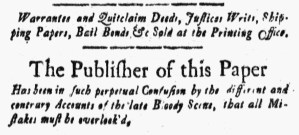
Daniel Fowle, the printer of the New-Hampshire Gazette, used one of his own advertisements to fill the space near the bottom of the last column on the final page of the April 21, 1775, edition.  He devoted two lines to announcing, “Warrantee and Quitclaim Deeds, Justices Writs, Shipping Papers, Bail Bonds &c Sold at the Printing Office.”  Many printers adopted a similar strategy, promoting goods they sold and services they provided when they had extra space in their newspapers.

Yet that advertisement was not the last word from the printer in that issue of the New-Hampshire Gazette.  Fowle followed it with a notice that stated, “The Publisher of this Paper Has been in such perpetual Confusion by the different and contrary Accounts of the late Bloody Scene, that all Mistakes must be overlook’d.”  He referred to the skirmishes at Lexington and Concord that occurred two days earlier on April 19.  As the masthead proclaimed, Fowle published the “Freshest ADVICES,” but that meant going to press with the information that he received even if some reports contradicted others.  Fowle anticipated that he would offer a clear account of events over time.  For the moment, however, he did his best with the “different and contrary” stories to keep readers informed of what he recognized as momentous events even if all the details were not yet clear.

New-Hampshire Gazette (April 21, 1775).

To that end, the first column on the first page not only began with a rare headline but one that demanded attention: “BLOODY NEWS.”  In an introductory note, the printer explained that “Early this Morning,” on April 20, “we were alarmed with an Express from Newbury-Port, with the following Letter, to the Chairman of the Committee of Correspondence in this Town.”  That letter relayed “Reports of the TROOPS having marched out of Boston to make some Attack in the Country.”  Those reports “in general concur, in part, in [British troops] having been at Lexington.—And it is very generally said they have been at Concord.”  The rider who brought that letter supplement it with his own version of what he had heard.  Fowle also published updated information from two other express riders who arrived in Portsmouth on April 20, one in the afternoon and the other in the evening.  He devoted an entire column to breaking news from Lexington and Concord.

Many of the readers that Fowle hoped would purchase the various printed blanks that he advertised had no doubt heard that something had happened at Lexington and Concord before they saw the April 21 edition of the New-Hampshire Gazette, yet they would have looked to it for confirmation and additional details.  Fowle gave them more details, but stopped short of confirming the accuracy of all of them.  In the coming weeks, he would sift through even more accounts as events continued to unfold, chronicling the Revolutionary War as it happened.

September 16

What was advertised in a colonial American newspaper 250 years ago today?

New-Hampshire Gazette (September 16, 1774).

“There are now the most interesting Matters depending that ever were in this Country.”

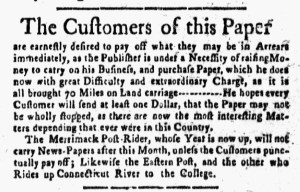
Colonial printers frequently ran advertisements asking customers, especially subscribers, to pay their overdue bills.  Daniel Fowle, the printer of the New-Hampshire Gazette, seemed to do so more often than others.  Such advertisements became a regular feature in his newspaper.  One appeared in the September 16, 1774, edition of the New-Hampshire Gazette.  This time, Fowle pleaded that the “Customers of this Paper” are earnestly desired to pay off what they may be in Arrears immediately, as the Publisher is under a Necessity of raising Money to carry on his Business.”  The fate of the newspaper, Fowle’s ability to continue publishing it, was at stake.  In part, that was because he apparently experienced a disruption in his supply of paper, acquiring it “with Difficulty and extraordinary Charge, as it is all brought 70 Miles on Land carriage.”  The printer did not go into greater detail on that point, though at various times in the past he had suggested that he used only paper produced in the colonies rather than paper imported from England.  The blockade of Boston, one of Parliament’s responses to the Boston Tea Party, may have affected Fowle’s route for receiving paper produced in another colony.

Even if subscribers could not settle accounts, Fowle requested that they “send at least one Dollar, that the Paper may not be wholly stopped, as there are the most interesting Matters depending that ever were in this Country.”  The printer recognized that the imperial crisis had intensified with the Boston Port Act and the rest of the Coercive Acts.  Earlier in the month, the First Continental Congress commenced its meeting in Philadelphia, deliberating about a unified response across the colonies.  Discussion and debates also took place in communities near and far.  That same issue of the New-Hampshire Gazette carried updates from Philadelphia, New London, Hartford, Newport, Boston, Salem, and other towns in Massachusetts.  Local news included coverage of a tea consignee in Portsmouth refusing to accept the shipment, diverting it to Halifax rather than cause a scene.  Yet that article also warned, “In future no such Indulgence will be allowed to the Enemies of America.”  Momentous events were underway.  Fowle did not know what would happen next, but he assured subscribers that they did not want to lose access to the news he supplied if they did not pay what they owed.

January 7

What was advertised in a colonial American newspaper 250 years ago today?

New-Hampshire Gazette (January 7, 1774).

“ALL Persons who send Advertisements for this Paper, are desired to let the pay accompany them, if they intend they shall be inserted.”

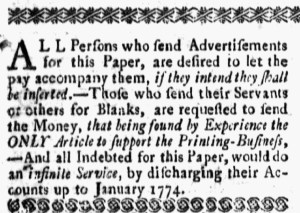
Daniel Fowle, the printer of the New-Hampshire Gazette, frequently inserted notices that tended to the business of operating a newspaper.  He had also done so when in partnership with his nephew, Robert Fowle, with most such notices most often calling on subscribers to settle accounts.  Fowle commenced 1774 with an advertisement that addressed several services available at his printing office in Portsmouth.  He exercised his prerogative as proprietor to give that notice a privileged place on the page; it appeared as the first item in the first column on the first page of the first issue of the New-Hampshire Gazette published in the new year.

Fowle presented a variety of instructions to current and prospective customers.  “ALL Persons who send Advertisements for this Paper,” he advised, “are desired to let the pay accompany them, if they intend they shall be inserted.”  In other words, Fowle did not extend credit for advertising.  Most colonial printers likely required advertisers to pay in advance, securing revenues from advertising to balance the credit they allowed for subscriptions, though occasionally some placed notices that called on advertisers to pay overdue bills.  Whatever the policies at the New-Hampshire Gazette had been in the past, Fowle made clear that no advertisements would make it into the pages of his newspaper before receiving payment.  He concluded his notice with a familiar appeal to subscribers to pay what they owed: “all Indebted for this Paper, would do an infinite Service, by discharging their Accounts up to January 1774.”

In addition, Fowle addressed another aspect of his business between his directions about advertisements and subscriptions.  “Those who send their Servants or others for Blanks,” he declared, “are requested to send the Money, that being found by Experience the ONLY  Article to support the Printing-Business.”  Fowle and other printers frequently advertised blanks or printed forms for common commercial and legal transactions.  In the January 7 issue, Fowle ran a short advertisement, “Blanks of most sorts, sold cheap At the Printing Office in Portsmouth,” on the final page.  He suggested that printing and selling blanks represented the only lucrative element of his business, provided that customers paid for them at the time of purchase.  He implied that he only broke even, at best, on advertisements, while the chronic tardiness of subscribers meant that he lost money on subscriptions.  In that case, printing the New-Hampshire Gazetteamounted to a public service rather than a profitable venture for Fowle.  He may have exaggerated whether he made money on anything other than blanks, but Fowle’s exasperation with advertisers and subscribers who did not pay their bills was unmistakable.

September 24

What was advertised in a colonial American newspaper 250 years ago today?

New-Hampshire Gazette (September 24, 1773).

“Send or bring the Receipts they have received, that a final Settlement may be made.”

Daniel Fowle, printer of the New-Hampshire Gazette, marked the seventeenth anniversary of the newspaper with a note running across the bottom margin of the first page of the September 23, 1774, edition.  A manicure directed readers to an announcement that “This Paper completes the seventeenth Year since its first Publication.”  In addition, Fowle inserted an advertisement calling on “Customers who are in Arrears for one Year or more” to pay their bills.  Colonial printers often inserted notices in their own newspapers for the purpose of encouraging their customers to pay, especially those who had not done so for several years.  Printers typically extended credit to subscribers, anticipating that increasing their circulation numbers would yield more advertisements and more advertising revenue.  (Some of the notices placed by printers, however, also called on advertisers to settle accounts, though not nearly as often as they singled out subscribers.  Apparently, not all printers required payment for advertisements in advance.)  Like merchants, shopkeepers, and other entrepreneurs who allowed credit for consumers, printers regularly resorted to advertisements requesting payment.  For many newspaper printers, this became part of an annual ritual upon completing another year of publication.

In addition to dealing with him directly, Fowle instructed customers who lived at a distance and “have sent by, or paid any Money to Post-Riders, or others,” to inform him that was the case and submit “the Receipts they have received” in order “that a final Settlement may be made, and the proper Persons charg’d.”  Fowle would consult his ledgers to confirm that post riders who carried the New-Hampshire Gazette to distant towns and received payment for both their services and the newspapers made the proper remittances to the printing office.  To that end, he expressed his desire that “there may be no Misunderstanding.”  That phrase, however, did not apply solely to reconciling accounts with post riders.  Regular readers likely would have recognized the implicit threat of legal action in that phrase.  Fowle was not as assertive as he and his nephew, Robert, had sometimes been when they ran similar advertisements during their partnership.  They explicitly threatened to sue and once even suggested that they would publish the names of subscribers who were delinquent in paying their bills.  Fowle did not resort to those measures this time, but he did make it clear that “Attendance will be given at the Printing-Office” with the expectation that customers would make overdue payments.