
What was advertised in a colonial American newspaper 250 years ago today?
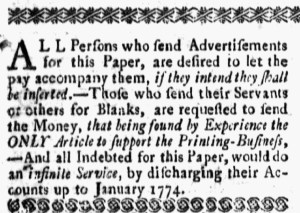
“ALL Persons who send Advertisements for this Paper, are desired to let the pay accompany them, if they intend they shall be inserted.”
Daniel Fowle, the printer of the New-Hampshire Gazette, frequently inserted notices that tended to the business of operating a newspaper. He had also done so when in partnership with his nephew, Robert Fowle, with most such notices most often calling on subscribers to settle accounts. Fowle commenced 1774 with an advertisement that addressed several services available at his printing office in Portsmouth. He exercised his prerogative as proprietor to give that notice a privileged place on the page; it appeared as the first item in the first column on the first page of the first issue of the New-Hampshire Gazette published in the new year.
Fowle presented a variety of instructions to current and prospective customers. “ALL Persons who send Advertisements for this Paper,” he advised, “are desired to let the pay accompany them, if they intend they shall be inserted.” In other words, Fowle did not extend credit for advertising. Most colonial printers likely required advertisers to pay in advance, securing revenues from advertising to balance the credit they allowed for subscriptions, though occasionally some placed notices that called on advertisers to pay overdue bills. Whatever the policies at the New-Hampshire Gazette had been in the past, Fowle made clear that no advertisements would make it into the pages of his newspaper before receiving payment. He concluded his notice with a familiar appeal to subscribers to pay what they owed: “all Indebted for this Paper, would do an infinite Service, by discharging their Accounts up to January 1774.”
In addition, Fowle addressed another aspect of his business between his directions about advertisements and subscriptions. “Those who send their Servants or others for Blanks,” he declared, “are requested to send the Money, that being found by Experience the ONLY Article to support the Printing-Business.” Fowle and other printers frequently advertised blanks or printed forms for common commercial and legal transactions. In the January 7 issue, Fowle ran a short advertisement, “Blanks of most sorts, sold cheap At the Printing Office in Portsmouth,” on the final page. He suggested that printing and selling blanks represented the only lucrative element of his business, provided that customers paid for them at the time of purchase. He implied that he only broke even, at best, on advertisements, while the chronic tardiness of subscribers meant that he lost money on subscriptions. In that case, printing the New-Hampshire Gazetteamounted to a public service rather than a profitable venture for Fowle. He may have exaggerated whether he made money on anything other than blanks, but Fowle’s exasperation with advertisers and subscribers who did not pay their bills was unmistakable.
[…] like this one from Towne likely contributed to that narrative. Other printers sometimes ran similar notices … yet some also ran notices calling on advertisers to make payment, suggesting that they did not […]