October 20

What was advertised in a revolutionary American newspaper 250 years ago today?
Essex Journal (October 20, 1775).

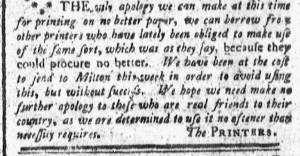
We hope we need make no further apology to those who are real friends to their country.”

John Mycall and Henry-Walter Tinges, the printers of the Essex Journal, found themselves in a situation similar to the one that Daniel Fowle, the printer of the New-Hampshire Gazette, experienced in the fall of 1775.  A disruption in Fowle’s supply of paper in Portsmouth had forced him to print his newspaper on smaller sheets on a few occasions, including the October 17 edition.  Three days later, Mycall and Tinges did the same in Newburyport.  Instead of four pages of three columns each, that issue had four pages of two columns each.  The masthead featured plain type for the title rather than presenting “Essex Journal” in the usual scrolling script.  The woodcuts that usually flanked the title, an Indigenous man with a bow and arrow on the left and a packet ship at sea on the right, did not appear at all.

Immediately above the advertisements, the printers inserted their own notice to explain what happened.  “THE only apology we can make at this time for printing on no better paper,” Mycall and Tinges stated, “we can borrow from other printers who have lately been obliged to make use of the same sort, which was as they say, because they could procure no better.”  They closely paraphrased portions of Fowle’s notice to his readers a couple of weeks earlier: “The only Apology the Publisher can make for this Day’s Paper, is that he could not procure any other.”  Mycall and Tinges printed their newspaper on different paper only as a last resort.  “We have been at the cost to send [an order for more paper] to Milton this week in order to avoid using this,” they informed readers, “but without success.”  With the disruptions and displacements that occurred in the six months since the battles at Lexington and Concord, securing paper became difficult.  The printers tried to get more from the paper mill on the Neponset River in Milton, but to no avail.  They expected their readers to understand, especially those who held the right sort of political principles.  “We hope we need make no further apology to those who are real friends to their country,” Mycall and Tinges proclaimed, “as we are determined to us [the substitute paper] no oftener than necessity requires.”  They hoped that readers would see the smaller newspaper as a minor inconvenience given the stakes of the contest between the colonies and Great Britain.  They did their best with the resources available to continue to disseminate news and advertising to their subscribers and other readers.
October 3

What was advertised in a revolutionary American newspaper 250 years ago today?

New-Hampshire Gazette (October 3, 1775).

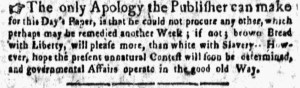
“Brown Bread with Liberty, will please more, than white with Slavery.”

No advertisements appeared in the October 3, 1775, edition of the New-Hampshire Gazette, though the printer, Daniel Fowle, inserted a notice addressing why that was the case.  “The only Apology the Publisher can make for this Day’s Paper,” he stated, is that he could not procure any other.”  He referred to the size of the broadsheet.  The newspaper usually consisted of four pages with three columns on each page, but since hostilities commenced at Lexington and Concord Fowle’s paper supply had been disrupted.  Many issues consisted of only two pages, including the one from the previous week.  Despite having fewer pages, the masthead for the September 26 edition featured an additional note that proudly exclaimed, “This Paper compleats the 19th Year of the New-Hampshire GAZETTE, AND HISTORICAL CHRONICLE.”  The newspaper began its twentieth year with a two-page edition that had only two columns on each page.  Given the limited space, Fowle published news and excluded advertisements.

Fowle hoped that the problem “may be remedied another Week,” but “if not; brown Bread with Liberty, will please more, than white with Slavery.”  Like many other printers, he had been a consistent supporter of the American cause.  Even so, he added his “hope [that] the present unnatural Contest will soon be determine, and governmental Affairs operate in the good old Way.”  In the fall of 1775, most colonizers still sought a redress of grievances from Parliament.  Within a year, however, the Continental Congress would declare independence and the war that started at Lexington and Concord would not end until 1783.  Those “governmental Affairs” would never again “operate in the good old Way.”  Fowle did, however, manage to acquire paper for the next issue of the New-Hampshire Gazette.  The October 10 edition once again had advertisements, including one from Mrs. Hooper, a milliner, and another insertion of John Williams’s invitation to his “House of Entertainment … at the Sign of the SALUTATION.”  It was not the last time, however, that Fowle would experience a disruption in his paper supply during the war.

January 22

What was advertised in a colonial American newspaper 250 years ago this week?

Massachusetts Spy (January 19, 1775).

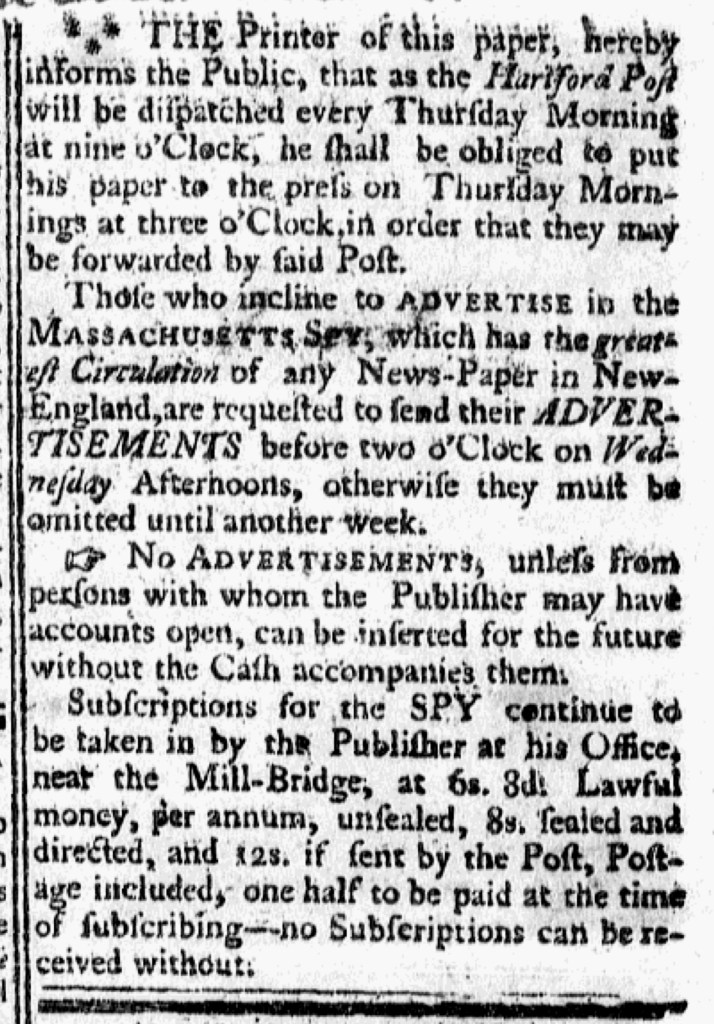
“No ADVERTISEMENTS … can be inserted for the future without the Cash accompanies them.”

In a notice in the January 19, 1775, edition of the Massachusetts Spy, Isaiah Thomas, the printer, provided several important details about the practices he enacted for publishing his newspaper.  He opened by noting that “the Hartford Post will be dispatched every Thursday Morning at nine o’Clock.”  In order that that the Massachusetts Spy “may be forwarded by said Post,” Thomas “shall be obliged to put his paper to the press on Thursday Mornings at three o’Clock.”  Calling attention to such early mornings not only testified to the industriousness of the printer but also alerted the public that he could publish updates that arrived at his printing office merely hours before he distributed the new issue of his weekly newspaper.

Thomas also advised “[t]hose who incline to ADVERTISE in the MASSACHUSETTS SPY … to send their ADVERTISEMENTS before two o”Clock on Wednesday Afternoons, otherwise they must be omitted until another week.”  To convince them to advertise in in his newspaper, he proclaimed that it “has the greatest Circulation of any News-Paper in New-England.”  That meant that advertisers were likely to experience the greatest return on their investment by placing notices in the pages of the Massachusetts Spy.  Although compositors worked quickly, they did need some time to set type for individual advertisements and lay out all the news, editorials, advertisements, and other content for each issue.  While Thomas might welcome “Articles of Intelligence” that arrived very shortly before taking his newspaper to press, he insisted that advertisements required more time to prepare for publication.  Advertisers needed to plan accordingly.

In addition, Thomas declared, “No ADVERTISEMENTS, unless from persons with whom the Publisher may have accounts open, can be inserted for the future without the Cash accompanies them.”  He also asserted that subscriptions for the newspaper required “one half [of the annual fee] to be paid time of subscribing” and “no Subscriptions can be received without.”  Historians of the early American press often make general statements about printers extending generous credit to subscribers, expecting that some would never pay, because they understood that newspaper advertisements were a much more most significant revenue.  According to such accounts, printers supposedly insisted on receiving payment for advertisements in advance of publishing them.  While that may have been the case in some printing offices, several printers published notices indicating that they departed from such practices.  That Thomas put in place such a policy “for the future” suggests that it may have been a new policy or one that he had not previously enforced.  Similarly, Thomas joined other printers who extended credit yet also demanded that subscribers submit half of the annual fee in advance, updating the terms that he published in the colophon that appeared in each issue of the Massachusetts Spy.

July 17

What was advertised in a colonial American newspaper 250 years ago this week?

New-York Journal (July 14, 1774).

“The great and daily Increase in the Number of Customers to this Paper.”

John Holt’s address to readers of the New-York Journal in the July 14, 1774, edition did not include an element that many likely expected to encounter.  It did not request that subscribers and others who owed money for goods and services provided by Holt’s printing office send payment or else face legal action.  Colonial printers frequently ran such notices, what Isaiah Thomas, printer of the Massachusetts Spy, termed a “‘dunning’ advertisement” a month earlier.  Instead, Holt expressed appreciation to his customers and expounded on the satisfaction he derived from serving the public by disseminating the news.

He also took the opportunity to promote the New-York Journal to readers who were not yet subscribers, commencing his notice by noting a “great and daily Increase in the Number of Customers to this Paper.”  Drawing attention to an increase in circulation also signaled to prospective advertisers that placing notices in the New-York Journal would be a good investment, especially since Holt’s newspaper competed with the New-York Gazette and Weekly Mercury and Rivington’s New -York Gazetteer.  Yet he framed the recent increase in subscribers as approval of “the Sentiments and Measures he has from Inclination and a Sense of Duty endeavoured to inculcate and promote for the public Good.”  For instance, the front page of that edition featured two items reprinted from the South-Carolina Gazette that Holt “republished both on account of the excellent sentiments they express, which are equally applicable to all the British Colonies, and to show that our brethren in South Carolina concur with the other Colonies in resenting and opposing the tyrannical acts of the British Parliament.”  The first of those editorials encouraged colonizers to “UNITE,” echoing the sentiments expressed in the “UNITE OR DIE” image that recently replaced the British coat of arms in the masthead.

Holt allowed that more customers meant “private Advantage to himself,” alluding to more revenue in his printing office, but emphasized that his editorial decisions “have been generally acceptable to all Ranks of People.”  He considered this a “double Pleasure,” while leaving no doubt that he regarded serving the public more important than earning his livelihood.  The printer asserted that “he shall ever receive more Pleasure from those Advantages he may receive in common with the Society of which he is a Member than in those peculiar to himself.”  Positioned first among the advertisements in that issue of the New-York Journal, Holt’s notice did not explicitly make demands of readers, neither to settle accounts nor to become subscribers.  Instead, the printer cultivated support for his newspapers in a more subtle manner, explaining that “the public Good” motivated his editorial perspective and gently suggesting to readers that they become patrons of a newspaper that was already increasing in circulation because “all Ranks of People” appreciated his approach to delivering news and editorials.

May 5

What was advertised in a colonial American newspaper 250 years ago today?

Massachusetts Gazette and Boston Weekly News-Letter (May 5, 1774).

“A very low State of Health, prevents his making Collection of Intelligence and Speculation.”

Printers often inserted notices about their own businesses immediately after any local news items they published, increasing the chances that readers would take note even if they did not closely examine the advertisements that followed.  Such was the case for a notice that Richard Draper placed in the May 5, 1774, edition of the Massachusetts Gazette and Boston Weekly News-Letter.  Right below news from Boston and Worcester, he declared, “The Publisher and Printer of this Paper being in a very low State of Health, prevents his making such Collection of Intelligence and Speculation, as his Customers must have expected to be given them.”  He especially lamented that he had been hampered in gathering news “since the arrival of the last Vessels,” acknowledging that ships arriving from London brought updates about Parliament’s reaction to the destruction of tea in Boston Harbor the previous December.  Colonial printers had to hustle to acquire the latest news and rumors from the other side of the Atlantic, learning what they could from captains and convincing merchants to share excerpts from the letters they received.

Even though a two-page supplement featuring “INTERESTING INTELLIGENCE” from London accompanied the May 5 edition, Draper did not consider himself up to the task of collecting and collating all the news flowing into the busy port.  That being the case, he addressed his subscribers, “beg[ging] their Indulgence till he recovers Strength, or till the Paper falls into other Hands.”  Planning for the latter, at least for the near future, he advised that a “Printer that understands collecting News, and carrying on a News Paper … may be concerned on very advantageous Terms” upon applying to Draper at his printing office.  His appeal met with success.  In the next issue he announced that he entered a “Co-Partnership with Mr. JOHN BOYLE, who was regularly brought up and has since carried on the Printing Business in this Town.”  Together, the partners would “Endeavor to support the Reputation the said Paper has had for many Years past.”  Draper alluded to the long publication history of the newspaper, established seventy years earlier.  In his History of Printing in America (1810), Isaiah Thomas described the Boston News-Letter (later the Massachusetts Gazette and Boston Weekly News-Letter) as “the first newspaper published in this country,” dismissing the single issue of Publick Occurences published in 1690.[1]  Thomas reported that Draper’s “ill health render[ed] him unable to attend closely to business” so Boyle “undertook the chief care and management of the newspaper.”[2]  A month later, Draper died.  Hs widow, Margaret, continued in partnership with Boyle for about a year, but they went their separate ways after the Revolutionary War began.  She then took John Howe as a partner, continuing to publish the newspaper “until the British troops left Boston in 1776.”  Thomas notes that it was the only newspaper “printed in Boston during the siege.”[3]  Despite Draper’s poor health and other turmoil, his newspaper lasted longer than any of the others published in Boston at the time he requested the “Indulgence” of his subscribers.

**********

[1] Isaiah Thomas, The History of Printing in America: With a Biography of Printers and an Account of Newspapers (1810; New York: Weathervane Book, 1970), 231.

[2] Thomas, History of Printing, 145.

[3] Thomas, History of Printing, 231.

March 31

What was advertised in a colonial American newspaper 250 years ago today?

Mar 31 - 3:31:1770 Providence Gazette
Providence Gazette (March 31, 1770).

We have neither Time nor Room for any Extracts.”

Several advertisements ran at the bottom of the final column on the third page of the March 31, 1770, edition of the Providence Gazette, concluding with a notice from the printer:  “A New-York Paper, which came to Hand before the Publication of this Day’s Gazette, contains addresses of both Houses of Parliament to the King, and some London Articles to the 13th of January; but we have neither Time nor Room for any Extracts.”  This notice reveals quite a bit about the production and dissemination of the news in eighteenth-century America.

First, it alludes to the widespread practice of reprinting articles, letters, and editorials from one newspaper to another.  John Carter, the printer of the Providence Gazette, indicated that he planned to publish “Extracts” from the other newspaper, but often printers copied important or interesting items in their entirety.  Sometimes they credited their sources; other times they did not.  Either way, printers often tended to edit or compile news from other publications instead of producing new content.

Carter’s notice also testifies to the production of newspapers as material objects, not just amalgamations of ideas.  Each weekly edition of the Providence Gazette took the form of a four-page issue, the standard for colonial newspapers prior to the American Revolution.  Each copy consisted of a single broadsheet with two pages printed on each side and then folded in half to produce a four-page newspaper.  This usually meant that the first and last pages were printed first and then the second and third pages later.  The position of Carter’s notice as the last item in the last column on the third page suggests that it was the final item added by the compositor before taking the issue to press.  Carter asserted that he did not have “Room for any Extracts,” indicating that the front page had been printed and the type already set for the remaining pages.  In stating that he also did not have time to insert extracts, the printer explained why he could not make substitutions for some of the material on the second and third pages as well as why he did not produce a supplement to accompany the issue.

Finally, Carter’s notice served as an advertisement for the newspaper itself.  The printer previewed the contents for the following week, enticing readers to return to read extracts or possibly even the entire “addresses of both Houses of Parliament to the King” as well as articles drawn from the London press by way of a “New-York Paper.”  In general, Carter’s notice evokes images of a busy printing office at the Sign of Shakespeare’s Head in Providence.

November 12

What was advertised in a colonial American newspaper 250 years ago this week?

Nov 12 - 11:9:1769 South-Carolina Gazette
South-Carolina Gazette (November 9, 1769).

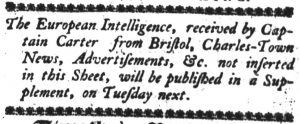
Advertisements, &c. not inserted in this Sheet, will be published in a Supplement.”

Peter Timothy, printer of the South-Carolina Gazette, inserted a brief note in the November 9, 1769, edition to inform readers that “The European Intelligence, received by Captain Carter from Bristol, Charles-Town News, Advertisements, &c. not inserted in this Sheet, will be published in a Supplement, on Tuesday next.” In so doing, he simultaneously provided a preview for subscribers and assurances to advertisers that their paid notices would indeed appear in print shortly. The South-Carolina Gazette, like most other colonial newspapers, was a weekly, but Timothy pledged to distribute a supplement five days later rather than asking subscribers and advertisers to wait an entire week for the content he did not have space to squeeze into the November 9 issue.

Whether Timothy did print a supplement on November 14 remains unclear. Accessible Archives includes issues for November 9 and 16, consecutively numbered 1782 and 1783, but not a supplement issued any time during the week between them. The November 16 issue does not, however, include news from Europe received from Captain Carter that had been delayed by a week, suggesting that it could have appeared in a supplement no longer extant. Advertising filled nearly three of the four pages of the November 16 edition. The headline “New Advertisements” appeared on two pages. While this might suggest that Timothy did not print “European Intelligence, received by Captain Carter, from Bristol” and simply delayed publishing the advertisements, the several newspapers printed in Charleston in 1769 regularly overflowed with advertising. Timothy very well could have printed overdue advertisements in a supplement and still had plenty more advertisements for the standard weekly edition.

While it is quite possible that the promised supplement never materialized, Timothy’s reputation was on the line. He promised certain content to his subscribers who had other options for receiving their news from papers printed in Charleston, including the South-Carolina and American General Gazette and the South-Carolina Gazette and Country Journal. Whether or not Timothy issued a supplement on November 14, Robert Wells did publish the South-Carolina and American General Gazette that day, complete with two extra pages devoted exclusively to advertising. The most important European news received from Captain Carter would have spread by word of mouth by the time it appeared in any supplement distributed by Timothy, but the printer needed to be wary of disappointing advertisers, not just subscribers. After all, those advertisers also had other options. Advertisements accounted for significant revenue for colonial printers. Timothy’s notice that “Advertisements … not inserted in this Sheet, will be published in a Supplement” very well could have resonated with advertisers more than subscribers. After all, they paid for that service and each expected a return on their investment, a return that could not manifest as long as the printer delayed publication of their advertisements. Although listed third in his notice, advertisements may have been the most important content that Timothy sought to assure readers would soon appear.