October 27

What was advertised in a colonial American newspaper 250 years ago today?
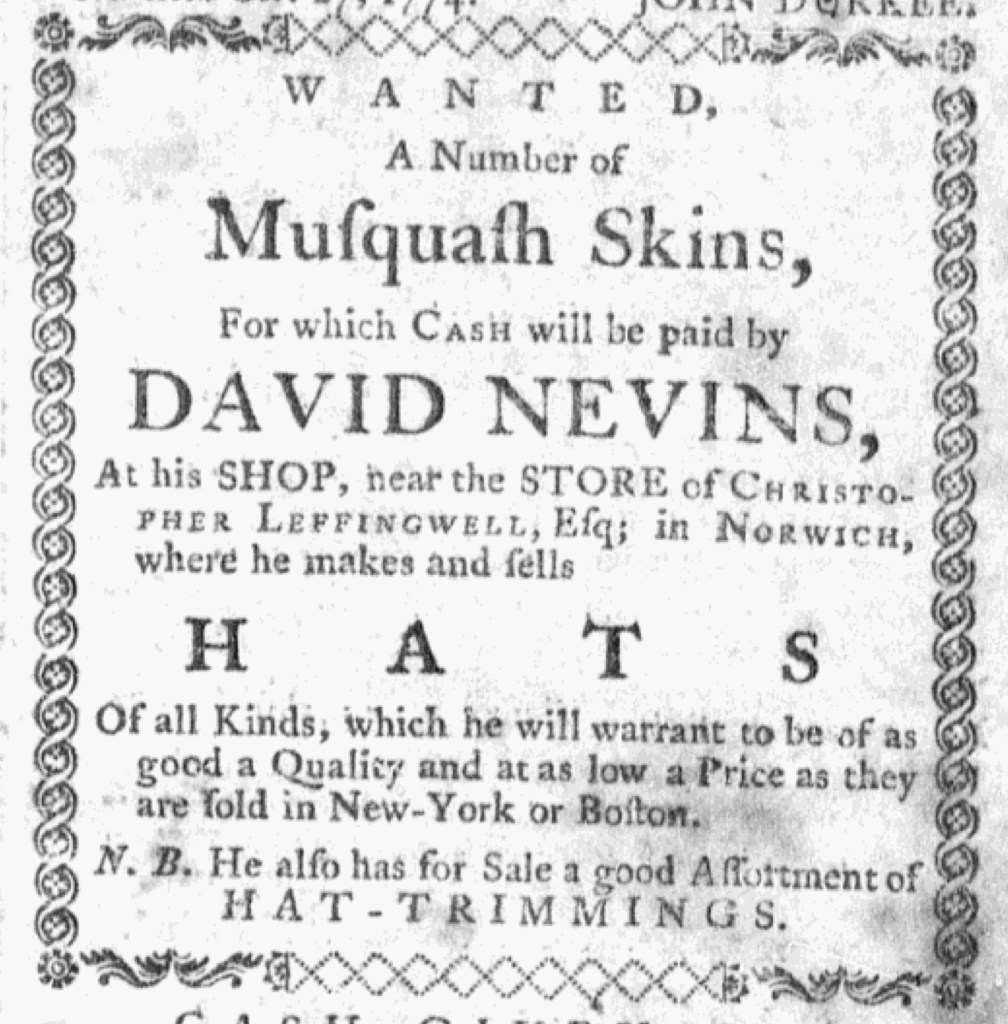
Norwich Packet (October 27, 1774).

“HATS … of as good a Quality and at as low a Price as they are sold in New-York and Boston.”

The use of decorative type as a border certainly distinguished David Nevins’s advertisement from other content in the October 27, 1774, edition of the Norwich Packet.  It appeared in the final column on the third page along with several other advertisements.  News items filled the facing page as well as the first two columns of that page, each of them in relatively small type compared to some of the fonts in the advertisements.  The compositor used printing ornaments to separate those news items, but nothing as extensive as the border that surrounded Nevins’s advertisement.

Some of the advertisements featured larger fonts to draw attention to consumer goods and services and their purveyors and providers, including “THOMAS COIT” and “Drugs and Medicines” in one, “FLAX SEED, SMALL FURRS, BEES-WAX” in another, and “PUBLIC VENDUE” in a third.  The same was true in Nevins’s advertisement, with his name, “Musquash Skins,” and “HATS” each centered and in larger fonts.  Yet Nevins did not deploy those fonts alone in his effort to draw the attention of readers.  He must have submitted a request for the decorative border along with the copy for his advertisement when he contacted the printing office.

Even with that visual advantage, Nevins also devised copy intended to sell the hats that he produced at his shop.  In addition to hats made of musquash or muskrat pelts, he promoted others “Of all Kinds” that customers could depend on being “of as good a Quality and at as low a Price as they are sold in New-York and Boston.”  Norwich was a small town compared to those major urban ports, yet that did not mean that consumers had to settle for second best or inflated prices. Nevins consistently mad that point in his advertisements.  In February, he “warranted” his hats “to be of the best Quality, and as cheap and fashionable as can be purchased in Boston and New-York” in an advertisement in the Connecticut Gazette.

Other advertisers who placed notices in the Norwich Packet may or may not have made requests about the design elements.  In writing the copy, they may have assumed that the compositor would select certain words to capitalize, center, and print in larger font without providing instructions to do so.  After all, that was a common feature of advertisements in that newspaper.  Nevins, on the other hand, almost certainly stated that he wished to enhance his advertisement with a decorative border to aid in highlighting the appeals he made in his copy.

February 18

What was advertised in a colonial American newspaper 250 years ago today?

Connecticut Gazette (February 18, 1774).

“HATS … both Bever and Castor.”

Ellie Chaclas, a student in my Revolutionary America class, and I worked together in selecting today’s advertisement.  Ellie has an interest in the history of fashion, completing her capstone research project on the politics of fashion during the era of the American Revolution.  She was drawn to this advertisement for “HATS, Manufactured by … DAVID NEVINS” that ran on the front page of the February 18, 1774, edition of the Connecticut Gazette.  Ellie noted that Nevins marketed the hats that he made as “warranted to be of the best Quality” as well as “as cheap and as fashionable as can be purchased in Boston and New-York.”  Nevins “Manufactured” hats in Norwich and marketed them to readers of a newspaper published in New London, reaching prospective customers in towns throughout Connecticut.  Colonizers did not have to live in urban ports like Boston and New York to participate in the consumer revolution of the eighteenth century.

Ellie also noted that Nevins made “Bever” or beaver hats but did not immediately recognize what he meant by “Castor.”  That gave us an opportunity to consult a resource that we frequently used in our class, the Oxford English Dictionary.  That yielded this definition: “a hat, originally either of beaver’s fur, or intended to be taken as such; in the end of the 17th and beginning of 18th cent. distinguished from ‘beaver’, and said to be of rabbit’s fur.”  We also discovered that “Bever” did not refer only to the material for “Manufactur[ing]” hats but in the eighteenth century was the name commonly used for a style of hat: “a hat made of beaver’s fur, or some imitation of it; formerly worn by both sexes, but chiefly by men.”  This underscored our conversations in class about eighteenth-century consumers speaking a language that they shared across the colonies yet much of their vocabulary no longer resonates with modern consumers.  To understand their experiences, we had to learn how to “translate” eighteenth-century English.

In addition, Ellie noted that even though the advertisement mentioned Boston and New York, Nevins likely had connections, even if indirect ones, with Detroit and the Great Lakes region and the trade in beaver fur.  As a class, we read and discussed Tiya Miles’s Dawn of Detroit: A Chronicle of Slavery and Freedom in the City of the Straits, shifting our examination of the era of the Revolution from the thirteen colonies on the Atlantic coast to the interior of the continent.  Miles’s book helped Ellie and her classmates (and their professor!) achieve a more complete understanding of the scope of Indigenous and African slavery in the Great Lakes region.  While not visible in Nevins’s advertisement, enslaved people likely played a part of in processing and transporting the fur he used in making his hats.