July 22

What was advertised in a revolutionary American newspaper 250 years ago today?
Essex Journal (July 22, 1775).

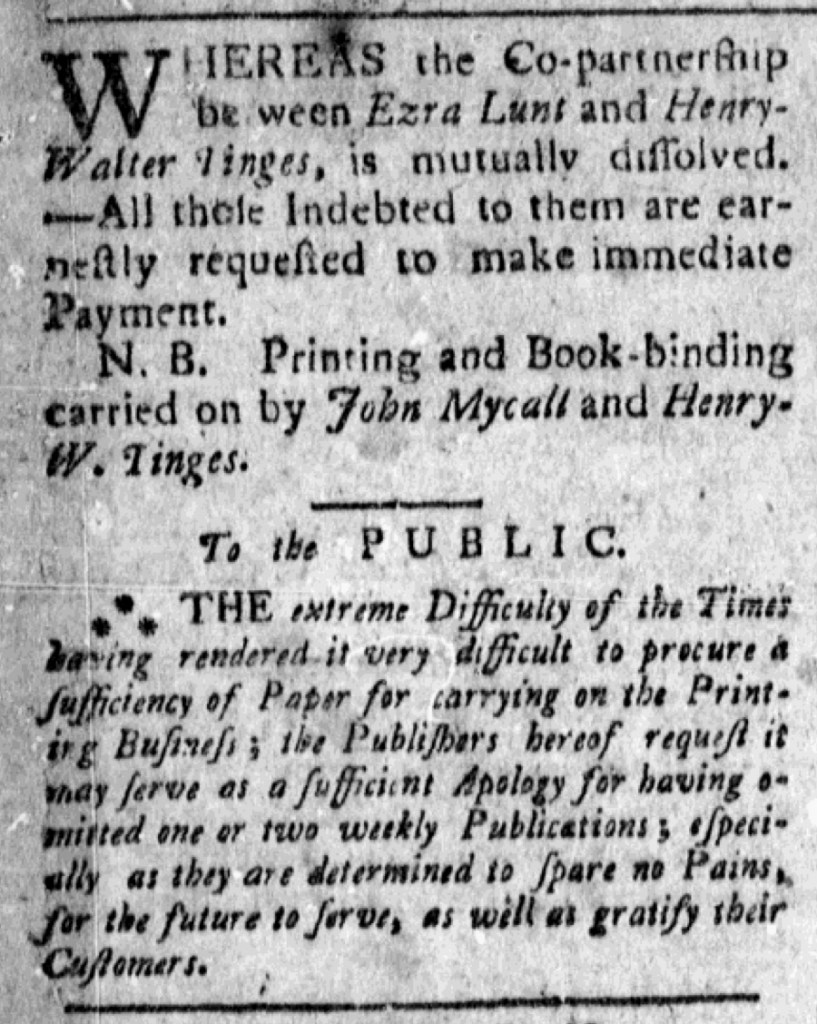
THE extreme Difficulty of the Times having rendered it very difficult to procure a sufficiency of Paper.”

A notice on the first page of the July 22, 1775, edition of the Essex Journal, Or, the Massachusetts and New-Hampshire General Advertiser informed readers that the “Co-partnership between Ezra Lunt and Henry-Walter Tinges,” the publishers of the newspaper, “is mutually dissolved” and called on “those Indebted to them” to settle accounts.  Yet the printing office in Newburyport was not being shuttered.  Instead, a nota bene declared, “Printing and Book-binding carried on by John Mycall and Henry-W. Tinges.”  Mycall became Tinges’s third partner in less than three years.  The young printer first went into business with Isaiah Thomas, the printer of the Massachusetts Spy in the late fall of 1773.  The more experienced printer remained in Boston while his junior partner oversaw the printing office and their new newspaper.  The partnership lasted less than a year.  On August 17, 1774, they notified the public that they “mutually dissolved” their partnership, but the “Printing Business is carried on as usual, by Ezra Lunt and Henry W. Tinges.”

Nearly a year later, Lunt departed and Mycall took his place.  As their first order of business, the new partners addressed some of the challenges the newspaper faced since the battles at Lexington and Concord three months earlier.  “THE extreme Difficulty of the Times having rendered it very difficult to procure a sufficiency of Paper for carrying on the Printing Business,” they lamented, “the Publishers hereof request it may serve as a sufficient Apology for having immitted one or two weekly Publications.”  Indeed, publication had been sporadic during May, immediately after the outbreak of hostilities, returned to a regular schedule in June, and then missed a week in July before announcing the departure of Lunt and arrival of Mycall.  The Essex Journal had missed only two issues, but the publishers did not consistently distribute the newspapers on the same day each week.  That likely added to the impression that they had not supplied all the newspapers that their customers expected.  In addition, the two most recent issues, June 30 and July, and the one that carried the notice about the new partnership consisted of only two pages rather than the usual four.  Mycall and Tinges vowed that “they are determined to spare no Pains, for the future to serve, as well as gratify their Customers.”  Mycall and Tinges kept that promise.  Publication returned to a regular schedule with only minor disruptions.
April 24

What was advertised in a revolutionary American newspaper 250 years ago today?

Boston Evening-Post (April 24, 1775).

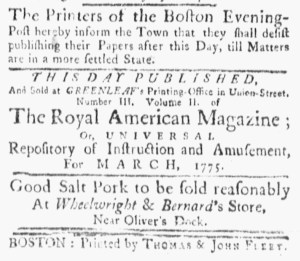
“They shall desist publishing their Papers after this Day, till Matters are in a more settled State.”

The printers and the public did not know it yet, but the April 24, 1775, edition of the Boston Evening-Post would be the last issue of that newspaper.  Thomas Fleet established the newspaper in August 1735.  His sons, Thomas and John, continued publishing the Boston Evening-Post after their father’s death in 1758.  They even disseminated issues while the Stamp Act was in effect from November 1765 through May 1766, though they did not include their names in the colophon.  The events at Lexington and Concord, however, were too much of a disruption to continue.  The Fleets initially intended to suspend the newspaper and continue publication at some point in the future.  The April 24 issue included only three advertisements, the first one from the printers to “inform the Town that they shall desist publishing their Papers after this Day, till Matters are in a more settled State.”  A newspaper that had served Boston for just shy of forty years ended with “NUMB. 2065.”

By that time, Isaiah Thomas, the printer of the Massachusetts Spy, had already published the final issue of that newspaper in Boston on April 6 and headed to Worcester.  He revived it as the Massachusetts Spy: Or, American Oracle of Liberty in early May.  Nathaniel Mills and John Hicks distributed the last known issue of the Massachusetts Gazette and Boston Post-Boy on April 17.  The April 20 edition of the Massachusetts Gazette and Boston Weekly News-Letter was the last for a month.  Margaret Draper and John Boyle resumed publication of that newspaper on May 19, though they published issues sporadically for the next several months before turning the newspaper over to John Howe.  The February 29, 1776, edition may have been the last; it is the last known issue.  Benjamin Edes and John Gill suspended the Boston-Gazette with the April 17, 1775, edition.  Edes went to Watertown and resumed publication there on June 5.  He remained in Watertown until the end of October 1776.  At that time, he returned to Boston and continued publication in November. His sons became partners in 1779.  The Boston-Gazette did not close until September 1798.

At the beginning of April 1775, five newspapers served Boston, yet the beginning of the Revolutionary War in nearby Lexington and Concord on April 19 had a dramatic impact on those newspapers.  Two folded immediately, even though they hoped to resume when “Matters are in a more settled state.”  One suspended publication for a month and then limped along for less than a year.  Another relocated to Worcester and experienced success there.  Only the Boston-Gazette survived the war and resumed publication in that city.  Other newspapers eventually filled the void, commencing publication during the war, but for some time the town that long had more newspapers than any other in the colonies adapted to new circumstances that limited publication of news (and advertisements).

September 9

What was advertised in a colonial American newspaper 250 years ago today?

Massachusetts Gazette and Boston Weekly News-Letter (September 9, 1773).

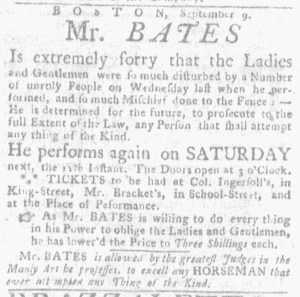
“Mr. BATES Is extremely sorry that the Ladies and Gentlemen were so much disturbed by a Number of unruly People.”

Mr. Bates’s first performance in Boston did not go as well as he hoped.  Some sort of fracas interrupted his exhibition of feats of horsemanship, something significant enough to merit an advertisement in the Massachusetts Gazette and Boston Weekly News-Letter the day after that inaugural performance.  Bates declared that he was “extremely sorry that the Ladies and Gentlemen were so much disturbed by a Number of unruly People on Wednesday last when he performed.”  He also expressed dismay at “so much Mischief done to the Fence,” threatening “to prosecute to the full Extent of the Law, any Person that shall attempt any thing of the Kind” during subsequent performances.

Whatever disorder occurred at that performance may have worked to Bates’s advantage.  Residents of Boston likely gossiped about the disruption, spreading word about Bates’s show when they did so.  Some colonizers may have become more curious to attend the next performance, both to see Bates riding “One, Two, and Three HORSES,” as he promised in his previous advertisement, and to observe whether the crowd behaved or repeated the commotion from the first performance.  Watching the audience had the potential to provide as much entertainment as the show, a situation perhaps not lost on Bates.  After all, he collected revenue no matter what motivated Bostonians to purchase tickets.

To further encourage sales and attendance, Bates announced that he “lower’d the Price to Three Shillings each,” part of his commitment “to do every thing in his Power to oblige the Ladies and Gentlemen” of the town.  Just in case some readers had not yet heard of him and his reputation, either via newspaper advertisements or word of mouth, Bates concluded his advertisement with a summary of the introduction that he inserted in other newspapers earlier in the week.  He trumpeted, “Mr. BATES is allowed by the greatest Judges in the Manly Art he professes, to excel any HORSEMAN that ever attempted any Thing of the Kind.”  Like other itinerant performers, Bates resorted to superlatives to market his show, promising a spectacle that exceeded anything audiences could view in Boston or anywhere else.

August 19

What was advertised in a colonial American newspaper 250 years ago today?

Aug 19 - 8:19:1768 New-Hampshire Gazette
New-Hampshire Gazette (August 19, 1768).

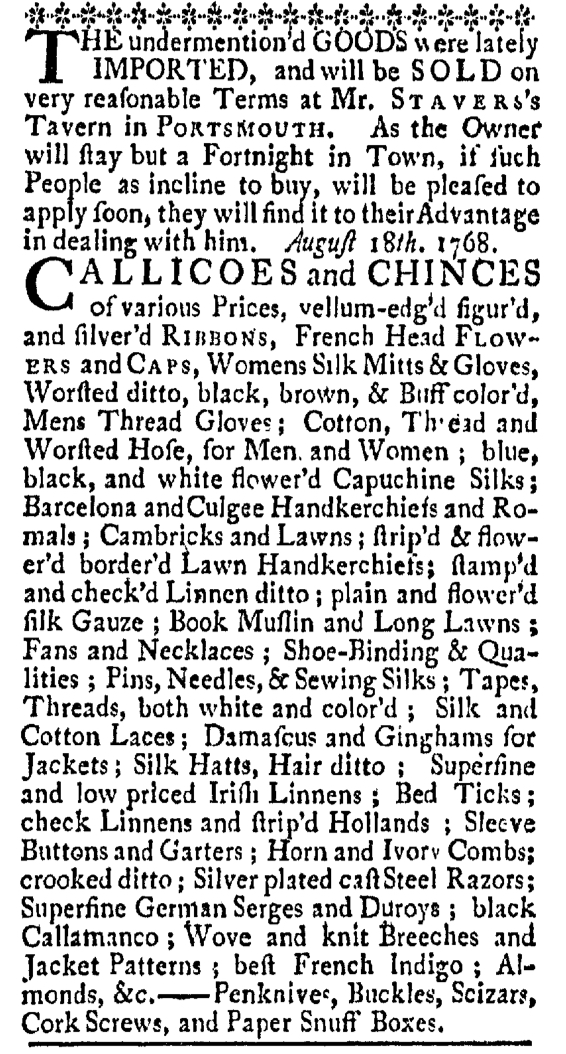
“The Owner will stay but a Fortnight in Town.”

Henry Appleton and Richard Champney placed advertisements in the New-Hampshire Gazette frequently. Members of their community likely knew where to find Appleton “At his shop in Portsmouth” and Champney “At his shop near Mr. John Beck’s, Hatter.” In the small port, both their faces and their shops would have been familiar. One of their competitors, however, was not nearly as familiar to the residents of Portsmouth and the surrounding area. An advertisement that appeared in the August 19, 17678, edition of the New-Hampshire Gazette listed many wares quite similar to those stocked by Appleton and Champney, but it did not specify the name of the seller.

Instead, it announced that “THE undermention’d GOODS were lately IMPORTED, and will be SOLD on very reasonable terms at Mr. STAVERS’s Tavern in PORTSMOUTH.” The unnamed advertiser stated that he “will stay but a Fortnight in Town.” From all appearances, Appleton and Champney found themselves in competition with a peddler. They likely did not appreciate his brief interlude in the local marketplace. Peddlers were disruptive. They diverted business away from the shops where customers usually acquired goods. In this case, the advertisement encouraged potential customers to head to a tavern to examine ribbons, gloves, fans, necklaces, and a variety of other “Baubles of Britain” (to borrow the evocative phrase from T.H. Breen’s examination of the consumer revolution in America in the eighteenth century). Those “incline[d] to buy … will find it to their Advantage in dealing with” the unnamed itinerant. Local shopkeepers like Appleton and Champney were probably none too pleased about this alternative means for their prospective customers to obtain many of the same trinkets they sold, especially not when the peddler implied that he offered lower prices than residents would otherwise encounter in Portsmouth.

Itinerant hawkers who traversed the roads from town to town in the late colonial period provided an alternate means of distributing many of the goods that were at the center of the consumer revolution. They complemented the shops and auctions that otherwise placed an array of merchandise in the hands and households of customers, usually to the chagrin of local entrepreneurs who did not appreciate the intrusion.