What was advertised in a revolutionary American newspaper 250 years ago today?

“THE Speeches of EDMUND BURKE, Esq; on American Taxation.”
James Rivington did not know it when he published the October 5, 1775, edition, nor did readers and the rest of the community, but he would soon discontinue printing Rivington’s New-York Gazetteer. With hindsight, we know that less than two months later, on November 27, the Sons of Liberty would attack his printing office and destroy his press and type “because of his pronounced Tory sentiments.”[1] It was not the first time. His home and printing office had been attacked the previous May. For a few weeks, he had sought refuge on a British ship in the harbor. He had been hung in effigy. After all that, the November 23, 1775, edition would be the last issue of Rivington’s New-York Gazetteer that he would print before departing for London. The printer returned to New York in 1777, during the British occupation, and established Rivington’s New-York Loyal Gazette. Today, historians consider it possible that Rivington spied on behalf of the American cause, but that would not have been public knowledge in the 1770s.
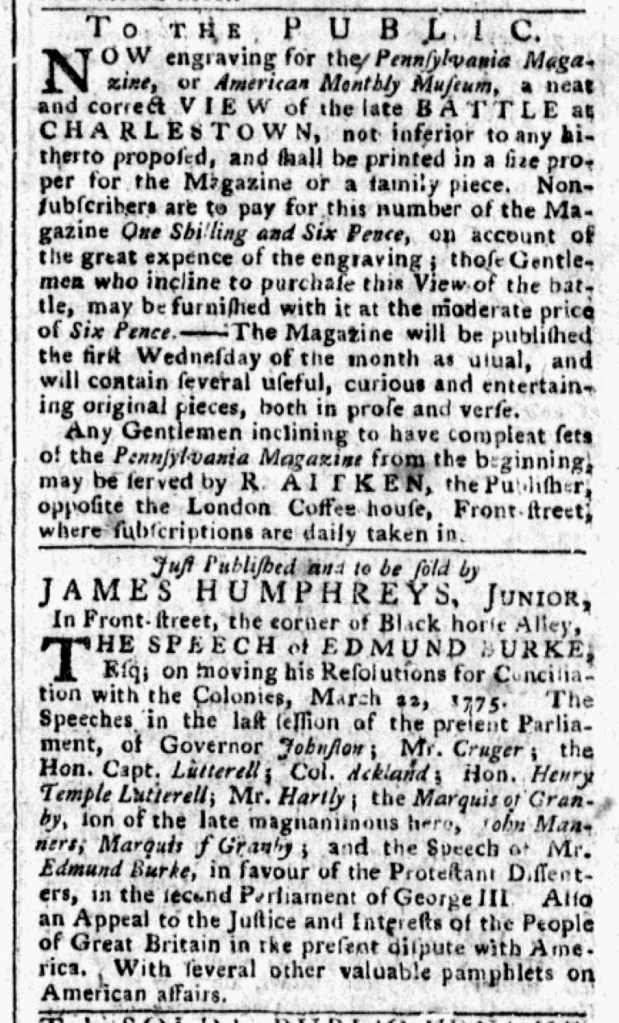
What was public knowledge was that the masthead of Rivington’s New-York Gazetteer featured the seal of Great Britain at a time when the mastheads for other newspapers did not have an image or chose some other device. The “UNITE OR DIE” political cartoon depicting a severed snake, each segment representing a colony, even appeared in the masthead of the Pennsylvania Journal. A few other newspapers did continue to include the seal of Great Britain in their masthead, but the printers did not have the same history of expressing positions that supported the officials considered enemies of American liberties. Even with the seal of Great Britain in the masthead, the October 5, 1775, edition of Rivington’s New-York Gazetteer included an advertisement for “THE Speeches of EDMUND BURKE, Esq; on American Taxation, delivered April 19, 1774” and “His Speech on Moving his Resolutions of Conciliation with the Colonies, March 22d, 1775.” Rivington printed and sold both speeches by a member of Parliament considered a friend to America. The printer had a history of marketing “pamphlets on the Whig and Tory side” of “The American Controversy” and arguing for freedom of the press when it came to the contents of his newspaper and other items he printed and sold. After the battles at Lexington and Concord, however, he discontinued advertising pamphlets that expressed the Tory perspective. The advertisement for Burke’s speeches, pamphlets that he printed as well as promoted, starkly presented only one side of “THE AMERICAN CONTEST.” Rivington seemingly changed his advertising strategy as the political situation in the colonies intensified once hostilities commenced in Massachusetts.
**********
[1] Clarence S. Brigham, History and Bibliography of American Newspapers, 1690-1820 (Worcester: American Antiquarian Society, 1947), 686.