What was advertised in a colonial American newspaper 250 years ago today?
Massachusetts Spy (March 9, 1775).
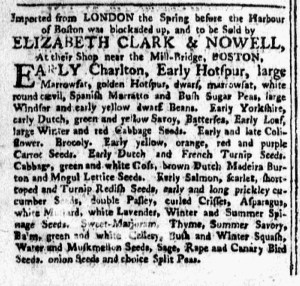
“Imported from LONDON the Spring before the Harbour of Boston was blockade up.”
Although marketing began a little later in the season than in recent years, several retailers placed advertisements for garden seeds in Boston’s newspaper in early March 1775. The March 9 edition of the Massachusetts Spy, for instance, once again carried Susannah Renken’s advertisement as well notices placed by John Adams, Elizabeth Clark and Elizabeth Nowell, and Ebenezer Oliver. Each of these purveyors of seeds took to the public prints as spring approached each year, though many familiar names did not yet appear. More than half a dozen women usually advertised garden seeds that they sold in Boston, but the imperial crisis, especially the closing of the harbor because of the Boston Port Act, disrupted that annual ritual.
Renken, one of the most enterprising of those female seed sellers, apparently acquired her inventory from a ship that landed at Salem. She identified the captain of the vessel that had transported them across the Atlantic. Adams and Oliver both declared that they sold seeds “Imported from London,” but did not provide additional details to allow prospective customers in the eighteenth century (or historians in the twenty-first century) to reach conclusions about when and how they came into possession of those seeds. Clark and Nowell, on the other hand, made clear that their seeds had been “Imported from LONDON the Spring before the Harbour of Boston was blockade up.” They received their seeds at least nine months earlier, a factor that may or may not have been an advantage. Adams declared that he “warrants [his seeds] good, and of the last Year’s Growth.” Similarly, Renken described her seeds as “New and warranted of the last Year’s Growth.” Clark and Nowell could not make such claims. Instead, they attempted to leverage the date of delivery as a point in their favor. Although not “new,” their seeds also were not so old that they would not germinate, especially if Clark and Nowell had stored them carefully. They asked prospective customers to take into account the challenges that they all faced due to the blockade, hoping that a sense of mutual support would convince consumers to select their seeds over the ones offered by their competitors.
What was advertised in a colonial American newspaper 250 years ago today?
Providence Gazette (December 31, 1774).
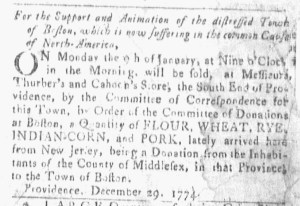
“For the Support … of the distressed Town of Boston … suffering in the common Cause of North-America.”
As 1774 ended, readers of the Providence Gazette contemplated how they could aid the town of Boston where the harbor had been closed to commerce for seven months. The Boston Port Act went into effect on June 1, retribution for the Boston Tea Party. In turn, that inspired a variety of responses, including the meetings of the First Continental Congress in Philadelphia in September and October and the formation of relief efforts for Boston. Local committees throughout the colonies started subscriptions for collecting food to send to the town, as Bob Ruppert documents in “The Winter of 1774-1775 in Boston.”
An advertisement in the December 31, 1774, edition of the Providence Gazette announced an upcoming sale of a “Quantity of FLOUR, WHEAT, RYE, INDIAN-CORN, and PORK” that would be held “For the Support and Animation of the distressed town of Boston, which is now suffering in the common Cause of North-America.” Although Parliament aimed the Boston Port Act, the Massachusetts Government Act, and the other Coercive Acts at agitators in Massachusetts, that legislation prompted a unified response, a sense of a “common Cause” as other colonies realized that Parliament could just as easily target them. The shipment of grains and pork that arrived in Providence came from New Jersey, “a Donation … to the Town of Boston.” According to the advertisement, the Committee of Correspondence in Boston instructed the Committee of Correspondence in Providence to sell the grains and pork to raise funds rather than attempt to transport them to Boston.
John Carter, the printer of the Providence Gazette, gave that advertisement a privileged place both times that it ran in his newspaper. The first time that it appeared, he inserted it immediately after local news and before other advertisements. Readers likely experienced it as a continuation of news related to the imperial crisis, including updates about other “Donations … to the Town of Boston.” When the advertisement ran a week later, two days before the sale, it was the first item in the first column on the first page, making it nearly impossible for readers to miss. Through the choices he made about the layout of his newspaper, the printer made his own contribution in support of the “common Cause of North-America.”
What was advertised in a colonial American newspaper 250 years ago today?
Essex Gazette (October 18, 1774).
“In Consequence of the Boston Port-Bill … he has opened a Store in Salem.”
In October 1774, Nathan Frazier did what he could to continue selling “an Assortment of Goods, suitable for the Season,” when the Boston Port Act closed the harbor in retaliation for colonizers destroying shipments of tea the previous December. He opted to open a second location, renting a shop in Salem. In the October 18 edition of the Essex Gazette, published in that town, he informed readers that “in Consequence of the Boston Port-Bill, and with a View of accommodating those of his Customers to whom it may be most convenient to have their Supplies conveyed by Water,” he now did business in Salem as well as in Boston. The circumstances had not caused him to close his original store; he “still continues his Business at his Store in Boston as usual.” Accordingly, his customers “may be supplied at either of said Stores,” though Frazier, “for the present, give[s] his personal Attendance at his Salem Store.”
In addition to inserting this notice in the Essex Gazette, the merchant also placed it in the Boston Evening-Post and the Boston-Gazette on October 17, increasing the chances that readers in Boston, Salem, and other towns would see it. In the Boston Evening-Post, Frazier’s advertisement happened to appear immediately below William Blair Townsend’s notice that he sold goods “imported before the oppressive Acts on this Town and Province were laid” and, accordingly, could be bought and sold “without any Breach on the solemn League and Covenant” that called for ceasing trade with Britain until Parliament repealed the Coercive Acts. In the Essex Gazette, Samuel Flagg asserted that “he is determined not to import any more Goods at present,” alluding to current events without naming them as plainly as Frazier and Townsend. All three advertisements testified to the challenges that merchants and shopkeepers faced as well as their efforts to meet them. As much as Frazier wished to encourage consumers to visit either of his shops, it was not business “as usual” in Boston and other towns in Massachusetts. Advertisements, as well as news articles and editorials, made that clear.
What was advertised in a colonial American newspaper 250 years ago this month?
Massachusetts Spy (August 25, 1774).
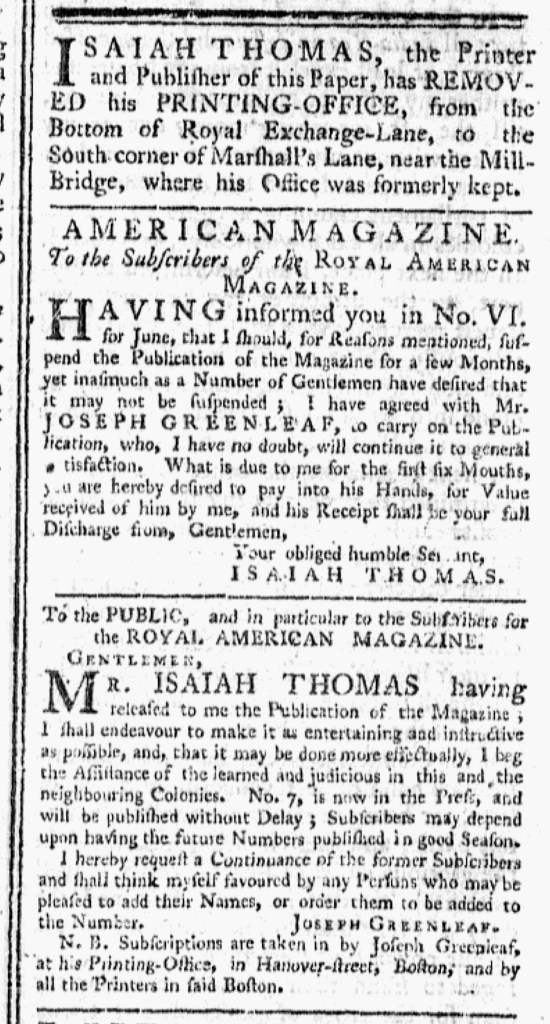
“Suspend the Publication of the Magazine for a few Months.”
For more than a year, the Adverts 250 Project has traced Isaiah Thomas’s advertising campaign for the Royal American Magazine, from his first announcement that he intended to circulate subscription proposals in May 1773 through the notices that ran in newspapers in June, July, August, September, October, November, and December 1773 and January, February, March, April,May, and June 1774. Last month, I noted that Thomas did not advertise the magazine in July 1774, that the sole marketing effort in the public prints was a poem “From the ROYAL AMERICAN MAGAZINE” that appeared in the “POETS CORNER” in the July 21, 1774, edition of the Massachusetts Spy, the newspaper that Thomas printed. I also commented that newspaper advertisements do not reveal when the June 1774 issue of the magazine became available to readers.
Further investigation, however, reveals that newspaper advertisements do indeed provide that information. The June 1774 issue of the Royal American Magazine was not published until August 1774. Eighteenth-century magazines commonly came out at the end of the month, unlike modern magazines issued in advance of the dates on their covers. Subscribers would have expected the June issue in late June or early July, but Thomas was more than a month late in distributing it. He had perpetually been behind the anticipated publication schedule since the first issue.
On Thursday, August 4, the Massachusetts Spy carried a notice that “Saturday next will be published … NUMBER VI. of THE ROYAL American Magazine.” To promote that issue, Thomas proclaimed that it would be “Embellished with elegant Engravings, I. The able Doctor, or America swallowing the bitter Draught. II. The Hooded Serpent.” Paul Revere produced both engravings. The “Able Doctor,” depicting America personified as an Indigenous woman being held down by members of Parliament and forced to drink tea, protested the Boston Port Act. It is now considered one of the most important examples of visual propaganda supporting the patriot cause produced during the imperial crisis.
By Monday, Thomas took the overdue issue to press. The August 8 edition carried a nearly identical advertisement with the headline updated to “THIS DAY PUBLISHED.” On August 11, an announcement received a prominent place in the Massachusetts Spy, running as the first item in the first column on the first page. Although delinquent in publishing the June issue, Thomas privileged promoting it when he could finally declare, “This day was published … NUMBER VI. of THE ROYAL American Magazine.” As he had done with previous issues, Thomas highlighted the engravings and provided a list of the contents to entice readers who were not already subscribers to purchase copies. The articles included a “Description of the Hooded Serpent” to accompany the second engraving.
The June issue included an address “To the PUBLIC” in which Thomas informed “all those Gentlemen and Ladies, in this and the other Provinces, who have favoured him with their Subscriptions” that current events forced him to suspend publication of the magazine. “The Distresses of the Town of Boston, by the shutting up of our Port,” Parliament’s response to the Boston Tea Party, had “throw[n] all Ranks of Men into Confusion,” including “those good Gentlemen … who kindly promised to assist the Editor with their various Lucrubrations.” Thomas had regularly published advertisements seeking original content for the magazine, but now those who had volunteered to contribute had found themselves overcome by other priorities. As a result, Thomas received “but few original Pieces.” He could not provide readers with “that Entertainment and Instruction, which they have a Right to expect.” Accordingly, he planned to suspend publication for a few months “until the Affairs of this Country are a little better settled” and his correspondents could once again turn their attention to supplying the magazine with content.
Not long after subscribers saw that notice in the June issue of the American Royal Magazine, Thomas took to the Massachusetts Spy with a new update on August 25. He reported that “a Number of Gentlemen have desired that it may not be suspended.” Not in a position to continue with the magazine at that time, Thomas “agreed with Mr. JOSEPH GREENLEAF, to carry on the Publication.” He assured subscribers that the new publisher “will continue it to general satisfaction.” He also instructed them to submit subscription fees for the first six issues to Greenleaf. A notice from Greenleaf “To the PUBLIC, and in particular to the Subscribers for the ROYAL AMERICAN MAGAZINE” immediately followed. He pledged to make the magazine “as entertaining and instructive as possible,” yet, like Thomas, needed the “Assistance of the learned and judicious in this and the neighbouring colonies.” He was on track to make good on his promise to subscribers, declaring that the next issue “is now in the Press, and will be published without Delay.” In addition, subscribers “may depend upon having the future Numbers published in good Season,” implicitly acknowledging that publication of previous issues had often been deferred longer than anticipated. The new publisher concluded with a request that current subscriber continue and new subscribers “add their Names,” either at his printing office or with any other printers in Boston.
The suspension could have been the end of the Royal American Magazine, but Greenleaf managed to publish new issues through February 1775. The Adverts 250 Project will continue to document advertisements for the magazine to compare Greenleaf’s marketing efforts to those of Thomas.
**********
“Saturday next will be published … NUMBER VI.”
August 4 – Massachusetts Spy (first appearance)
“THIS DAY PUBLISHED … NUMBER VI.”
August 8 – Boston Evening-Post (first appearance)
August 15 – Boston Evening-Post (second appearance)
“This day was published … NUMBER VI.” [with list of contents]
August 11 – Massachusetts Spy (first appearance)
“To the Subscribers of the ROYAL AMERICAN MAGAZINE”
August 25 – Massachusetts Spy (first appearance)
“To the PUBLIC, and in particular to the Subscribers”