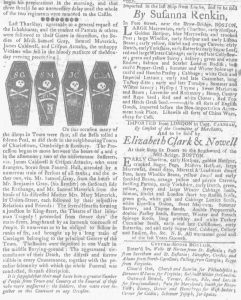
March 9

What was advertised in a colonial American newspaper 250 years ago today?
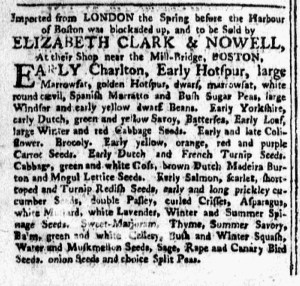
Massachusetts Spy (March 9, 1775).

“Imported from LONDON the Spring before the Harbour of Boston was blockade up.”

Although marketing began a little later in the season than in recent years, several retailers placed advertisements for garden seeds in Boston’s newspaper in early March 1775.  The March 9 edition of the Massachusetts Spy, for instance, once again carried Susannah Renken’s advertisement as well notices placed by John Adams, Elizabeth Clark and Elizabeth Nowell, and Ebenezer Oliver.  Each of these purveyors of seeds took to the public prints as spring approached each year, though many familiar names did not yet appear.  More than half a dozen women usually advertised garden seeds that they sold in Boston, but the imperial crisis, especially the closing of the harbor because of the Boston Port Act, disrupted that annual ritual.

Renken, one of the most enterprising of those female seed sellers, apparently acquired her inventory from a ship that landed at Salem.  She identified the captain of the vessel that had transported them across the Atlantic.  Adams and Oliver both declared that they sold seeds “Imported from London,” but did not provide additional details to allow prospective customers in the eighteenth century (or historians in the twenty-first century) to reach conclusions about when and how they came into possession of those seeds.  Clark and Nowell, on the other hand, made clear that their seeds had been “Imported from LONDON the Spring before the Harbour of Boston was blockade up.”  They received their seeds at least nine months earlier, a factor that may or may not have been an advantage.  Adams declared that he “warrants [his seeds] good, and of the last Year’s Growth.”  Similarly, Renken described her seeds as “New and warranted of the last Year’s Growth.”  Clark and Nowell could not make such claims.  Instead, they attempted to leverage the date of delivery as a point in their favor.  Although not “new,” their seeds also were not so old that they would not germinate, especially if Clark and Nowell had stored them carefully.  They asked prospective customers to take into account the challenges that they all faced due to the blockade, hoping that a sense of mutual support would convince consumers to select their seeds over the ones offered by their competitors.

February 27

What was advertised in a colonial American newspaper 250 years ago this week?

Massachusetts Spy (February 27, 1774).

“GARDEN SEEDS … SOLD by SUSANNA RENKEN.”

Susanna Renken was not the first entrepreneur to advertise seeds in Boston’s newspapers as the spring of 1774 approached, though she had been on several occasions in the past decade.  That distinction went to John White, “Gardner, and Seeds-Man, in SEVEN-STAR LANE,” with his advertisement in the February 17 edition of the Massachusetts Spy, yet within a week Renken she activated her advertising campaign.  Fittingly, Renken placed an advertisement for “GARDEN SEEDS” in the next issue, serving as a counterpoint to White’s repeated notice.

Unlike the approach White had taken so far, Renken did not confine her marketing efforts to a single newspaper.  When she ran her first advertisement on February 24, she placed it in both the Massachusetts Gazette and Boston Weekly News-Letter and the Massachusetts Spy.  That made her among the first of the sorority of female seed sellers to advertise in 1774.  Her competitors Elizabeth Clark and Elizabeth Nowell also ran a notice in the Massachusetts Gazette and Boston Weekly News-Letter.  It appeared immediately to the left of Renken’s advertisement.

So began the annual contest to woo customers to purchase seeds.  As had been her practice in the past, Renken continued expanding her advertising campaign, seeking to reach more prospective customers by inserting her notice in multiple newspapers.  On February 28, she ran it in the Boston Evening-Post, immediately above Elizabeth Greenleaf’s advertisement for “GARDEN-SEEDS.”  The appropriately named Greenleaf was part of the sisterhood of seed sellers who advertised extensively each spring.  On the same day, her advertisement appeared immediately above Renken’s advertisement in the Boston-Gazette.  Perhaps having noticed that Renken and Clark and Nowell commenced their advertising Greenleaf determined that it was time to invest in her own marketing efforts for 1774.

For whatever reason, none of them or their competitors placed advertisements in the Massachusetts Gazette and Boston Post-Boy on February 28, but the March 3 edition of the Massachusetts Gazette and Boston Weekly News-Letter once again featured advertisements from Renken and Clark and Nowell, joined by Greenleaf.  As had been common in previous years, the compositor arranged them one after the other in a single column.  Printers did not usually arrange advertisements by purpose or category, but they often made an exception for women who sold seeds in Boston.  Renken and White once again placed their notices in the Massachusetts Spy on March 3.

For newspaper readers in and near Boston, this flurry of advertising was an annual ritual.  It signaled that spring was on its way.  Perhaps for modern readers who regularly visit the Adverts 250 Project, these advertisements serve a similar purpose, a sign of the changing seasons as days become longer even if not necessarily warmer.

April 25

What was advertised in a colonial American newspaper 250 years ago this week?

Massachusetts Gazette and Boston Weekly News-Letter (April 22, 1773).

“Garden Seeds, &c. Are to be Sold by the following Persons, who have advertised the Particular Sorts in this Paper.”

Richard Draper, the printer of the Massachusetts Gazette and Boston Weekly News-Letter, did not have room for all of the news, letters, and advertisements submitted to his printing office for the April 22, 1773, edition.  To remedy the matter, he collected together and abbreviated notices about “Peas, Beans, [and] Garden Seeds” peddled by John Adams, Ebenezer Oliver, Elizabeth Greenleaf, Susanna Renken, Elizabeth Clark and Nowell, and Lydia Dyar.  Draper informed readers that the “following Persons, who have advertised the Particular Sorts in this Paper” continued to sell seeds, but “we have not Room this Week.”  Along with each name, the printer provided the location, but did not elaborate on their merchandise except for a note at the end intended to apply to each advertiser, a single line advising prospective customers that “All the Seeds [were] of the last Year’s Growth.”

Indeed, each of those purveyors of seeds had indeed “advertised the Particular Sorts in this Paper” … and in the four other newspapers published in Boston in the spring of 1773.  For two months readers had encountered advertisements placed by Adams, Oliver, Greenleaf, Renken, Clark and Nowell, and Dyar, an annual herald of the arrival of spring in Boston.  Eighteenth-century printers did not usually classify and categorize advertisements according to purpose and then organize them accordingly in the pages of their newspapers.  Advertisements for seeds, however, proved the exception to the rule. In each of the newspapers printed in the city, the compositors often clustered advertisements for seeds together.  When they did so, those advertisements filled entire columns and, sometimes, more than one column.  In the supplement that accompanied the previous edition of the Massachusetts Gazette and Boston Weekly Mercury, the advertisements by Adams, Oliver, Greenleaf, Renken, Clark and Nowell, and Dyar accounted for half the content on the final page, running one after another in the last two columns.

That practice in place, it made sense for Draper to truncate those advertisements when he did not have sufficient space for all of them in the April 22 edition.  He likely assumed that subscribers and others who regularly read his newspapers had already seen those notices on several occasions.  They could even consult previous editions if they needed more information.  Besides, the season for advertising seeds was coming to an end.  The Massachusetts Gazette and Boston Weekly Mercury did not run any more advertisements for seeds in the following weeks, nor did some of the other newspapers.  Some of the seed sellers discontinued their advertising efforts.  The others began tapering off their notices, placing them in fewer newspapers for the overall effect of seeds having less prominence in the public prints in Boston as April came to a close and May arrived.  The annual ritual completed for 1773, it would begin again the following February.

April 6

What was advertised in a colonial American newspaper 250 years ago today?

Apr 6 - 4:6:1770 Massachusetts Gazette and Boston Weekly News-Letter
Massachusetts Gazette and Boston Weekly News-Letter (April 6, 1770).

“Seeds.”

It was a sign of spring.  Just as advertisements for almanacs told readers of colonial newspapers that fall had arrived and the new year was coming, advertisements for seeds signified that winter was coming to an end and spring would soon be upon them.  In the newspapers published in Boston in the late 1760s and early 1770s, this meant a dramatic increase in female entrepreneurs among those who placed advertisements.  Women who sold goods or provided services appeared only sporadically among newspaper notices throughout the rest of the year, but turned out in much greater numbers to peddle seeds in the spring.

Although printers and compositors did not usually organize or classify advertisements according to their purpose in eighteenth-century newspapers, they did tend to group together notices placed by women selling seeds.  Consider the last column of the final page of the April 6, 1770, edition of the Massachusetts Gazette and Boston Weekly News-Letter.  Although it concluded with a legal notice, advertisements for seeds sold by women comprised the rest of the column. Bethiah Oliver hawked seeds available at her shop “opposite the Rev. Dr. Sewall’s Meeting House.”  The appropriately named Elizabeth Greenleaf advised prospective customers to visit her shop “at the End of Union-Street, over-against the BLUE-BALL.”:  Elizabeth Clark and Elizabeth Nowell sold seeds at their shop “six Doors to the Southward of the Mill-Bridge.”  Susanna Renken also carried seeds at her shop “In Fore Street, near the Draw-Bridge.”  She was the only member of this sorority who advertised other wares, declaring that she stocked “all sorts of English Goods, imported before the Non-importation Agreement took Place.”  She was also the only one who sometimes advertised at other times during the year.  Did the others sell only seeds and operate seasonal businesses?  Or did they also carry other wares but refrain from advertising?

Spring planting was a ritual for colonists, including women who kept gardens to help feed their families.  Placing advertisements about seeds for growing peas, beans, onions, turnips, lettuce, and other produce was a ritual for the female seed sellers of Boston.  Encountering those advertisements in the city’s newspapers became one or many markers of the passage of time and the progression of the seasons for readers of those newspapers.  The news changed from year to year, but advertisements for seeds in the spring was a constant feature of the Massachusetts Gazette and Boston Weekly News-Letter and other newspaper.

March 15

What was advertised in a colonial American newspaper 250 years ago today?

Mar 15 - 3:15:1770 Massachusetts Gazette and Boston Weekly News-Letter
Massachusetts Gazette and Boston Weekly News-Letter (March 15, 1770).

“All sorts of English Goods, imported before the Non-importation Agreement took place.”

Richard Draper, printer of the Massachusetts Gazette and Boston Weekly News-Letter, included coverage of the “bloody massacre” and the funerals of the victims in the March 15, 1770, edition of his newspaper.  In so doing, he adopted a method commonly used by printers throughout the colonies:  he reprinted news that already appeared in another newspaper.  In this case, he reprinted an article about the funeral procession that Benjamin Edes and John Gill originally printed in the March 12, 1770, edition of the Boston-Gazette, though Draper included a brief addendum at the conclusion.  “It is supposed,” he added, “that their must have been a greater Number of People from Town and Country at the Funeral of those who were massacred by the Soldiers, than were ever together on this Continent on any Occasion.”  Draper even included an image depicting the coffins of Samuel Gray, Samuel Maverick, James Caldwell, and Crispus Attucks.  Edes and Gill presumably loaned him the woodcut.

The article, along with the dramatic image that drew attention to it, aimed to disseminate information about the Boston Massacre to readers in the city and far beyond.  The advertisements that appeared in close proximity may have received more notice – and more scrutiny – than under other circumstances.  The two notices that ran immediately next to the article about the “bloody massacre,” both placed by female seed seller commencing their annual marketing campaigns as spring approached, addressed the politics of the period, though they did not comment explicitly on recent events in King Street or the funeral procession that followed.  Susanna Renken listed the seeds she offered for sale, but also declared that she stocked “all sorts of English Goods.”  She carefully noted that she imported those wares “before the Non-importation Agreement took Place.”  Similarly, Elizabeth Clark and Elizabeth Nowell asserted that they imported their seeds from London and sold them “By Consent of the Committee of Merchants” who oversaw adherence to the nonimportation agreement and reported violators.

These advertisements demonstrate that readers did not experience a respite from politics and current events when they perused advertisements for consumer goods and services during the era of the American Revolution.  Instead, advertisers increasingly inflected politics into their notices as they enticed prospective customers not only to make purchases but also to make principled decisions about which merchandise they did buy.  Those advertisers assured the community that they had already made such principled decisions themselves.

March 14

What was advertised in a colonial American newspaper 250 years ago today?

Mar 14 - 3:14:1768 Boston-Gazette
Boston-Gazette (March 14, 1768).

“A Fresh Assortment of Garden Seeds.”

Colonists in Boston glimpsed a sign that spring was on its way when Susanna Renken inserted an advertisement for seeds in the Massachusetts Gazette in late February 1768. It was the first of many similar advertisements that residents of Boston would have recognized as part of an annual ritual. As the first day of spring approached, other seed sellers, most of them women, joined Renken in advising the public of the many sorts of seeds they stocked, from vegetables to herbs to flowers.

Such advertisements appeared in newspapers published in other cities, but they were especially prevalent in Boston. A greater number of women who participated in the seed trade turned to the public prints to attract customers. Many of them advertised in multiple newspapers. Renken, for example, launched her advertising campaign for 1768 in the Massachusetts Gazette but very quickly followed up with notices in the Boston Evening-Post, the Boston-Gazette, and the Boston Post-Boy. For instance, her advertisement was the first item in the first column on the final page of the March 14, 1768, edition of the Boston-Gazette.

By then her competitors had joined her in hawking their wares in the city’s newspapers. Advertisements placed by women who sold seeds filled almost the entire column (with the exception of a two-line advertisement for “Scotch COALS” and the colophon). Rebeckah Walker, Elizabeth Greenleaf, Bethiah Oliver, Elizabeth Clark, and Lydia Dyar each promoted their seeds, renewing their efforts from the spring of 1768. Elsewhere in the same issue Anna Johnson’s advertisement even featured a headline for “Garden Seeds, Peas, Beans, &c.” that distinguished her notice from the others. On the same day, Sarah Winsor advertised seeds in the Boston Post-Boy.

Advertisements by Renken, Greenleaf, Dyar, and other women who sold seeds cropped up in Boston’s newspapers each spring, but even though several of them indicated that they also sold “all sorts of Groceries” or “English Goods” or other merchandise at their shops they disappeared from the advertising pages throughout the rest of the year. Why did these women consider it imperative to advertise only seeds and only as spring approached? In general, female shopkeepers were disproportionately underrepresented compared to their male counterparts when it came to placing newspaper advertisements. Considered separately, a survey of advertisements for seeds suggests that selling them was a feminized occupation in the late 1760s. Did women who otherwise avoided drawing attention to their participation in the marketplace as retailers who competed with men (rather than solely as consumers) feel more latitude to place advertisements when they knew that they competed predominantly with other women?

March 9

What was advertised in a colonial American newspaper 250 years ago today?

Mar 9 - 3:9:1767 Boston-Gazette
Boston-Gazette (March 9, 1767).

“Red and white Clover, Red Top and Herds Grass Seed, warranted to be of last Year’s Growth.”

Compared to their male counterparts, women who pursued their own businesses placed advertisements in eighteenth-century newspapers much less frequently. Even though they comprised a sizeable minority of shopkeepers in urban ports, they tended not to inject themselves into the marketplace via the public prints.

For one type of female entrepreneur, however, that changed, at least temporarily, in Boston for several weeks in late winter and early spring in the 1760s. Women who specialized in selling seeds placed advertisements in Boston’s newspapers and competed with each other for customers as the time for planting gardens approached.

Consider the March 9, 1767, issues of the Boston-Gazette. Susanna Renken’s advertisement appeared on the first page. Notices placed by four other female seed sellers (and one male competitor who, unlike the women, described his occupation as “Gardener”) filled almost an entire column on the final page of the supplement devoted solely to advertising. Just as Renken stated in her advertisement, Bethiah Oliver, Elizabeth Clark, Lydia Dyar, and Elizabeth Greenleaf noted that they imported seeds from London and listed the varieties they stocked. Each had advertised the previous year as well.

Clark, Dyar, and the appropriately named Greenleaf confined their advertising to seeds, but Renken also promoted “all Sorts of English GOODS and China Ware” and Oliver stocked “a general Assortment of Glass, Delph and Stone Ware, Lynn Shoes, best Bohea Tea, Coffee, Chocolate, and all other Groceries.” Their advertisements suggest that Renken and Oliver ran operations much more extensive than peddling seeds, which may explain why those two also inserted advertisements in the Boston Post-Boy on the same day. Clark, Dyar, and Greenleaf may have also stocked various imported housewares and groceries, despite not making an indication in their own advertisements. None of these five women who ran advertisements for the seeds they sold in successive springs, however, placed advertisements at other times during the year.

What explains the prominence of advertisements by women selling seeds amid the scarcity of advertising by other women in colonial Boston’s marketplace? Why did the women in this occupation turn to advertising when other women who operated other sorts of businesses did not? Why did Renken and Oliver only advertise their other wares at the conclusion of their advertisements for seeds and not in separate advertisements throughout the rest of the year? These advertisements demonstrate women’s activity in the marketplace as sellers, not just consumers, but they also raise a series of questions about the limits of that participation captured in print during the period.

March 24

GUEST CURATOR:  Elizabeth Curley

What was advertised in a colonial newspaper 250 years ago today?

Mar 24 - 3:24:1766 Boston-Gazette
Boston-Gazette (March 24, 1766).

Elizabeth Clark placed this advertisement to sell an assortment of seeds. She got her supplies “per Capt. Freeman” from London. The timing makes perfect sense, because April showers bring May, June, July, and August crops. With it being late March the planting season was right upon colonists in Boston and the rest of Massachusetts.

Anyone who frequently visits the Adverts 250 Project might notice that this advertisement seems repetitive. To be honest I had to review my work from my first week as guest curator in February. The historical impact that woman of the past have on women of the present and future interests me greatly so I try to pick advertisements that feature primarily woman if I am able. On February 17, I featured an advertisement from Lydia Dyar, who also sold garden seeds and had gotten them from Captain Freeman. In his additional commentary Prof. Keyes also pointed out an advertisement from yet another woman, Susanna Renken, who both sold seeds and bought them from Captain Freeman. All three of these woman posted similar advertisements, for mostly the same product, and bought their goods from the same man.

Two of them seem to have had shops in the same vicinity: Mill Creek. Susanna Renken states that her shop is “near the Draw Bridge” and Elizabeth Clark advertised that she was located “near the Mill Bridge,” which was located on Mill Creek. This trade card helped further convince me that these two woman shops were near each other because William Breck had a shop “at the Golden Key near the draw-Bridge Boston.”

Mar 25 - William Breck Trade Card
William Breck’s trade card (Paul Revere, engraver, ca. 1768).  This trade card is part of the American Antiquarian Society’s Paul Revere Collection.
Mar 24 - Nathaniel Abraham - 2:20:1766 Massachusetts Gazette
Massachusetts Gazette (February 20, 1766).

Nathaniel Abraham, who also regularly advertised in the Boston newspapers, listed “Sign of the Golden Key, in Ann-street” as his location too.

This map shows that Ann Street intersected Mill Creek.  The drawbridge crossed Mill Creek.  Elizabeth Clark, Susanna Renken, William Breck, and Nathaniel Abraham had shops located near each other.

Mar 24 - Detail of Map
Detail of A Plan of the Town of Boston.

**********

Mar 24 - Map of Boston.jpg
A Plan of the Town of Boston with the Intrenchments &ca. of His Majesty’s Forces in 1775, from the Observations of Lieut. Page of His Majesty’s Corps of Engineers, and from Those of Other Gentlemen (1777?).  Library of Congress.

**********

ADDITIONAL COMMENTARY:  Carl Robert Keyes

I am impressed with the way that Elizabeth mobilizes several different primary sources –newspaper advertisements, trade cards, maps – in a preliminary attempt to reconstruct neighborhoods and marketplaces in Boston in the 1760s. This is work that historians and scholars in related fields have undertaken on a grander scale.

I appreciate that Elizabeth draws attention to an aspect of eighteenth-century advertisements that has not yet received much attention here: when examined systematically the locations listed in the advertisements help us to understand not only the geography of early American towns and cities but also relationships of various sorts.

More than two decades would pass before publication of the Boston Directory, the city’s first directory that listed the occupations and residences of its inhabitants, in 1789. That and subsequent city directories from Boston and other urban centers in early America have been invaluable to historians, but such sources do not exist for earlier periods.

Elizabeth has discovered on her own – and helps to demonstrate – that newspaper advertisements provide more information than just lists of goods or attempts to convince potential customers to make purchases. They include valuable information about where people worked and where they lived, details that fill in some of the blanks for an era before city directories.