October 14

Who was the subject of an advertisement in a revolutionary American newspaper 250 years ago today?
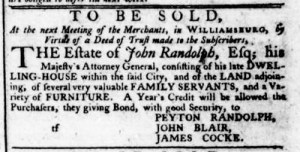
Virginia Gazette [Dixon and Hunter] (October 14, 1775).

“Several very valuable FAMILY SERVANTS.”

A notice concerning the “Estate of John Randolph, Esq; his Majesty’s Attorney General,” first appeared in the October 14, 1775, edition of John Dixon and William Hunter’s Virginia Gazette.  It was not Randolph’s death that occasioned the notice.  Instead, the Loyalist and his family departed for England at the beginning of the Revolutionary War, leaving trustees in charge of selling “his late DWELLING-HOUSE” in Williamsburg, “several very valuable FAMILY SERVANTS, and a Variety of FURNITURE.”

At a glance, modern readers might assume that those “FAMILY SERVANTS” consisted of indentured servants like the ones that had “JUST ARRIVED” in Virginia on the Saltspring.  According to an advertisement on the next page, those servants included “many Tradesmen,” such as carpenters, blacksmiths, shoemakers, weavers, a cabinetmaker, and a wheelwright, as well as “FARMERS and other COUNTRY LABOURERS.”  Yet that almost certainly was not the case for the “FAMILY SERVANTS” in the notice about Randolph’s estate.  They did indeed possess a variety of skills like the indentured servants recently arrived in the colony, yet that phrase – “FAMILY SERVANTS” – referred to enslaved people who had been part of the Randolph household.
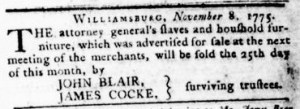
Virginia Gazette [Pinkney] (November 9, 1775).

A subsequent advertisement did not use the same turn of phrase.  After Peyton Randolph, one of the trustees, died suddenly on October 22, a new advertisement that first appeared in the November 9 edition of John Pinkney’s Virginia Gazette clarified that the “attorney general’s slaves and household furniture, which was advertised for sale at the next meeting of the merchants, will be sold the 25th day of this month, by JOHN BLAIR, [and] JAMES COCKE, surviving trustees.”  Of course, eighteenth-century readers understood the reference to “FAMILY SERVANTS” in the original advertisement.  They did not need a subsequent notice to clarify that it meant enslaved men and women.  They knew the lexicon of newspaper notices about enslaved people just as well as they knew the lexicon of consumer culture in advertisements that promoted all sorts of goods, especially textiles, with names that seem unfamiliar to today’s readers.

August 9

What was advertised in a colonial American newspaper 250 years ago today?

South-Carolina Gazette (August 9, 1773).

“Lands, Houses, and Negroes, Bought and sold at private Sale, upon the usual Commissions.”

Jacob Valk opened a brokerage office in Charleston in the early 1770s.  For months in 1773, he ran an advertisement in the South-Carolina Gazette and the South-Carolina Gazette and Country Journal to alert “the PUBLIC in general, and his Friends in particular” about the various services he provided.  He presented five primary categories of tasks undertaken in his office:  “Merchants and Tradesmen may have their Books regulated,” “Sets of Books opened properly, for Persons newly commencing any Kind of Business and superintended with the utmost Care,” “Persons desirous of settling their yearly Business expeditiously, by sending their Books to him may have it done,” “Money borrowed and lent at Interest,” and “Lands, Houses, and Negroes, Bought and sold at private Sale, upon the usual Commissions.”  Among the various jobs that he did on behalf of colonizers who employed him, Valk facilitated buying and selling enslaved men, women, and children.

To that end, he also placed advertisements on behalf of his clients.  In the August 9, 1773, edition of the South-Carolina Gazette, one of those advertisements ran immediately below his weekly notice about his various services.  On behalf of his clients, the broker described “Four valuable and seasoned Negroes” available “by private Contract” rather than auction.  Two young men were “fit for the Field,” but another young man as well as a woman possessed skills for contributing to a household.  The “young FELLOW” had experience as a “complete Waiting-Man” who had also seen to the “Care and Management of Horses, and can drive a Carriage.”  The woman was a “complete” housekeeper, “who is also a good ordinary Cook.”  Valk concluded with instructions that prospective buyers should contact him for more information about the enslaved men and woman and the “Terms of Sale.”

In another advertisement in the same issue, the broker described a house and lot for sale.  Valk’s newspaper advertisements outlining his services likely helped generate business in his brokerage office.  In turn, he placed additional notices that increased his visibility and, when successful, augmented his reputation among his clients and the general public.  Those advertisement also demonstrated that the broker actively worked on behalf of his clients, confirming for prospective customers that they might do better by entrusting sales to him “upon the usual Commissions” rather than invest their own time and effort.  In addition, those additional advertisements testified to the fact that others did indeed employ Valk, perhaps elevating the confidence that prospective clients had in his abilities.

July 21

What was advertised in a colonial American newspaper 250 years ago today?

Jul 21 - 7:21:1770 Providence Gazette
Providence Gazette (July 21, 1770).

“Some Negroes likewise to be sold.”

For several weeks in the summer of 1770, Henry Paget took to the pagers of the Providence Gazette to advertise several properties for sale in Rhode Island, Massachusetts, and Connecticut.  Those properties included a farm in Smithfield, Rhode Island, a “Lot of very good Land” near Ware, Massachusetts, and a house near Reading, Connecticut.  He also offered for sale his “Dwelling-House” with “Shops and a good Store below” in Providence, promoting its prime location “near the Great Bridge, and handy to the College.”  Yet Paget’s notice was not merely a real estate advertisement.

At the conclusion of the advertisement, Paget inserted two additional lines indicating that he also sought to sell enslaved people:  “Some Negroes likewise to be sold.  For further Particulars enquire of said Paget.”  He did not provide further details.  He did not state how many enslaved people he intended to sell.  He did not say how many were men or women or children.  He did not list any ages.  He did not report on the skills any of them possessed.  Other advertisements sometimes included those “Particulars,” but many did not.

Eighteenth-century newspapers, including those published in New England, frequently carried advertisements that casually mentioned enslaved people for sale.  In many instances, such sales were not the primary purpose of the notices.  Instead, such sales appeared as postscripts to advertisements placed for other reasons, such as Paget’s real estate notice, or enslaved people were included alongside various commodities, treating them as though they were nothing more than commodities themselves.  Rather than focusing exclusively on enslaved people, many advertisements made casual reference to enslaved people, integrating the buying and selling of men, women, and children into other daily activities and commercial transactions.

At a glance, Paget’s advertisement does not appear to be an advertisement offering enslaved people for sale.  The headline, “His FARM,” suggests that it was a real estate notice.  That might make it easy for modern readers to overlook those final two lines unless they read carefully.  For readers of the Providence Gazette in 1770, however, enslavement was part of the fabric of everyday life.  Advertisements that hint at “Some Negroes likewise to be sold” only begin to tell much more extensive stories of enslavement in colonial and revolutionary New England.