December 26

Who was the subject of an advertisement in a revolutionary American newspaper 250 years ago today?

Dunlap’s Maryland Gazette (December 26, 1775).

“N.B. A Negroe woman Cook, healthy honest and sober, 33 years old.”

Alexander Stenhouse apparently wished to discontinue his medical supply business in Baltimore.  In the final week of December 1775, he placed advertisements in both Dunlap’s Maryland Gazette and the Maryland Journal that listed a “general Collection of DRUGS and MEDICINES” available for sale.  He added vials, “Large bottles for Distilled Waters,” “Pill pots of various sizes, labelled and plain,” “Mortars and pestles,” “Surgeons Instruments,” and other medical equipment.  He even included “Shop Furniture,” suggesting that he no longer needed it because he would no longer pursue that trade.  In addition, he declared that the “Drugs and Medicines will not be sold singly, so it is expected those who want will take an assortment.”  To make the offer even more attractive, Stenhouse promised a “considerable discount … to a person who will purchase the whole.”  Perhaps Stenhouse even intended to leave Baltimore.  His inventory concluded with a “Collection of Books, mostly modern publications,” and “Houshold and kitchen furniture, in general almost new.”

Stenhouse offered more than just the contents of his shop and home for sale.  In a nota bene that followed his signature, he described a “Negroe woman Cook, healthy honest and sober, 33 years old.”  The sale of that woman whose name was once known testifies to the widespread use of the early American press to perpetuate slavery and the slave trade.  At a glance, the phrases “TO BE SOLD” and “DRUGS and MEDICINES,” dominated Stenhouse’s advertisement.  The list of items for sale, divided into two columns, unlike any of the other in either newspaper, likely caught readers’ eyes as well.  Those aspects of Stenhouse’s advertisement overshadowed but did not eclipse the portion that offered an enslaved woman for sale.  The format did not indicate that Stenhouse felt any shame or embarrassment about selling a “Negroe woman Cook” and wanted to downplay it; instead, the format demonstrated just how casually enslavers incorporated such transactions into everyday advertising and routine business.  “N.B.” or nota bene, after all, meant “take note.”  Stenhouse wished for readers to “take note” that he wished to sell an enslaved woman as he “disposed of” the contents of his shop and home.
June 6

Who was the subject of an advertisement in a revolutionary American newspaper published 250 years ago today?

Pennsylvania Evening Post (June 6, 1775).

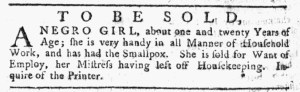
“TO BE SOLD, A NEGRO GIRL…  Inquire of the Printer.”

The June 6, 1775, edition of the Pennsylvania Evening Post carried only two advertisements.  One announced that the Ann from Bristol arrived with a “NUMBER of healthy Men and Women SERVANTS, among whom are Tradesmen, also Sawyers, Footmen, [and] Labourers.”  William and Fisher and Son sold the “Times” of these indentured servants, each of whom willingly made the voyage across the Atlantic.  In exchange for their passage, they agreed to serve for a certain number of years, their “Times,” as specified in their indentures or contracts.

The other advertisement offered a “NEGRO GIRL, about one and twenty Years of Age,” for sale, describing her as “very handy in all Manner of Household Work.”  In addition, she “has had the Smallpox,” which meant that she would not contract the disease again.  As a result, potential buyers could feel more secure in their investment if they bought her.  Furthermore, the advertisement explained that the young woman “is sold for Want of Employ, her Mistress having left off Housekeeping.”  Again, the seller sought to offer reassurances.  The enslaved woman was not sick nor disobedient, just unnecessary.  Rather than free the young woman, her enslaver opted to sell her.  Unlike the servants featured in the other advertisement, she would not gain her freedom in a few years.  She did not have a contract.  She did not serve willingly.

Benjamin Towne, on the other hand, willingly acted as a slave broker in facilitating the transaction.  The advertisement instructed anyone interested in purchasing the enslaved woman to “Inquire of the Printer.”  Towne had been printing the Pennsylvania Evening Post, one of the first tri-weekly newspapers in the colonies, since late January 1775.  This advertisement was the first that offered an enslaved person for sale as well as the first that positioned the printer as a broker.  That it took more than four months does not seem to have been the result of any principles exercised by Towne, though that could have been a factor initially.  Instead, the Pennsylvania Evening Post, printed on a smaller sheet than other newspapers published in Philadelphia, carried fewer advertisements than its competitors.  That seems like the most probable explanation for taking so long to carry an “Inquire of the Printer” advertisement that presented an enslaved person for sale.  Even if Towne had misgivings about such notices when he embarked on publishing the newspaper, the need to generate revenue and remain competitive with Philadelphia’s other newspapers won out.

February 25

Who was the subject of an advertisement in a colonial American newspaper 250 years ago today?

Pennsylvania Ledger (February 25, 1775).

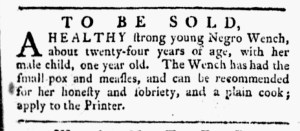
“A HEALTHY strong young Negro [Woman] … with her male child, one year old.”

Five issues.  It took only five issues for an advertisement offering enslaved people for sale to appear in the Pennsylvania Ledger.  James Humphreys, Jr., launched the newspaper on January 28, 1775.  Four weeks later, he printed an advertisement about a “HEALTHY strong young Negro [Woman], about twenty-four years of age,” to be sold “with her male child, one year old.”  The Pennsylvania Ledger was still such a new publication when it carried this advertisement that the proposals and conditions for subscribing appeared as the first item in the first column on the first page.  An advertisement for a political pamphlet ran immediately below the proposals, followed by the advertisement for the enslaved young woman and her child.  Readers encountered them before news reprinted from the Maryland Gazette or any of the other content in that issue.

Humphreys did not merely print and disseminate the advertisement.  He also acted as a broker in the sale.  The notice instructed interested parties to “apply to the Printer.”  What role Humphreys would play when someone did “apply” to him was not apparent in the advertisement.  He may have referred prospective buyers to the advertiser, he may have provided more details about the sale, including price and credit, or he may have been empowered to agree to a sale should a buyer meet the terms specified by the enslaver who offered the woman and child for sale.  Whatever role he played, Humphreys was actively involved in the sale beyond printing the advertisement in his newspaper.

He may have even consulted with the advertiser in composing the advertisement, though it was formulaic enough that an enslaver looking to sell human property likely did not need such assistance.  After all, such “enquire of the printer” advertisements appeared regularly in newspapers published during the era of the American Revolution.  The anonymous advertiser noted that the enslaved woman “has had the small-pox and measles,” a guarantee of her health in the future since she would not contract those diseases again, and “can be well recommended fort her honesty and sobriety.”  In addition, she was a “plain cook.”  Such language was just as common in advertisements for enslaved people as directions to “apply to the Printer” who would act as a broker in the sale.

For more on such advertisements, see Jordan Taylor’s “Enquire of the Printer: The Slave Trade and Early American Newspaper Advertising.”

January 31

Who was the subject of an advertisement in a colonial American newspaper 250 years ago today?

New-Hampshire Gazette (January 31, 1772).

“TO BE SOLD A LIKELY Negro Woman.”

An advertisement in the January 31, 1772, edition of the New-Hampshire Gazette offered a “LIKELY Negro Woman” for sale.  Nothing about the advertisement distinguished it from similar advertisements published in newspapers from New England to Georgia in the era of the American Revolution.  Slavery was so ubiquitous, such a part of everyday life, throughout the colonies that such an advertisement did not look out of place to the readers of the New-Hampshire Gazetteany more than it would have for readers of the Maryland Gazette, the Virginia Gazette, the South-Carolina Gazette, or the Georgia Gazette.  Newspapers published in southern colonies certainly carried more advertisements about enslaved people, but they were not unique to that region.

The advertisement in the New-Hampshire Gazette provided few details about the “LIKELY Negro Woman.”  Instead, it directed interested parties to “Enquire of the Printers.”  Enslavers often adopted this approach in their advertisements, relying on printers to act as brokers in such transactions.  As a result, printers became implicated in the slave trade twice over, first through disseminating such advertisements and then through actively participating in sales of enslaved men, women, and children.  They did not need to be enslavers themselves to play an important role in perpetuating the slave trade.

Yet printers did more than facilitate sales.  They also published advertisements that described enslaved people who liberated themselves by escaping from their enslavers and offered rewards for their capture and return.  Such advertisements contributed to a culture of surveillance of Black people, encouraging readers to carefully scrutinize any Black person they encountered to determine if they matched the descriptions in the newspaper advertisements.

Each advertisement that printers published generated revenues that helped in making their newspapers viable enterprises.  Even as many printers critiqued the abuses perpetrated by Parliament and advocated for independence during the era of the American Revolution, they also published advertisements that perpetuated slavery.  Those advertisements underwrote the dissemination of news and editorials during the imperial crisis that culminated in the American Revolution.  Denied liberty for herself, the “LIKELY Negro Woman” advertised in the New-Hampshire Gazette played a part in the colonies achieving independence and establishing a new nation.

**********

For a more extensive chronicle of newspaper advertisements about enslaved people published during the era of the American Revolution, follow the Slavery Adverts 250 Project.

December 7

GUEST CURATOR:  Samantha Rhodes

Who was the subject of an advertisement in a colonial American newspaper 250 years ago today?

Providence Gazette (December 7, 1771).

“A LIKELY NEGRO GIRL … that understands … Spinning.”

During the era of the American Revolution, Matthew Allen of Barrington, Rhode Island, placed an advertisement offering “A LIKELY NEGRO GIRL” for sale. Allen stated that the enslaved young woman “understands all Kinds of Houshold Work.” In particular, she was familiar with spinning. That young woman spun wool on a spinning wheel, perhaps contributing to the revolutionary cause even as she remained enslaved.  In The Age of Homespun, Laurel Thatcher Ulrich argues that women “played a critical role” during the “decades of resistance leading up to the War of Independence.”  When “Americans throughout the colonies began boycotting the importation of British goods in protest of increased taxation on everyday items,” women participated in spinning bees.  Ulrich declares, “One writer described the Daughters of Liberty at Newport, Rhode Island, ‘laudably employed in playing on a musical Instrument called a Spinning Wheel, the Melody of whose Music, and the beauty of the Prospect, transcending for Delight, all the Entertainment of my Life.’”  What did the sound of the spinning wheel mean to the enslaved woman in this advertisement?  She may not have experienced the same enthusiasm.

**********

ADDITIONAL COMMENTARY:  Carl Robert Keyes

Ulrich examines accounts of spinning bees in New England.  Reports about those public demonstrations staged by women received positive coverage in the early American press, celebrating women who devised an appropriately feminine means of making political statements in the wake of the abuses perpetrated by Parliament.  According to Ulrich, “Only six newspaper stories explicitly described the spinners as ‘Daughters of Liberty.’”  Others made reference to “young women,” “the fair sex,” “Daughters of Industry,” and “noble-hearted Nymphs.”  Some writers were even more verbose.  One presented the spinners in Taunton, Massachusetts, as “young Blooming Virgins … with all their Native Beauties of Sixteen.”  Another lauded the spinners who gathered at Daniel Weeden’s house in Jamestown, Rhode Island, asserting that they were “of good Fashion and unexceptionable Reputation.”

The enslaved woman advertised in the Providence Gazette possessed the same skills as the women who participated in the spinning bees, yet, as Samantha notes, spinning likely had a very different meaning for her.  To a young enslaved woman marketed as someone who “understands … spinning,” the noises made by spinning wheels did not resonate with the ideals of freedom and resistance enunciated by white women who attended spinning bees, white observers who witnessed or read about their efforts, and white writers who memorialized their activities.  This form of domestic labor became a form of political protest for some women in the colonies, but not for every woman.  In private spaces, the enslaved woman in this advertisement may have labored alongside other women who became visible symbols of the American cause when they participated in spinning bees observed by the public.  Her efforts at the wheel may have been part of a chain of production that ultimately resulted in homespun cloth that replaced imported textiles when nonimportation agreements were in effect.  Yet spinning did not hold the same promises of freedom for that “LIKELY NEGRO GIRL” offered for sale in the Providence Gazette that it did for the young women acclaimed in so many accounts that appeared elsewhere in the newspaper.