June 8

Who was the subject of an advertisement in a revolutionary American newspaper 250 years ago today?
Freeman’s Journal (June 8, 1776).

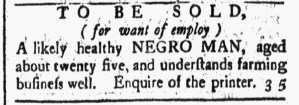
“A likely healthy NEGRO MAN … Enquire of the printer. 3 5”

Benjamin Dearborn published the third issue of the Freeman’s Journal on June 8, 1776.  Among the various advertisements that appeared in that issue, one announced, “TO BE SOLD, (for want of employ) A likely healthy NEGRO MAN, aged about twenty five, and understands farming business well.”  For interested parties who wanted to know more, the notice instructed them to “Enquire of the printer” at his printing office in Portsmouth, New Hampshire.  The previous issue of the Freeman’s Journal featured an advertisement in which Samuel Hall described Seneca, an enslaved man who liberated himself by running away from his enslaver on May 29, and offered a reward for his capture and return.  In the course of the first three issues, Dearborn went from proclaiming “the most sacred rights of a free people” in an address to readers to encouraging the surveillance of Black men in a notice placed for the purpose of capturing a fugitive from slavery to actively participating in the slave trade as a broker and proxy for an anonymous advertiser.

Notations in both advertisements suggests that each met with success.  Hall’s advertisement concerning Seneca concluded with “2–4,” a notation intended for the compositor who set type rather than for readers.  It indicated that Hall’s advertisement should appear in issue “No. 2” through issue “No. 4.”  However, Hall’s advertisement did not run in any subsequent issue, suggesting that Seneca had been captured and returned and, in turn, the notice withdrawn.  The anonymous “enquire of the printer” advertisement concluded with a similar notation, “3 5.”  It first appeared in issue “No. 3” and should have appeared in the next two issues as well.  It did not run the following week, but a note from the printer promised that “Advertisements &c. omitted, will be in our next.”  The advertisement did indeed appear in issue “No. 5” the following week, with the notation revised to “3 6” to allow for the week it did not run.  That meant that it should have appeared in the third (June 8), fifth (June 22) and sixth (June 29) issues of the Freeman’s Journal.  The advertisement did not run again, suggesting that someone had indeed enquired of the printer and completed the transaction.  Dearborn commenced advertising the “Books so much admired, entitled COMMON SENSE,” the most influential political pamphlet advocating for the colonies to declare independence, on June 22, the last issue that carried the advertisement offering the enslaved man for sale.  Dearborn deployed the power of the press to promote the liberty of some Americans while restricting the liberty of others.
June 6

Who was the subject of an advertisement in a revolutionary American newspaper published 250 years ago today?

Pennsylvania Evening Post (June 6, 1775).

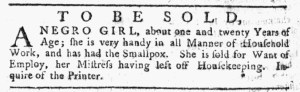
“TO BE SOLD, A NEGRO GIRL…  Inquire of the Printer.”

The June 6, 1775, edition of the Pennsylvania Evening Post carried only two advertisements.  One announced that the Ann from Bristol arrived with a “NUMBER of healthy Men and Women SERVANTS, among whom are Tradesmen, also Sawyers, Footmen, [and] Labourers.”  William and Fisher and Son sold the “Times” of these indentured servants, each of whom willingly made the voyage across the Atlantic.  In exchange for their passage, they agreed to serve for a certain number of years, their “Times,” as specified in their indentures or contracts.

The other advertisement offered a “NEGRO GIRL, about one and twenty Years of Age,” for sale, describing her as “very handy in all Manner of Household Work.”  In addition, she “has had the Smallpox,” which meant that she would not contract the disease again.  As a result, potential buyers could feel more secure in their investment if they bought her.  Furthermore, the advertisement explained that the young woman “is sold for Want of Employ, her Mistress having left off Housekeeping.”  Again, the seller sought to offer reassurances.  The enslaved woman was not sick nor disobedient, just unnecessary.  Rather than free the young woman, her enslaver opted to sell her.  Unlike the servants featured in the other advertisement, she would not gain her freedom in a few years.  She did not have a contract.  She did not serve willingly.

Benjamin Towne, on the other hand, willingly acted as a slave broker in facilitating the transaction.  The advertisement instructed anyone interested in purchasing the enslaved woman to “Inquire of the Printer.”  Towne had been printing the Pennsylvania Evening Post, one of the first tri-weekly newspapers in the colonies, since late January 1775.  This advertisement was the first that offered an enslaved person for sale as well as the first that positioned the printer as a broker.  That it took more than four months does not seem to have been the result of any principles exercised by Towne, though that could have been a factor initially.  Instead, the Pennsylvania Evening Post, printed on a smaller sheet than other newspapers published in Philadelphia, carried fewer advertisements than its competitors.  That seems like the most probable explanation for taking so long to carry an “Inquire of the Printer” advertisement that presented an enslaved person for sale.  Even if Towne had misgivings about such notices when he embarked on publishing the newspaper, the need to generate revenue and remain competitive with Philadelphia’s other newspapers won out.

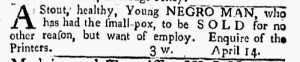
April 14

Who was the subject of an advertisement in a colonial American newspaper 250 years ago today?

Story and Humphreys’s Pennsylvania Mercury (April 14, 1775).

“A Stout, healthy, Young NEGRO MAN … to be SOLD … Enquire of the Printers.”

On April 14, 1775, Enoch Story and Daniel Humphreys published “VOL. I.  NUMB. 2,” the second issue of their new newspaper.  They updated the title in the masthead from The Pennsylvania Mercury; and the Universal Advertiser to Story and Humphreys’s Pennsylvania Mercury, and Universal Advertiser.  The colophon running across the bottom of the final page remained the same, advising readers that they “gratefully received” subscriptions, advertisements, articles, and “Letters of Intelligence” at their printing office in Norris’s Alley in Philadelphia.  Their first issue featured a significant number of advertisements.  The second issue contained even more.  Advertisers were willing to take a chance with this new newspaper, apparently believing that its circulation justified the investment in purchasing space to disseminate their notices.

Among the advertisements that ran for the first time in the second issue of Story and Humphreys’s Pennsylvania Mercury, one offered “A Stout, healthy, Young NEGRO MAN, who has had the small-pox, to be SOLD for no other reason, but want of employ.”  It advised interested parties to “Enquire of the Printers” to learn more.  The notice was dated “April 14” and had a notation, “3 w,” that let the compositor know to include it in three issues.  Last week, Story and Humphreys’s Pennsylvania Mercury made its first appearance in the Adverts 250 Project to examine the advertisements in it (or its second appearance when counting subscription proposals that ran in another newspaper).  Today, the Adverts 250 Project features that newspaper once again because it is making its first appearance in the Slavery Adverts 250 Project.

Yet Story and Humphreys did not merely publish an advertisement that offered an enslaved man for sale.  They published an “Enquire of the Printers” advertisement that made them active participants in the sale.  They may have facilitated an introduction, or they may have negotiated on behalf of the advertiser.  The notice does not reveal the extent of their involvement, but it does indicate that they were involved beyond publishing the advertisement and earning revenue for doing so.  As Jordan E. Taylor documents, American printers acted as slave brokers in thousands of advertisements in newspapers published throughout the colonies and, later, states in the eighteenth century.[1]  Participating in the slave trade was part of the business model for operating a viable newspaper.  Taylor could not identify any printers who refused to run advertisements that offered enslaved people for sale as a matter of principle; the financial incentives were too strong to ignore.  Story and Humphreys very quickly incorporated perpetuating slavery into the practices for their press, both as printers who disseminated advertisements offering enslaved people for sale and as printers who served as slave brokers via “Enquire of the Printers” advertisements.

**********

[1] Jordan E. Taylor, “Enquire of the Printer: Newspaper Advertising and the Moral Economy of the North American Slave Trade, 1704-1807,” Early American Studies: An Interdisciplinary Journal 18, no. 3 (Summer 2020): 287-323.

February 25

Who was the subject of an advertisement in a colonial American newspaper 250 years ago today?

Pennsylvania Ledger (February 25, 1775).

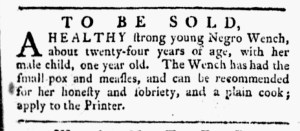
“A HEALTHY strong young Negro [Woman] … with her male child, one year old.”

Five issues.  It took only five issues for an advertisement offering enslaved people for sale to appear in the Pennsylvania Ledger.  James Humphreys, Jr., launched the newspaper on January 28, 1775.  Four weeks later, he printed an advertisement about a “HEALTHY strong young Negro [Woman], about twenty-four years of age,” to be sold “with her male child, one year old.”  The Pennsylvania Ledger was still such a new publication when it carried this advertisement that the proposals and conditions for subscribing appeared as the first item in the first column on the first page.  An advertisement for a political pamphlet ran immediately below the proposals, followed by the advertisement for the enslaved young woman and her child.  Readers encountered them before news reprinted from the Maryland Gazette or any of the other content in that issue.

Humphreys did not merely print and disseminate the advertisement.  He also acted as a broker in the sale.  The notice instructed interested parties to “apply to the Printer.”  What role Humphreys would play when someone did “apply” to him was not apparent in the advertisement.  He may have referred prospective buyers to the advertiser, he may have provided more details about the sale, including price and credit, or he may have been empowered to agree to a sale should a buyer meet the terms specified by the enslaver who offered the woman and child for sale.  Whatever role he played, Humphreys was actively involved in the sale beyond printing the advertisement in his newspaper.

He may have even consulted with the advertiser in composing the advertisement, though it was formulaic enough that an enslaver looking to sell human property likely did not need such assistance.  After all, such “enquire of the printer” advertisements appeared regularly in newspapers published during the era of the American Revolution.  The anonymous advertiser noted that the enslaved woman “has had the small-pox and measles,” a guarantee of her health in the future since she would not contract those diseases again, and “can be well recommended fort her honesty and sobriety.”  In addition, she was a “plain cook.”  Such language was just as common in advertisements for enslaved people as directions to “apply to the Printer” who would act as a broker in the sale.

For more on such advertisements, see Jordan Taylor’s “Enquire of the Printer: The Slave Trade and Early American Newspaper Advertising.”

October 10

Who was the subject of an advertisement in a colonial American newspaper 250 years ago today?

Connecticut Courant (October 10, 1774).

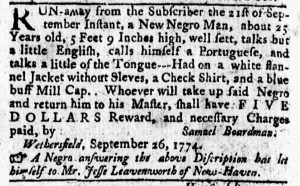
A Negro answering the above Discription has let himself to Mr. Jesse Leavensworth of New-Haven.”

In the fall of 1774, Samuel Boardman of Wethersfield took to the pages of the Connecticut Courant and Hartford Weekly Intelligencer to offer a reward for the capture and return of a “New Negro Man” who liberated himself by running away.  Boardman did not give a name for this man, but instead stated that he “talks but a little English, calls himself a Portuguese, and talks a little of the Tongue.”  He offered a reward to “Whoever will take up said Negro and return him to his Master.”  Dated September 26, the advertisement first appeared in the October 3 edition of the Connecticut Courant.  It included a notation indicating that a “Negro answering the above Discription has let himself to Mr. Jesse Leavensworth of New-Haven.”  Boardman most likely did not include that information in the copy he submitted to the printing office.

Instead, Ebenezer Watson, the printer, likely supplied it upon reading an advertisement that Leavenworth placed in the September 30 edition of the Connecticut Journal and New-Haven Post-Boy.  After all, printers regularly exchanged newspapers in hopes of acquiring content for their own publications.  Leavenworth devoted most of that notice to giving instructions for hiring his ferry, but added a note that recently a “lusty negro man, about 23 or 24 years old, speaks the Portuguese language, but little English” had “let himself to me.”  Leavenworth hired the young man, but was suspicious that he was a fugitive seeking freedom and his enslaver was looking for him.  Just in case, he supplemented his advertisement for the ferry with the description of the Black man who spoke Portuguese.  Given the timing of the advertisements in the two newspapers, Boardman would not have seen Leavenworth’s notice when he drafted his own advertisement.  If he had that information, he could have dispensed with advertising at all.

What role did Watson play in keeping Boardman informed about this development?  He might have dispatched a message to the advertiser in Wethersfield, though he could have considered the note at the end of the advertisement sufficient to update Boardman, figuring that his customer would check the pages of the Connecticut Courant to confirm that his notice appeared.  Watson could have also sent a message to Thomas Green and Samuel Green, the printers of the Connecticut Journal, along with his exchange copy of the Connecticut Courant, expecting they might pass along the information to Leavenworth.  In addition, Leavenworth might have eventually encountered Boardman’s advertisement, depending on his reading habits, or otherwise heard about it.  That alternative seems most likely.  No matter what other action Watson took, inserting the note that connected the unnamed Black man in Boardman’s advertisement in the Connecticut Courant to the unnamed Black man in Leavenworth’s advertisement in the Connecticut Journal alerted readers that they could collect the reward if they decided to pursue the matter.  The power of the press, including a printer whose assistance extended beyond merely setting type and disseminating the advertisement, worked to the advantage of Boardman, the enslaver, against the interests of the unnamed Black man who spoke Portuguese.