November 10

What was advertised in a revolutionary American newspaper 250 years ago today?
Virginia Gazette (November 10, 1775).

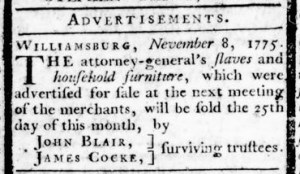
“JOHN BLAIR, JAMES COCKE, surviving trustees.”

An advertisement about the upcoming sale of the “attorney-general’s slaves and household furniture” in the November 10, 1775, edition of Alexander Purdie’s Virginia Gazette was signed by John Blair and James Cocke, the “surviving trustees.”  Upon learning of the death of Peyton Randolph, one of the original trustees, they had updated an advertisement that had been running in that newspaper as well as John Pinkney’s Virginia Gazette and John Dixon and William Hunter’s Virginia Gazette for several weeks.  John Randolph, the King’s Attorney General for the colony and a loyalist, had departed for England, leaving his brother, Peyton, along with Blair and Cocke as trustees to oversee and sell his estate. Peyton, a patriot and the president of the First Continental Congress, was in Philadelphia representing Virginia in the Second Continental Congress when he unexpectedly died, leaving Blair and Cocke as the “surviving trustees.”

Among the printers in Williamsburg, Purdie published the news of Randolph’s death first, nearly a week ahead of the other two newspapers.  Given that each published a new issue once a week, the news spread ahead of it appearing in print.  All the same, Purdie supplemented the brief notice that he ran in the November 3 edition with extensive coverage in the next issue on November 10.  “LAST sunday died of an apoplectick stroke,” the report began, “the hon. PEYTON RANDOLPH, Esq; of Virginia, late President of the Continental Congress, and Speaker of the House of Burgesses of that colony.”  On the following Tuesday, “his remains were removed … to Christ church, where an excellent sermon on the mournful occasion was preached … after which the corpse was carried to the burial ground, and deposited in a vault until it can be conveyed to Virginia.”  The dignitaries in the funeral procession included John Hancock, then serving as president of the Second Continental Congress, other “members of the Congress,” members of the Pennsylvania Assembly, and the mayor of Philadelphia.  Elsewhere in that issue, Purdie printed a memorial to Randolph, an eighteenth-century version of an obituary.  He also inserted a notice from Williamsburg’s Masonic Lodge: “Ordered, THAT the members of this Lodge go into mourning, for six weeks, for the late honourable and worthy provincial grand master, Peyton Randolph, esquire.”  To honor Randolph, Purdie enclosed the contents of the entire issue within thick black borders that signaled mourning.  Those borders ran on either side of the updated advertisement placed by the “surviving trustees” of John Randolph’s estate.

November 3

What was advertised in a revolutionary American newspaper 250 years ago today?

Virginia Gazette [Purdie] (November 3, 1775).

“To be SOLD … THE estate of John Randolph, esq; his majesty’s attorney-general.”

The advertisement for the “Estate of John Randolph” that ran in John Dixon and William Hunter’s Virginia Gazette in the fall of 1775 also appeared in the other newspapers published in Williamsburg, John Pinkney’s Virginia Gazette and Alexander Purdie’s Virginia Gazette.  When the Loyalist departed for England, either he left instructions to advertise widely or the trustees – Peyton Randolph (his brother), John Blair, and James Cocke – decided that they wanted news of the upcoming sale of Randolph’s house, furniture, and enslaved “family servants” to circulate as widely as possible.

Virginia Gazette [Purdie] (November 3, 1775).

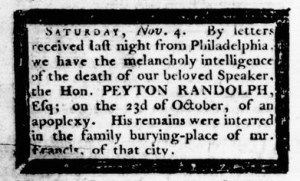
When the advertisement ran on the final page in the November 3 edition of Purdie’s Virginia Gazette, it contradicted news that appeared on the second page.  Thick black borders that indicated mourning surrounded a short article that informed readers, “By letter received last night from Philadelphia, we have the melancholy intelligence of the death of our beloved Speaker, the Hon. PEYTON RANDOLPH, Esq; on the 23d of October, of an apoplexy.  His remains were interred in the family burying-place of mr. Francis, of that city.”  Randolph had served as speaker of the colony’s House of Burgesses.  He also held very different political views than his brother, having served as president of the First Continental Congress when it met in Philadelphia in the fall of 1774 and, briefly, as president of the Second Continental Congress when it convened after the battles at Lexington and Concord the following year.  He had been in Philadelphia as one of Virginia’s delegates when he died.

Blair and Cocke, the “surviving trustees,” ran an updated advertisement the following week, but there had not been time to revise the notice that had been running for several weeks.  The side of the broadsheet that carried the advertisement may even have been printed already when Purdie’s printing office received word of Randolph’s death.  In addition, the report, dated “SATURDAY, Nov. 4,” introduces some confusion about when the news arrived and when Purdie printed and distributed the November 3 edition of his newspaper.  Purdie scooped the other two newspapers.  Pinkney delivered the news in his next edition on November 9 (along with the updated advertisement).  Dixon and Hunter inserted a news report and an extensive memorial on November 11.  Either they did not have the news in time for their November 4 edition, or the type had been set and the printing already commenced when it arrived.  That still does not describe the discrepancy in the dates for Purdie’s newspaper, though he may have been a day late in publishing it but listed November 3, the anticipated date of publication for the weekly newspaper, in the masthead as a polite fiction.

Not only did Purdie publish the news first with a brief article, but the following week he ran both a news article about Randolph’s death and funeral and a memorial to Randolph in his November 10 edition.  The text matched the memorial in Dixon and Hunter’s November 11 edition, but the compositor made different choices for the format.  Purdie also honored Randolph with thick black borders around the content on all four pages, not just enclosing the memorial.  That issue included the updated notice about John Randolph’s estate sale as the first of the advertisements on the final page, though the two-page supplement that accompanied it carried the original advertisement.  The news and an advertisement continued delivering contradictory information, suggesting that Purdie and others in his printing office were not attentive to every detail in every advertisement they published.  The original advertisement may have appeared again as filler to complete the page rather than as an intentional insertion by the trustees who oversaw the sale it announced.

June 10

What was advertised in a colonial American newspaper 250 years ago today?

New-Hampshire Gazette (June 10, 1774).

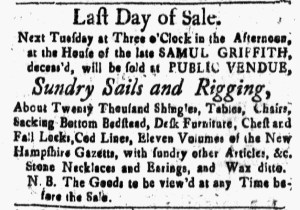
“Last Day of Sale.”

The executors for Samuel Griffith’s estate held a sale in Portsmouth on June 14, 1774, advertising a “PUBLIC VENDUE” in the June 10, 1774, edition of the New-Hampshire Gazette.  The sale included “Sundry Sails and Rigging” as well as “About Twenty Thousand Shingles, Tables, Chairs, [a] Sacking Bottom Bedstead, Desk Furniture, …with sundry other Articles” that prospective buyers could view prior to the sale.

Griffith had apparently kept abreast of the news.  His estate included “Eleven Volumes of the New Hampshire Gazette,” a “HISTORICAL CHRONICLE” (according to the masthead) of events in the colony and throughout the Atlantic world.  The executors considered Griffith’s collection of newspapers of significant enough interest to merit mention in the sale notice.  Griffith had not treated his copies of the New-Hampshire Gazette as ephemeral.  If those “Eleven Volumes” corresponded with the past eleven years, then buyers could acquire an account of the imperial crisis as it had unfolded with the Royal Proclamation of 1763, the passage and repeal of the Stamp Act in 1765 and 1766, the Townshend Acts and nonimportation agreements in the late 1760s, the Boston Massacre in 1770, and the Boston Tea Party in 1773.  Some colonizers, like Harbottle Dorr, revisited news and editorials to inform their understanding of current events.

To incite interest and increase the number of people in attendance, the executors included a headline that proclaimed, “Last Day of Sale.”  That alerted readers that they had limited opportunity to acquire any of the items from the estate, likely at bargain prices for secondhand wares compared to what they would pay retail for new items.  Those interested in the sails, rigging, and shingles for their own businesses also had the potential for lower prices than purchasing them elsewhere on the market, but not if they hesitated.  They needed to be present the following Tuesday when the sale commenced.  Many advertisements in the New-Hampshire Gazette did not feature headlines at all, so one announcing “Last Day of Sale” likely helped draw attention to an event soon to take place.

May 1

GUEST CURATOR: Patrick Waters

What was advertised in a colonial American newspaper 250 years ago today?

May 1 - 5:1:1769 New-York Gazette Weekly Mercury
New-York Gazette and Weekly Mercury (May 1, 1769).

“A compleat set of gold and silver smith’s tools.”

On May 1, 1769, this advertisement in the New-York Gazette and Weekly Mercury informed the public that there would be a public sale of household and kitchen items at the house of Nicholas Roosevelt, deceased. Roosevelt was probably a silversmith since the advertisements included “a compleat set of gold and silver smith’s tools.” Silver was used to create many items like teapots, silverware, plates, and bowls. Silversmithing was a notable occupation in colonial America, often seen as more of an art than a trade, according to the historians at Colonial Williamsburg.

In order to create a simple silver bowl, a silversmith needed to heat silver to 2000 degrees in a graphite and clay crucible. This liquid silver was then be poured out into a large sheet which would be hammered and molded into the desired shape. This was a difficult process because the silver would be extremely fragile while in this cooling state. To keep the silver malleable the smith repeatedly heated it and then plunged into an acid bath while it was being worked. This was a long process that required many different hammers – a “compleat set” – to achieve a perfectly smooth bowl.

These silver items had to be perfect not only because of the expensive materials used, but because they were sold to elite buyers. Silver teapots, bowls, and other items were very expensive commodities that only the upper class could afford, which they would then use to show off their affluence to their guests.

**********

ADDITIONAL COMMENTARY: Carl Robert Keyes

The same day that the advertisement concerning the sale of items from Nicholas Roosevelt’s estate appeared in the New-York Gazette and Weekly Mercury it also ran in the New-York Gazette: Or, the Weekly Post-Boy. The copy was exactly the same, though the compositors for the two newspapers made slightly different decisions about the format. The executor certainly sought to achieve maximum exposure for this sale, having previously advertised in the New-York Journal on April 27. The copy for that advertisement, however, deviated from what appeared in the other newspapers. The first portion was consistent, but the notice did not include the second half that offered the tools of Roosevelt’s trade for sale.

What explained this difference? Usually when advertisers invested the time and expense in placing notices in multiple newspapers they submitted identical copy to the printing offices. Why did the executor expand on the original advertisement from the New-York Journal when it ran in other newspapers a few days later? Perhaps the circumstances for settling Roosevelt’s estate changed. Maybe the executor had arranged for a buyer for the tools but then the deal fell apart, prompting a revised version of the advertisement.

Whatever the reason for adding the tools to the second iteration of the advertisement, the executor did not consider it necessary to update the original advertisement when it made a subsequent appearance in the New-York Journal on May 4. It ran just as it had the previous week, without mention of the “compleat set of gold and silver smith’s tools.” With the revised advertisement slated for publication in the other two newspapers one more time on May 8, the executor may have considered that sufficient visibility for attracting buyers. Alternately, the executor may not have considered it worth the expense to tinker with the wording of the advertisement in the New-York Journal since the type had already been set. The executor may have already received special consideration when placing that advertisement. The colophon listed a fee to run advertisements for a minimum of four weeks with additional fees for each subsequent insertion, yet this advertisement ran only twice.

Collating advertisements that appeared in multiple newspapers sometimes produces fairly definitive conclusions. For instance, identical copy with variations in format strongly suggests that advertisers were responsible for generating copy and compositors responsible for graphic design. The variations in the advertisements concerning Roosevelt’s estate, however, raise questions about decisions made by advertisers and business practices in printing offices, questions that elude answers when examining only eighteenth-century newspapers. They may also elude answers when consulting printers’ records and other sources, but the questions themselves do provide direction for another stage of research on advertising in early America. As the guest curators in my Revolutionary America class reach the end of the semester, this is another important lesson: no matter who much we have learned in this process, there is still so much more to discover. Seeking answers sometimes leads us to far more questions.

May 11

What was advertised in a colonial American newspaper 250 years ago today?

May 11 - 5:11:1768 Georgia Gazette
Georgia Gazette (May 11, 1768).

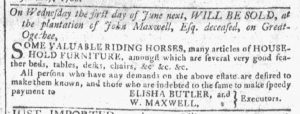
WILL BE SOLD … many articles of HOUSEHOLD FURNITURE.”

Advertisements for goods and services, especially newspaper notices, helped to stimulate the consumer revolution in eighteenth-century America. Colonial newspapers featured countless advertisements placed by merchants, shopkeepers, and artisans hawking countless new goods. Yet purchasing those items was not the only manner in which colonists acquired goods. Other advertisements testify to alternate means for participating in the consumer revolution. Many notices promoted vendues or auctions where savvy bidders stood to benefit from even greater bargains than they might experience in shops and warehouses. Customers purchased both new and used goods at auction. Other advertisements announced secondhand goods for sale, often as the result of sellers planning to leave the colony. Some advertisements also alerted colonists about thefts from homes and shops, warning them to be careful when purchasing secondhand goods because they might have been stolen.

When it came to opportunities to obtain secondhand goods, colonists most frequently encountered advertisements for estate sales, such as this advertisement from the May 11, 1768, edition of the Georgia Gazette in which the executors for “John Maxwell, Esq. deceased, on Great-Ogechee” sought to sell “many articles of HOUSEHOLD FURNITURE, amongst which are several very good feather beds, tables, desks, chairs.” Other advertisements in the same issue also promoted secondhand consumer goods that entered the marketplace via estate sales. The executors of “the ESTATE of FREDERICK HOLZENDORFF,” for instance, simultaneously called for his associates to settle accounts and announced the sale of “Household Goods and sundry other Articles.” Compared to newspapers published in Boston, Charleston, New York, Philadelphia, and other larger ports, the Georgia Gazette featured relatively few advertisements placed by merchants, shopkeepers, and artisans looking to sell inventories of new merchandise. In most issues, readers were as likely to find advertisements for estate sales as any other sort of notices presenting opportunities to acquire consumer goods. In eighteenth-century America, buying and selling the baubles of Britain and other items radiated far beyond shops and warehouses.

January 27

What was advertised in a colonial American newspaper 250 years ago today?

Jan 27 - 1:27:1768 Georgia Gazette
Georgia Gazette (January 27, 1768).

To be sold … ALL the PERSONAL ESTATE of said BENJAMIN GOLDWIRE.”

Some colonial newspapers seemed to overflow with advertisements places by merchants, shopkeepers, and artisans seeking to sell consumer goods. This was especially true of newspapers published in the largest urban ports, including Boston, Charleston, New York, and Philadelphia. Many newspapers from those cities frequently issued supplements devoted entirely to advertising. Other newspapers, however, featured far fewer advertisements for the wholesale or retail sale of consumer goods. Such was the case for the Georgia Gazette, published in Savannah by James Johnston. Even given the smaller population of the colony, shopkeepers placed relatively few advertisements in the Georgia Gazette. Perhaps the smaller population and fewer shops meant that the proprietors had less need to resort to the public prints rather than worrying about familiarity and word of mouth to promote their businesses.

The January 27, 1768, edition of the Georgia Gazette, for instance, did not include any advertisements placed by shopkeepers. That did not mean, however, that it lacked evidence of participation in the vibrant consumer culture of the eighteenth-century Atlantic world. Several advertisements encouraged colonists to acquire goods at venues other than shops and warehouses in Savannah. Instead of purchasing new items at those locations, consumers could get similar items at bargain rates at estate sales and auctions. In four of the thirty-one advertisements in that issue, executors announced such sales. Each of them included either “Household Furniture” or “HOUSEHOLD GOODS” in addition to slaves and livestock. Unlike advertisements placed by merchants and shopkeepers, these notices did not incorporate any of the most popular marketing strategies, although the appeal to price was implicit when it came to the possibility of low bids at auctions. In the absence of appeals to quality, fashion, or consumer choice, advertisements for estate sales and auctions stimulated the market for secondhand goods, expanding the realm of consumer culture for greater numbers of colonists who may not have had the means to acquire solely new goods from merchants and shopkeepers.

March 18

GUEST CURATOR: Daniel McDermott

Who was the subject of an advertisement in a colonial American newspaper 250 years ago today?

Mar 18 - 3:18:1767 Georgia Gazette
Georgia Gazette (March 18, 1767).

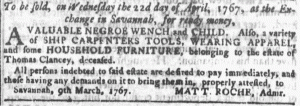
“A VALUABLE NEGROE WENCH and CHILD.”

Scanning through a colonial American newspaper, especially one from Georgia, it is not uncommon to see advertisements selling slaves with other goods. It is appalling to see a woman and her child being sold as property along with carpentry tools and household furniture. Ironically, in the 1730s the Georgia Trustees envisioned their colony as a free settlement. Unfortunately, the economic temptations were too strong and by 1751 slavery was legalized. In contrast, by 1784, the northern states, Pennsylvania, Massachusetts, New Hampshire, Connecticut, and Rhode Island, had all abolished slavery. But Georgia remained a slave state after the Revolution.

Two crops dominated the Georgia economy, rice in the eighteenth century and cotton in the nineteenth century. Rice and cotton plantations required an adequate slave labor force, so as Georgia’s plantations grew so did the demand for slaves. A state law passed in 1793 prohibited the importation of slaves, but the law went into effect in 1798. During the 1790s the number of slaves in Georgia nearly doubled. In 1790 Georgia had 29,264 slaves, but then 54,699 slaves in 1800.

What did it really mean to see a slave advertisement in the colonial American newspaper? It means viewing human beings as property that could contribute to the owner’s own economic growth. They were seen just as equal as household furniture and other common goods that could be sold and advertised in a newspaper.

**********

ADDITIONAL COMMENTARY: Carl Robert Keyes

Today is the 251st anniversary of the repeal of the Stamp Act. Such an odd number merits little notice in a culture that usually prefers to celebrate landmark numbers of years measured in decades. For the purposes of the Adverts 250 Project, however, March 18, 1767, was the first anniversary of the repeal of the Stamp Act. Colonists did not allow that important anniversary to pass unnoticed. Instead, they engaged in commemorations noted in newspapers published throughout the colonies during the week before and several weeks after March 18.

Against that backdrop, today’s advertisement for “A VALUABLE NEGROE WENCH and CHILD” seems especially jarring. The juxtaposition did not go unnoticed during the years prior to the American Revolution. In Taxation No Tyranny, published in 1775, Samuel Johnson famously asked, “How is it that we hear the loudest yelps for liberty among the drivers of negroes?” The British author and lexicographer identified a glaring inconsistency in the rhetoric of colonists who claimed they were being enslaved by Parliament.

Although patriots in northern colonies (later states) did not level the same sort of acerbic observations against their southern counterparts, many increasingly applied the rhetoric of liberty to the circumstances of their own slaves. As Daniel notes, several northern states abolished slavery by the end of the eighteenth century. Others adopted gradual emancipation plans. As a result, advertisements offering slaves for sale tapered off in northern newspapers.

For the past six months, the Slavery Adverts 250 Project has demonstrated, however, that advertisements for slaves were common in newspapers printed in New England and the Middle Atlantic, regions not associated with slavery to the same extent as the Chesapeake and the Lower South (in part because the northern regions abolished or phased out slavery after the Revolution). Today’s advertisement lumping together “A VALUABLE NEGROE WENCH and CHILD” with tools, clothing, and furniture appeared in some variation in newspapers printed in Boston, New York, and Philadelphia during its week of initial publication.

As Daniel and his peers in my Revolutionary America class work on the Adverts 250 Project and the Slavery Adverts 250 Project, I am encouraging them to contemplate the tensions between liberty and enslavement in eighteenth-century America, as well as the uneven application of the rhetoric of the Revolution when it came to slavery. While it is important to realize that approximately half a million slaves resided in the colonies at the time of the Revolution, the micro-histories embedded in slavery advertisements tell the stories of individuals. They provide further insight into the daily lives and lived experiences of enslaved men, women, and children in early America.