What was advertised in a revolutionary American newspaper 250 years ago this week?
New-York Journal (February 15, 1776).
“A NEW and CORRECT EDITION … of that justly esteemed PAMPHLET, called COMMON SENSE.”
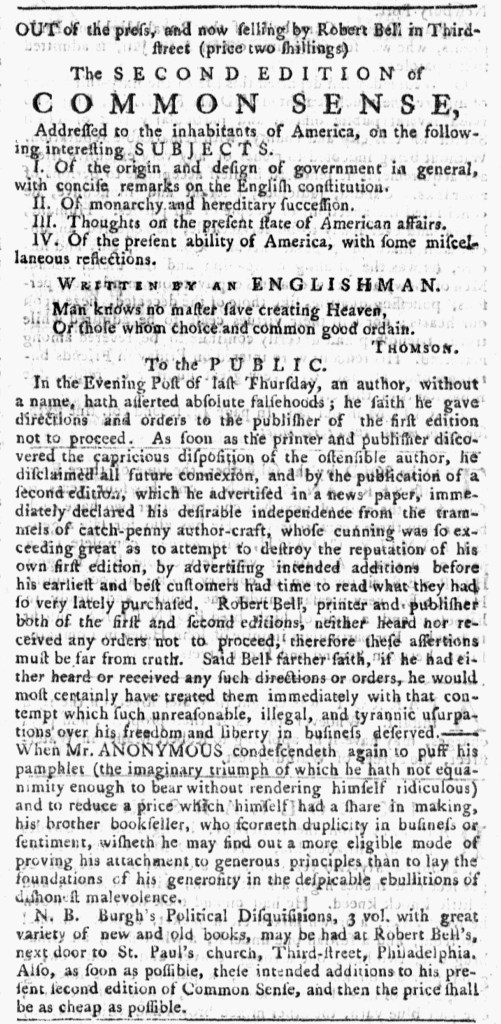
A month after Robert Bell published the first edition of Thomas Paine’s Common Sense in Philadelphia on January 9, 1776, readers of the New-York Journal certainly knew about the pamphlet, even if they had not read it or heard much about its contents. Just reading the newspaper would have been enough to get a sense of the pamphlet’s popularity. After all, the February 15 edition of the New-York Journal carried four advertisements for Common Sense!
Some of them would have looked familiar to regular readers of that newspaper. William Green, a bookbinder in Maiden Lane and Bell’s agent in New York, once again advertised the unauthorized “Second Edition of COMMON SENSE” that Bell published in Philadelphia. It was the third consecutive week his notice ran in the New-York Journal. Also appearing for the third time, another advertisement informed readers that William Bradford and Thomas Bradford would soon publish a “NEW EDITION, (with LARGE and INTERESTING ADDITIONS …) OF COMMON SENSE,” an edition undertaken “by appointment of the Author.” After a falling out with Bell, Paine approached the printers of the Pennsylvania Journal to publish a new edition. The Bradfords set about advertising that expanded edition in both Philadelphia and New York.
A variation of one of the other advertisements ran in the previous issue of the New-York Journal. In it, John Anderson, the printer of the Constitutional Gazette, announced publication of a local edition of “that justly esteemed PAMPHLET, called COMMON SENSE.” The previous version ended with the title of the pamphlet. The new one included two elements often included in other advertisements for Common Sense: the section headings that outlined the contents and an epigraph from “Liberty,” a poem by James Thomson. The addition material in Anderson’s advertisement may have helped draw attention to it …
… but the final advertisement dwarfed all the others. For the first time, Bell advertised directly in the New-York Journal rather than indirectly through Green. In doing so, he transferred to New York the feud that he and Paine had waged in advertisements in the Pennsylvania Evening Post and other newspapers published in Philadelphia. Compared to the Bradfords’ new edition “In the PRESS, and will be published as soon as possible,” Bell’s unauthorized second edition was “Out of the Press” and on sale. His notice included the section headers and epigraph by Thomson as well as an address “To the PUBLIC” that first appeared in the Pennsylvania Evening Post on January 27 and an even longer diatribe “To Mr. ANONYMOUS” that first appeared in the Pennsylvania Evening Post on February 1. While the Bradfords’ advertisement hinted at discord between Bell and Paine, this advertisement put the argument on full display for readers in New York. Perhaps that helped generate interest in the pamphlet. For readers who had not yet perused Common Sense themselves, those four advertisements may have encouraged them to acquire a copy to find out more about all the hullabaloo.
What was advertised in a revolutionary American newspaper 250 years ago today?
Pennsylvania Evening Post (February 1, 1776).
“A Number of ANXIOUS FRIENDS, and all the MILITARY MEN who wanted MITTENS.”
The screed extended an entire column and overflowed into another in the February 1, 1776, edition of the Pennsylvania Evening Post. It continued the feud between Thomas Paine, the author of Common Sense, and Robert Bell, the publisher of the first edition who embarked on an unauthorized second edition. Two days earlier, advertisements for Bell’s second edition and a forthcoming edition that Paine collaborated with William Bradford and Thomas Bradford in publishing ran side by side in that newspaper. One included an address “To the PUBLIC” by Bell and the other featured a “declaration” by the author. Paine, who still remained anonymous given the radical contents of the pamphlet, concluded by stating, “This is all the notice that will ever be taken of [Bell] in future.”
For his part, Bell was not finished taking notice of Paine. He quickly submitted a response, addressed “TO MR. ANONYMOUS,” for publication among the advertisements that ran in the next issue of the Pennsylvania Evening Post. He mocked Paine because the “Feeble author” “took the field” and engaged in battle that he supposedly could not win against the “Provedore to the Sentimentalists,” as Bell often referred to himself in the subscription proposals he circulated and in his newspaper advertisements for book auctions. The publisher claimed that he had been “wantonly, and maliciously, dragged … into the unwished for field of public altercation,” yet he would defend his actions and his reputation. Bell attacked Paine’s claim that he wished to remain anonymous: “You say you wanted to remain unknown … but, in practice, yourself telling it in every beer-house, gives the direct LIE to the assertor of such falsehood.” Even though Paine’s name had not yet appeared in print, Bell alleged that the author had been bragging about writing Common Sense in taverns around town.
Bell also demeaned “boasted intentional generosity” of the “Would-be-Author” who had declared that he planned to use his share of the profits from the first edition, which he never received, to purchase mittens for the soldiers participating in the American invasion of Canada. Bell insinuated that Paine mentioned drew the “MILITARY MEN who wanted MITTENS” into the dispute as a means of currying favor with the public as he threatened “malevolent LAW SUITS … against one industrious Bookseller, who never asked or received any thing from the public without giving an equivalent.” In contrast to Paine’s manipulations of both his friends who acted as intermediaries and the public, Bell portrayed himself as an honest entrepreneur, “a poor individual who neither attempteth nor wisheth for more FRIENDS than the rectitude of his conduct in business, an in the affairs of society, shall both gain and retain.”
Taking another shot at Paine, Bell instructed him that “your taking the public field was bad, because there was no foundation for it, unless envy be allowed a good one.” Furthermore, his “management of the fight and precipitate flight was worse – and final exit (as you say) worse and worse.” The publisher scorned the way that author backed down, comparing his handling of the situation to a “rascally PUPPY, who, with open mouth, runs snarling at an honest manly DOG, whose notice is attracted by the yelpings of the ill-natured CUR.” Paine, the “PUPPY,” ran away with his tail between his legs once he was on the receiving end of “words of stern contempt.”
Much of the dispute revolved around the revenues generated by Common Sense (or, as “the assignees of the nameless author” discovered, a surprising lack of profits on the first edition). Yet the feud and the publication of multiple editions of Common Sense did produce revenues for Benjamin Towne, the printer of the Pennsylvania Evening Post. The competing advertisements comprised one-quarter of the content in the January 30 edition and Bell’s notice in response to Paine’s “declaration” occupied nearly as much space. With those advertisements, Towne did not need to sell a single copy of the pamphlet to turn a profit on its publication by other printers.
What was advertised in a revolutionary American newspaper 250 years ago today?
Pennsylvania Evening Post (January 30, 1776).
“The said gentlemen have not yet been able to settle with Robert Bell.”
The feud between the Thomas Paine, the author of Common Sense, and Robert Bell, the publisher of the first edition of Common Sense, intensified in the January 30, 1776, edition of the Pennsylvania Evening Post. Advertisements for Bell’s unauthorized “SECOND EDITION” and a “NEW EDITION” currently “In the press, and [to] be published as soon as possible” by William Bradford and Thomas Bradford dominated the final page of that newspaper. Variations of both advertisements appeared in the Pennsylvania Evening Post three days earlier, each of them stirring the pot and inspiring Bell and Paine to submit new material to Benjamin Towne, the printer of that newspaper, to incorporate into their advertisements.
The advertisement for the Bradfords’ edition still included an address “To the PUBLIC,” but it doubled in length with a “declaration” made by the author “for the sake of relieving the anxiety of his friends.” At this point, Paine remained anonymous, at least as far as associating his name with the political pamphlet in the public prints was concerned. He explained that his original plan for Common Sense had been to have it “printed in a series of newspapers,” but others, including Benjamin Rush, convinced him that was impractical and that even printers who supported the American cause would shy away from such radical content. Rush recommended Robert Bell, the noted bookseller as an alternative to the several printers who published newspapers in Philadelphia, acting as an intermediary between Paine and Bell. In this new “declaration,” Paine explained that “he knew nothing of Robert Bell, who was engaged to print it by a gentleman of this city,” referring to Rush but not naming him. Though Rush acted “from a well meaning motive,” his suggestion eventually embroiled Paine in “the unpleasant situation.”
Paine did not hesitate to name Bell, proclaiming that he “hath neither directly, nor indirectly, received, or is to receive, any profit or advantage from the edition printed by Robert Bell.” In the agreement negotiated by Rush, Paine paid for the expense of printing the pamphlet whether it sold or not. In addition, that “noisy man,” Bell, would receive “one half of the profits” if the pamphlet was a success. Paine estimated that amount should have been “upwards of thirty pounds.” Furthermore, the author did not intend to keep his half of the profits. Instead, “when news of our repulse at Quebec arrived in this city,” he committed his share “for the purpose of purchasing mittens for the troops ordered on that cold campaign.” An assault on Quebec City, part of the invasion of Canada undertaken by American forces, had failed on New Year’s Eve. The patriotic Paine wanted to send supplies, especially mittens, to the American soldiers who continued the siege of that city, but Bell did not turn over any money “into the hands of two gentlemen” that Paine designated as his intermediaries. Paine claimed that he had “Bell’s written promise” for that arrangement. Anyone who wished to do so could verify that by consulting with them since their “names are left at the bar of the London Coffee-house” for that purpose.
“The said gentlemen,” Paine continued, “have not yet been able to settle with Robert Bell according to the conditions of his written engagement.” In addition, when they examined his account of the expenses and sales, they did not consider it “equitable” according to that agreement. Paine warned that Bell had a week to make good on their agreement or else “he will be sued for the same.” He concluded by stating, “This is all the notice that will ever be taken of him in future.” Given the ferocity of the advertisements already published, readers may have doubted that.
The advertisement for the Bradfords’ edition featured far more new material than Bell’s advertisement. He added a few lines to the nota bene that ran in the previous edition of the Pennsylvania Evening Post, though he had been so anxious to publish his updated advertisement that he inserted it in the January 29 edition of Dunlap’s Pennsylvania Packetrather than waiting for it to appear in the Pennsylvania Evening Post on January 30. In Dunlap’s Pennsylvania Packet, Bell’s expanded advertisement ran next to the shorter version of the advertisement for the Bradfords’ edition of Common Sense, the one that included an address “TO THE PUBLIC” but not the additional “declaration” by the author.
Bell took the opportunity to demean the “NEW EDITION” the Bradfords were printing. He declared that “the public may be certain” that the “smallness of print and scantiness of paper” meant that it would be an inferior edition “when compared with Bell’s second edition.” Why would readers wait for the Bradfords’ edition “yet in the press” when Bell’s second edition was “out of the press” and available for sale? As a final insult, he trumpeted that comparing the Bradfords’ forthcoming edition to his own second edition was like the difference “in size and value” between a “British shilling” and a “British half-crown.” His second edition, Bell claimed, was the better value in so many ways. Even though Paine pledged that he had nothing more to say about Bell, that made it seem unlikely that the author and the publisher of the first edition would quietly discontinue their attacks in the public prints. In three short weeks since the first advertisement for Common Sense appeared in the Pennsylvania Evening Post, the controversy between Bell and Paine became its own commotion!
What was advertised in a revolutionary American newspaper 250 years ago today?
Pennsylvania Evening Post (January 27, 1776).
“An author, without a name, hath asserted absolute falsehoods.”
The dispute over publishing the second edition of Thomas Paine’s Common Sense continued in an advertisement in the January 27, 1776, edition of the Pennsylvania Evening Post. Robert Bell, the publisher of the first edition, and William Bradford and Thomas Bradford, the printers designated by Paine to publish a new edition with additional materials, ran competing advertisements on January 25. The Bradfords’ advertisement included a note that informed the public that the author had not authorized Bell to publish a second edition, yet the enterprising printer and bookseller moved forward with the project anyway. That advertisement ran once again on January 27.
In response, Bell submitted a new advertisement to the printing office. An even more prominent headline proclaimed, “The SECOND EDITION of COMMON SENSE,” followed by a list of the four sections that appeared in the first edition. That overview had been part of most of Bell’s advertisements, as well as an epigraph from “Liberty,” a poem by James Thomson. In response to the address “To the PUBLIC” in the Bradfords’ advertisement, Bell added his own address “To the PUBLIC.” In it, he explained that in the previous edition of the Pennsylvania Evening Post, “an author, without a name, hath asserted absolute falsehoods.” At the time, Paine remained anonymous (and, for the first time, this advertisement described his political pamphlet as “WRITTEN BY AN ENGLISHMAN”). Bell objected to the claims that Paine made that “he gave directions and orders to the publisher of the first edition not to proceed.” For his part, Bell declared that “[a]s soon as the printer and publisher discovered the capricious disposition of the ostensible author, he disclaimed all future connexion,” perfectly content to break ties with Paine. Furthermore, “by the publication of a second edition which he advertised in a news paper, [Bell] immediately declared his desirable independence from the trammels of catch-penny author-craft, whose cunning was so exceeding great as to attempt to destroy the reputation of his own first edition, by advertising intended additions before his earliest and best customers had time to read what they had so very lately purchased.” That certainly was not a flattering portrait of Paine. The contents of Common Sense gave colonizers a lot to discuss. The dispute in the newspaper advertisements gave them even more.
Undaunted, Bell testified that he “neither heard nor received any orders not to proceed, there [the author’s] assertions must be far from truth.” In addition, Bell further dismissed Paine’s expectations for the publication of a second edition, stating that “if he had either heard or received any such directions or orders, he most certainly would have treated them immediately with that contempt which such unreasonable, illegal, and tyrannic usurpations over his freedom and liberty in business deserved.” Bell launched one more tirade: “When Mr. ANONYMOUS condescendeth again to puff his pamphlet … and to reduce a price which himself had a share in making, his brother bookseller, who scorneth duplicity in business or sentiment, wisheth he may find out a more eligible mode of proving his attachment to principles than to lay the foundations of his generosity in the despicable ebullitions of dishonest malevolence.” Bell was annoyed that Paine promoted the Bradfords’ edition as “one half of the price of the former edition,” a suggestion that Bell overcharged when, according to Bell, the author and the publisher set the price in consultation with each other. A lower price for the Bradfords’ edition was not truly “generosity,” especially when inspired by “despicable ebullitions of dishonest malevolence” rather than a desire to make the pamphlet more accessible to the public. Clearly, Paine’s address “To the PUBLIC” did not cause Bell to back down but instead to double down on printing and marketing his second edition of Common Sense.
What was advertised in a colonial American newspaper 250 years ago today?
Boston-Gazette (February 15, 1773).
“THE Persons who may incline to purchase PATTY HALL’s House … need not be afraid of the Neighbours.”
The feud between Patty Hall and her neighbors continued in the advertisements in the February 15, 1773, edition of the Boston-Gazette. The altercation first appeared in the public prints when Hall placed a notice offering her house for sale in the February 1 edition of the Boston-Gazette. She noted that her neighbors made “a great Bustle” in court about “a Piece of Land” associated with the property, but then “dropt the Matter.” That being the case, she assured “Any Person that inclines to Purchase, may depend that a good Title will be given.” Hall also accused her neighbors of various acts of vandalism and intimidation, including throwing stones at her.
Hall’s neighbors apparently read or heard about the advertisement. They did not wait a week to respond in the next issue of the Boston-Gazette. Instead, they placed notices in the next newspapers published in town, the Massachusetts Gazette and Boston Weekly News-Letter and the Massachusetts Spy on February 4. Hall’s neighbors sarcastically mentioned the “Politeness” accorded to them before clarifying that the matter had moved to another court and requesting that public “suspend their Judgment” until “Evidences on both Sides are properly examined.” They also inserted their advertisement in the next issue of the Boston-Gazette on February 8, a week after Hall’s original notice. It ran immediately above a response from Hall. She described additional harassment she claimed that she experienced from her neighbors.
Having set the record straight once already, Hall’s neighbors did not feel the need to rush to publish a response to Hall’s latest advertisement. Instead, they waited for the next edition of the Boston-Gazette on February 15. In what they framed as a letter to the editors, Hall’s neighbors assured anyone “who may incline to purchase PATTY HALL’s House – with such a Title as she can give – need not be afraid of the Neighbours.” They asserted that knocking at all hours and other alleged torments “were never heard by the Neighbours” and concluded that “it was all done within Doors.” That being the case, they declared, Hall was in the best position to identify the real culprits. Her neighbors recommended that if anyone who purchased the house wished to avoid such intrusions that they “need not keep the same Company” as Hall.
Edes and Gill, the printers of the Boston-Gazette, may have enjoyed the argument between Hall and her neighbors. They almost certainly appreciated the revenue that their advertisements generated. In publishing those advertisements, Edes and Gill and the printers of other newspapers abdicated a small amount of editorial control to those who paid to purchase space in their publications. The advertisements carried news, of a sort, that would not have appeared among the articles and editorials that the printers selected to include elsewhere in their newspapers. Hall and her neighbors could have relied on rumors and gossip to malign each other, but they realized that advertisements gave them a much larger audience for presenting their grievances to the court of public opinion.
What was advertised in a colonial American newspaper 250 years ago today?
Boston-Gazette (February 8, 1773).
“MRS. HALL is sensible that the Advertisement in Thursday’s Papers was intended to injure her in the Sale of her House.”
The feud between Patty Hall and her neighbors continued to move back and forth between newspapers. It began when Hall inserted a notice in the February 1, 1773, edition of the Boston-Gazette. She accused five of her neighbors of conspiring to drive her out of her house on Hanover Street by making spurious claims in court before dropping the matter and simultaneously vandalizing the house and even throwing stones at her as she passed through her year. Hall did not give any reason that her neighbors felt such enmity, but she did declare that she could give “a good Title” to anyone who purchased the house.
Rather than waiting a week to respond in the next issue of the Boston-Gazette, Hall’s neighbors inserted a response in the February 4 editions of both the Massachusetts Gazette and Boston Weekly News-Letter and the Massachusetts Spy. They described themselves as “THE PERSONS mentioned with so much Politeness by Mrs. HALL in her Advertisement” and directed readers to “See Edes and Gill’slast Gazette.” They advised that the “Conduct of both Parties” would become apparent, “either to their Honor or Disgrace,” upon more extensive examination. In other words, they cautioned readers not to believe everything that Hall put into print. At the same time, they warned against trusting the title that Hall offered “until the same shall be determined in a due Course of Law,” clarifying that they had not dropped the case, as Hall indicated, but instead moved it to another court.
Hall had at least one thing in common with her neighbors. She did not wait to respond in the same newspaper that carried their notice. She did not allow them that much time to frame the narrative. Instead, she once again published an advertisement in the Boston-Gazette, this time in the February 8 edition. Her neighbors apparently decided to insert their advertisement in that newspaper as well. The compositor conveniently combined the two notices into a single advertisement that told a story for readers. The format, a short line instead of a full line separating the two notices, allows the possibility that Hall reprinted the advertisement to provide context for her response, but her reference to suspending further advertisements because she had “no Money to trifle with” suggests that she would not have taken on the expense of reprinting an advertisement she found so objectionable.
She certainly meant to acknowledge that “the Advertisement in Thursday’s Papers was intended to injure her in the Sale of her House.” She intentionally misunderstood the “Compliment to her Politeness,” stressing that she “least intended” any pleasantries because she “knew to whom she was speaking, and chose to address them in a Language they understood.” She adamantly asserted that she had “no Notion of treating Persons politely” when she suspected them of perpetrating the “dirty Actions” she described in her first advertisements as well as “daubing her Yard and Doors with the most nauseous Filth, beating at her Shutters with Axes and Clubs, and disturbing her with repeated Noises at all Hours of the Night.” She lamented that she gave her neighbors “no other Provocation” except her “Refusal to cut down Part of her House” until a court determined the true ownership of the land that portion of the dwelling occupied. Hall claimed that she welcomed a court decision because she was confident that it “will do her Justice, and act without Partiality.” Beyond the courts, she continued to use the public prints to excoriate her neighbors for their malicious behavior.
Both Hall and her neighbors expected that the public engaged with their version of events across multiple publications and through discussing what they read in one newspaper or another or what their acquaintances told them they had read or heard. As the adversaries waited for a legal decision from the court, they pursued another sort of vindication in the court of public opinion.
What was advertised in a colonial American newspaper 250 years ago today?
Massachusetts Gazette and Boston Weekly News-Letter (February 4, 1773).
“The Conduct of the Parties from first to last will best appear … when the Evidences on both Sides are properly examined.”
Printers selected which items appeared among the news and editorials in their newspapers, yet colonizers exercised some amount of editorial authority when they published news in the form of advertisements. Consider and exchange between Patty Hall and her neighbors in two newspapers published in Boston in the first week of February 1773.
Hall initiated the exchange with an advertisement in the February 1 edition of the Boston-Gazette. Placing the notice for the purpose of selling a house, Hall seized the opportunity to name several of her neighbors and report that they “made a Complaint to the Selectmen, about a Piece of Land; and they laid it before the Grand Jury; and after making a great Bustle, dropt the Matter.” The matter being settled, Hall declared that the purchaser “may depend that a good Title will be given.” According to Hall, that was only the beginning of the trouble she supposedly had with her neighbors. She claimed that at the same time she “had her Windows broke, Spouts tore down, the Drane stopt,and frequently Stones thrown at all Parts of the House.” To make matters even worse, she “very nearly escap’d a great Stone thrown at her passing thro’ the Yard.” She suspected that her neighbors were directly responsible or “employ somebody to do it” and offered a reward to anyone “that will apprehend the Person or Persons concern’d.”
Boston-Gazette (February 1, 1773).
The neighbors that Hall named – “Constable Hale, James Bailey, Samuel Sloan, Retailer, Elizabeth Clarke and Nowell, and Deacon Barrett” – objected to the version of events that Hall published in the Boston-Gazette. Rather than wait a week to make their rebuttal in the next edition of that newspaper, they inserted their own notice in both the Massachusetts Gazette and Boston Weekly News-Letter and the Massachusetts Spy just three days later. They identified themselves as “THE PERSON mentioned with so much Politeness by Mrs. HALL in her advertisement, *” and directed readers to “* See Edes and Gill’slast Gazette.” They offered clarifications about the outcome of the “Bustle” in court, stating that when Hall “gave Notice that the Matter was dropt, she should have added,— “in order to be taken up at another Court.’” Unlike Hall, the neighbors considered the matter far from settled. They encouraged others “to suspend their Judgment both as to the Merits of the Cause and the Title … until the same shall be determined in a due course of law.” As for the other allegations made by Hall, her neighbors implied that she fabricated the story. “The Conduct of the Parties from first to last will best appear, either to their Honor or Disgrace,” they asserted, “when the Evidences on both Sides are properly examined.” In refusing the dignify Hall’s allegations with any more of a response, her neighbors suggested they had no merit.
Hall wished to frame the narrative of her troubles with her neighbors. Purchasing a paid notice in one of the local newspapers allowed her to do so. Similarly, those neighbors also bought advertising space to tell their side of the story. This allowed both parties to bypass the printer-editors of the Boston-Gazette, the Massachusetts Gazette and Boston Weekly News-Letter, and the Massachusetts Spy to determine for themselves what kind of content the public read or heard about as colonizers discussed the altercation that appeared among newspaper advertisements that delivered all kinds of local news.
“In your Gazette of the 26th Ultimo, I observe and Advertisement signed by Alexander Wodrow.”
Colonizers placed newspaper advertisements to serve a variety of purposes. They hawked consumer goods and services. They described enslaved people who liberated themselves by running away and offered rewards for their capture and return. They called on debtors and creditors to settle accounts with the executors of estates. They offered real estate for sale. They notified readers about stray livestock to claim.
Some colonizers used advertisements to pursue feuds with others or to defend their reputations to the public. Such was the case with notices placed by Alexander Wodrow and William Love, both of Falmouth, in Alexander Purdie and John Dixon’s Virginia Gazette in November and December 1772. It began with a “letter” addressed to the printers but placed among the paid notices in the November 26 edition. Wodrow asked the printers “to acquaint the Publick that William Love, by the Connivance of David Kerr,” Wodrow’s former attorney, “has this Day in his Possession an accepted Note for near two Hundred Pounds, drawn by Kerr on Mr. Gavin Lawson, and accepted by Mr. Lawson, payable to William Love, and Company.” Furthermore, “the said Note was fraudulently obtained” and accepted by Lawson “inadvertently.” Wodrow did not specify his relationship to Lawson or his interest in the matter.
That did not matter to Love. What did matter was that his reputation had been impugned in the public prints. In response, he dispatched his own “letter” to the printers. It appeared among other paid notices in column with a header that read, “Advertisements,” in the December 10 edition. Love cited the Wodrow’s advertisement, directing the printers (and readers) to “your Gazette of the 26th Ultimo.” For those who had not seen the previous advertisement and did not have access to the newspaper from two weeks ago, Love provided a summary of Wodrow’s allegations. He then declared that “the said Note is still in my Hands.” To defend his reputation, he invited “any Persons who will give themselves the Trouble to inquire into the Matter of Mr. Gavin Lawson, or the Gentlemen of Falmouth” to consult with Love directly. Upon doing so, Love was convinced that they would “be satisfied that there was no Fraud done or intended in this Transaction.” Even if no readers went to “the Trouble” of contacting Love for more information, he did not allow Wodrow the sole power of framing their dispute in the public prints.
It was a convoluted story. A significant sum and, just as valuable, the reputations of several colonizers were on the line. Dressing up their notices as letters to the printers and purchasing space in a newspaper gave both Wodrow and Love an opportunity to air their grievances, warn others of a potentially fraudulent note, and defend their reputations to the broader public beyond their local community in Falmouth. Purdie and Dixon published updates from London, Boston, Philadelphia, Charleston, and Williamsburg in the section of the newspaper devoted to news, but readers sometimes encountered accounts of local affairs, like the quarrel in Falmouth, among the advertisements.
What was advertised in a colonial American newspaper 250 years ago today?
South-Carolina Gazette (July 30, 1772).
“WHO … can doubt of the amazing Effects of that powerful and invaluable Medicine?”
A feud between Charles Crouch, printer of the South-Carolina Gazette, and Powell, Hughes, and Company, printers of the South-Carolina Gazette and Country Journal, played out in the pages of their newspapers in the summer of 1772. This feud did not concern their work as printers, nor did it appear in editorials. Instead, they sniped at each other in advertisements hawking a popular patent medicine, “Dr. KEYSER’S famous PILLS.”
According to advertisements that frequently appeared in newspapers from New England to South Carolina, colonial printers often supplemented their revenues from newspaper subscriptions, advertising, job printing, books, and stationery by selling patent medicines. Doing so required no specialized knowledge of the cures. The printers merely needed to supply the directions that often accompanied the nostrums they peddled. In addition, many consumers were already familiar with the most popular patent medicines, the eighteenth-century equivalent of over-the-counter medications.
Powell, Hughes, and Company ran a lengthy advertisement for “Dr. Keyser’s GENUINE Pills” in the July 9 edition of the South-Carolina Gazette. They opened by stating that “numerous Trials have proved [the pills] to be the safest, best, mildest, and most agreeable Medicine ever discovered, for the Cure of the VENEREAL DISEASE, from the slightest Infection to the most inveterate State of that dreadful and almost unconquerable Disorder.” They provided a long history of the medicine and its efficacy, concluding with a guarantee “to return the Money, if a complete Cure is not performed, provided the Patient adheres to the Manner of taking [the pills], as is given in the printed Directions.”
In the next issue of the South-Carolina Gazette and Country Journal, distributed on July 14, Crouch positioned his own extensive advertisement for “A CONSIGNMENT” of patent medicines on the front page. The list of medicines began with “A FRESH PARCEL of Dr. KEYSER’s FAMOUS PILLS, With FULL DIRECTIONS for their Use in all CASES.” Rather than publish the history of that medicine in his advertisement, Crouch alerted readers that they could read “A NARRATIVE of the Effects of Dr. KESYER’s MEDICINE, with an Account of its ANALYSIS, by the Members of the Royal Academy of Sciences.” He further elaborated, “It were needless to trouble the public with more Encomiums on the Effects of this Remedy.”
That statement, as well as competition for customers, raised the ire of Powell, Hughes, and Company. Two days later, they updated their previous advertisement, inserting an introductory paragraph that directly addressed Crouch’s advertisement. The partners, “far from thinking ‘it NEEDLESS to trouble the Public with more Encomiums of the Effects of this Remedy,’ look upon it as their Duty to insert the following Particulars of Keyser’s invaluable Medicine, in order that the Afflicted in this Province, may, in some Respects be made acquainted with the Virtues of the most efficacious Medicine ever discovered, and know where to apply for Relief, without the Danger of having other Pills imposed on them instead the GENUINE.” Powell, Hughes, and Company implied that Crouch carried counterfeit pills before inserting their original advertisement in its entirety.
Crouch objected to that insinuation. In the July 21 edition of the South-Carolina Gazette and Country Journal, he added a short note to his previous advertisement. Crouch now stated that he carried “A FRESH PARCEL of Dr. KEYSER’s FAMOUS PILLS, (perhaps the only REAL ONES that can be had in the Province at present) With FULL DIRECTIONS for their Use in all CASES.” He turned the accusation back to Powell, Hughes, and Company, suggesting that it was they, not he, who attempted to dupe the public with counterfeit and ineffective medicines.
That prompted Powell, Hughes, and Company to double down on their insistence that Crouch peddled counterfeits. On July 23, they expanded the new introduction of their advertisement, reiterating the “NEEDLESS to trouble the Public” quotation and adding a note about “the Danger of having a spurious Sort imposed on them, notwithstanding any forcible ‘PERHAPS’ to the Contrary.” Furthermore, they “assured” prospective customers that the pills they carried “were received from Mr. Keyser, therefore there can be no ‘Perhaps’ entertained of THEIR not being the GENUINE, unless it is by such who are naturally Obstinate and Conceited, without one good Quality to entitle them to be either.”
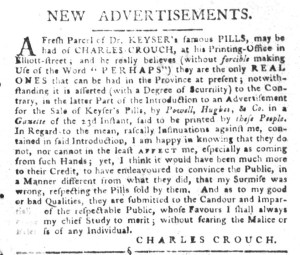
The back-and-forth continued in the next edition of the South-Carolina Gazette and Country Journal. Crouch and his competitors carefully monitored what each said about the other in their new advertisements. Crouch placed “NEW ADVERTISEMENTS” on the first page of the July 28 edition, leading with a new advertisement for “Dr. KEYSER’s famous PILLS” limited to a single paragraph that focused primarily on the controversy that had been brewing for the past few weeks. He once again stated that he sold the pills and declared that “he really believes (without forcible making Use of the Word “PERHAPS”) they are the only REAL ONES that can be had in the Province at present.” For the first time, he named his competitors, noting that “it is asserted (with a Degree of Scurrility) to the Contrary, in the latter Part of the Introduction to an Advertisement for the Sale of Keyser’s Pills, by Powell, Hughes, & Co. in a Gazette of the 23d Instant, said to be printed by these People.
Crouch devoted the remainder of his advertisement to upbraiding his competitors and defending his reputation. “In regard to the mean, rascally Insinuations against men, contained in said Introduction,” the printer stated, “I am happy in knowing that they do not, nor cannot in the least AFFECT me, especially as coming from such Hands.” He then suggested, “I think it would have been much more to their Credit, to have endeavoured to convince the Public, in a Manner different from what they did, that my Surmise was wrong, respecting the Pills sold by them.” He concluded with an assertion that “as to my good or bad Qualities, they are submitted to Candour and Impartiality of the respectable Public, whose Favours I shall always make my chief Study to merit; without fearing the Malice or Baseness of any Individual.”
South-Carolina Gazette and Country Journal (July 28, 1772).
Powell, Hughes, and Company did not interpret that as an overture to make peace or change their tone. On July 30, they began with the “New Advertisements” in the South-Carolina Gazette by reprinting Crouch’s advertisement “From the South-Carolina GAZETTE, AND Country Journal, of July 28, 1772. [No. 348.]” in its entirety. They made sure that readers could examine the original, though they also added “(t b c t f.)” to the final line, a notation that signaled to the compositor to continue inserting the advertisement until instructed to remove it. In so doing, they implied that Crouch intended to publicly shame them indefinitely. Yet they felt no remorse. Instead, they implied that Crouch suffered from the effects of venereal disease himself, especially cognitive deterioration, composing his latest advertisement only after taking a pill he acquired from Powell, Hughes, and Company. “WHO,” they asked, “after perusing the foregoing masterly Piece, produced by a SINGLE Dose of Dr. Keyser’s GENUINE Pills, sold by POWELL, HUSGHES, & Co. … can doubt of the amazing Effects of that powerful and invaluable Medicine?” They further intimated that Crouch suffered from venereal disease by asking, “After so copious a Discharge by ONE Dose, what may not be expected from a SECOND, or should THAT Patient take a WHOLE BOX?” Powell, Hughes, and Company snidely asserted that Crouch’s mental faculties were so far gone due to venereal disease that a single dose managed to give him only a few moments of clarity but he needed much more medicine to cease ranting and raving.
Powell, Hughes, and Company compounded the insult in a short paragraph that commented on Crouch’s grammar, further imputing that the effects of venereal disease made it difficult for him to string together coherent sentences. “In the mean Time,” they proclaimed, “the Reader is desired to correct TWO egregious Blunder, by inserting FORCIBLY for forcible, and THOSE PEOPLE instead of these People. The Word RASCALLY may stand, as ONE distinguishing Mark of the happy Talents and Abilities of the ingenious Author, as a —.” Pettiness descended into other insults unfit to print in the newspaper.
These exchanges demonstrate that Crouch and Powell, Hughes, and Company did not peruse each other’s publications solely in search of news items to reprint in their own. They also paid attention to advertisements, especially when their competitors marketed ancillary goods, like patent medicines, to supplement their revenues. These printers found themselves in competition to sell “Dr. KEYSER’S famous PILLS.” Rather than pursue their own marketing efforts, they chose to take umbrage at the strategies deployed by the other. Many purveyors of patent medicines stated in their advertisements that they did not need to offer additional information because the public was already so familiar with the product. Crouch may or may not have intended such an observation as a critique of Powell, Hughes, and Company’s advertisement. Whatever his intention, that was enough to garner a response that further escalated into a feud between rival printers hawking patent medicines.
What was advertised in a colonial American newspaper 250 years ago this week?
New-York Journal (July 16, 1772).
“WATCHES, HORIZONTAL, REPEATING, or PLAIN.”
By coincidence or by design, the compositor made the feud between rival watchmakers James Yeoman and John Simnet difficult to overlook in the July 16, 1772, edition of the New-York Journal, placing their advertisements next to each other. The two had been sparring in the public prints for months, but their advertisements did not previously appear in such close proximity.
Yeoman devised a distinctive headline for his advertisement: “WATCHES, / HORIZONTAL, REPEATING, or PLAIN; / CLOCKS, / ASTRONOMICAL, Musical or / Plain.” He then asserted that “he can with Propriety declare himself a realManufacturer, having had the Government of a large Manufactory from its Infancy to its Maturity, one Hundred Miles from London.” In so doing, he answered allegations that Simnet made about Yeoman’s lack of skill and experience. Yeoman also proclaimed that he could supply “proper Testimonials … to prove the Assertion” that he managed a “large Manufactory” in England. A notation on the final line, “27,” indicated that the advertisement first appeared in issue 1527 on April 9.
For his part, Simnet had a history of mocking his competitors. In this instance, he appropriated Yeoman’s headline for his own advertisement: “WATCHES, / HORIZONTAL, REPEATING, or PLAIN; CLOCKS, / ASTRONOMICAL, MUSICAL.” He then insinuated that Yeoman greatly exaggerated his abilities, asking “IS any ingenious Artificer (or Spirit) within 100 Miles, capable of making either, or a Thing in Imitation of either?” The reference to “100 Miles” underscored that Simnet sought to twist the contents of Yeoman’s advertisement against his competitor.
By the time Simnet’s advertisement first appeared in the New-York Journal on July 2, readers were familiar with Yeoman’s notice, making it difficult to overlook the derision of the intentional replication and alteration of the original. Positioning the notices next to each other served Simnet’s purposes, even for readers who quickly scanned the advertisements and missed the interplay between notices when they previously appeared on different pages.