October 24

What was advertised in a revolutionary American newspaper 250 years ago today?
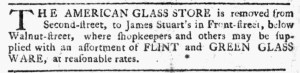
Pennsylvania Evening Post (October 25, 1775).

“THE AMERICAN GLASS STORE is removed from Second-street.”

The advertisement consisted of only five lines in the October 24, 1775, edition of the Pennsylvania Evening Post, yet it spoke volumes about the current events.  “THE AMERICAN GLASS STORE,” the notice informed the public, “is removed from Second-street, to James Stuart’s in Front-street, below Walnut-street, where shopkeepers and others may be supplied with an assortment of FLINT and GREEN GLASS WARE, at reasonable rates.”  It was one of many advertisements that presented opportunities for colonizers to “Buy American” during the imperial crisis that eventually became a war for independence.

On several occasions, supporters of the American cause participated in boycotts in hopes of using their participation in the marketplace as leverage to achieve political ends.  They organized nonimportation agreements in response to the Stamp Act in 1765 and in response to the duties levied on certain imported goods, including glass, in the Townshend Acts in the late 1760s.  Simultaneously, they called for “domestic manufactures” or goods produced in the colonies as alternatives to imported wares.  In August 1769, Richard Wistar advertised products from his “GLASS-WORKS,” items “of American manufactory” produced in Pennsylvania, “consequently clear of the duties the Americans so justly complain of.”  The most extensive and coordinated boycott, the Continental Association devised by the First Continental Congress in response to the Coercive Acts, went into effect on December 1, 1774.  Within a week, the “Proprietors of the GLASS HOUSE near this city,” Philadelphia, advertised “White and Green Glass Ware; Such as are usually imported from Great-Britain.”  The proprietors accepted orders from “store-keepers and others, both of town and country.”  As the imperial crisis intensified, savvy entrepreneurs opened an “AMERICAN GLASS STORE” in Philadelphia, an establishment that specialized in glassware produced locally.  The Continental Association specified that colonizers “will, in our several Stations, encourage Frugality, Economy, and Industry; and promote Agriculture, Arts, and the Manufactures of this Country.”  Local producers of glassware delivered, but they needed retailers and consumers to do their part as well.  The brief advertisement in the Pennsylvania Evening Post let shopkeepers and other customers, all of them very much aware of the events of the last decade, know where they could express their political principles by purchasing American glassware.
December 7

What was advertised in a colonial American newspaper 250 years ago today?

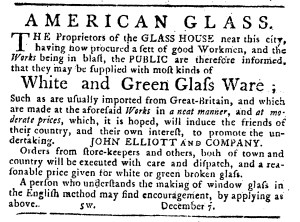
Pennsylvania Journal (December 7, 1774).

“White and Green Glass Ware; Such as are usually imported from Great-Britain.”

A headline in capital letters and a large font proclaimed, “AMERICAN GLASS.”  In a secondary headline composed of font of the same size, John Elliott and Company promoted “White and Green Glass Ware” that they produced ay their “GLASS HOUSE” near Philadelphia.  That advertisement happened to appear in the December 7, 1774, edition of the Pennsylvania Journal, the first issue published since the Continental Association went into effect on December 1.  Throughout the colonies, retailers and consumers adopted that boycott of goods imported from Britain, some enthusiastically and some under pressure.  They hoped that measure would help convince Parliament to repeal the Coercive Acts passed in retaliation for the Boston Tea Party.

Ever since the boycotts inspired by the Stamp Act nearly a decade earlier, supporters of the American cause emphasized the importance of “domestic manufactures” or goods produced in the colonies.  Such products offered an alternative to imported wares while also bolstering local economies and creating jobs.  The Continental Association had the potential to disrupt consumption practice, but it also presented opportunities for American entrepreneurs, including Elliott and Company.

In their advertisement, the proprietors of the Glass House reported that they had “procured a sett of good Workmen” and the glassworks were “in blast.”  That meant that the public “may be supplied with most kinds of White and Green Glass Ware; Such as are usually imported from Great-Britain.”  Prospective customers did not need to worry about the quality or cost of this alternative.  Elliott and Company offered assurances that they produced glassware “in a neat manner, and at moderate prices.”  In their appeal to “the PUBLIC,” Elliott and Company did not address consumers alone.  They also hoped to entice retailers, noting that “Orders from store-keepers and others, both of town and country will be executed with care and dispatch.”  They hoped these various appeals would “induce the friends of their country, and their own interest, to promote the undertaking.”  It was a win-win-win situation for the protest against Parliament, for customers, and for Elliott and Company.

August 13

What was advertised in a colonial American newspaper 250 years ago this week?

Aug 13 - 8:10:1769 Pennsylvania Gazette
Pennsylvania Gazette (August 10, 1769).

“At present it seems peculiarly the interest of America to encourage her own manufactories.”

In August 1769, Richard Wistar took to the pages of the Pennsylvania Gazette to advertise the products he manufactured at his “GLASS-WORKS” in Philadelphia. His inventory included “BOXES of WINDOW GLASS, consisting of the common sizes” as well as “most sorts of bottles,” containers for mustard and snuff, and other specialty glassware. Wistar also offered to cut glass windows of “uncommon sizes.”

To encourage prospective customers to purchase his wares, Wistar emphasized that “the abovementioned glass is of American manufactory” and then launched into a political lesson that matched the discourse circulating throughout the colonies in newspapers and in conversations in taverns, coffeehouses, and town squares. Glass produced in the colonies was “consequently clear of the duties the Americans so justly complain of,” duties imposed on certain imported goods by Parliament in the Townshend Acts. Wistar continued his lecture: “at present, it seems peculiarly the interest of America to encourage her own manufactories, more especially those upon which duties have been imposed, for the sole purpose of raising a revenue.” Those goods included paper, tea, lead, paints, and, most significantly for Wistar, glass.

In response, colonists revived a strategy they had previously pursued to resist the Stamp Act: merchants and shopkeepers vowed not to import goods from Britain. In order for their economic resistance to have greater political impact, they did not limit their boycott to only those goods indirectly taxed by the Townshend Acts. Instead, they enumerated a broad array of goods that they would not import or sell until the duties had been repealed. Simultaneously, they issued calls for the encouragement of “domestic manufactures” and argued that consumers could demonstrate their own politics in the marketplace by making a point of purchasing goods produced in the colonies. Neither producers nor consumers alone would have as much of an impact as both exercising their civic virtue through “encourage[ing] her own manufactories,” as Wistar reminded readers of the Pennsylvania Gazette.

Colonists certainly imbibed political arguments in news articles and editorials in newspapers, but they also encountered them in advertisements. In the service of selling goods and services, savvy entrepreneurs mobilized politics during the period of the imperial crisis that led to the American Revolution. They directed consumers away from some products in favor of purchasing others, challenging them to consider the ramifications of their activities in the marketplace.