April 1

What was advertised in a colonial American newspaper 250 years ago today?
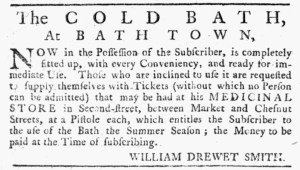
Pennsylvania Evening Post (April 1, 1775).

“The COLD BATH, At BATH TOWN.”

William Drewet Smith, a “Chemist and Druggist,” diversified his business interests in the spring of 1775.  He operated a shop “At HIPPOCRATES’s HEAD” on Second Street Philadelphia, selling a “general Assortment of Druggs and patent medicines, surgeons instruments, [and] shop furniture.”  In an advertisement in the March 25 edition of the Pennsylvania Ledger, he promoted one of those patent medicines, “Baron SCHOMBERG’s Grand Prophylactic LIMIMENT” to prevent venereal diseases and treat the symptoms of those who did not practice prevention soon enough.  In that same issue, he inserted a second advertisement, that one hawking “Baron Van Haake’s royal letters pattent composition, for manuring land” to farmers and gardeners.

A week later, Smith ran yet another notice to announce that he was now the proprietor of the “COLD BATH, At BATH TOWN.”  The facility, he reported, “is completely fitted up, with every Conveniency, and ready for immediate Use.”  Those seeking entry needed to buy tickets (“without which no Person can be admitted”).  The apothecary sold them for “a Pistole each” at his “MEDICINAL STORE.”  Those who intended to travel to Bath, about sixty-five miles north of Philadelphia, could obtain their tickets before making the trip.  Rather than a single admission, each ticket entitled the bearer “to the use of the Bath [throughout] the Summer Season,” but they had to pay the entire balance “at the Time of subscribing.”  Smith did not allow guests to avail themselves of the amenities at his spa on credit.

Advertising in both the Pennsylvania Evening Post and the Pennsylvania Ledger, Smith joined the ranks of eighteenth-century entrepreneurs who marketed health tourism in America.  The apothecary probably figured that it made sense to branch out in that direction.  When clients visited his shop in Philadelphia, especially clients of means who had the leisure to travel, he could recommend the rejuvenating waters at the “COLD BATH” and the benefits of being away from the bustling urban port to supplement the medicines that he supplied.  He likely believed that his reputation and experience as a “Chemist and Druggist” made him a trustworthy provider of other health services in the eyes of the public.

June 22

What was advertised in a colonial American newspaper 250 years ago today?

Pennsylvania Gazette (June 22, 1774).

“ABINGTON MINERAL WATER, SO useful in Chronic Diseases.”

As the first day of summer arrived in 1774, a headline in the Pennsylvania Gazette promoted “ABINGTON MINERAL WATER, inviting residents of Philadelphia and other towns to visit that “most healthy Part of the Province of Pennsylvania.”  There they could experience the waters “SO useful in Chronic Diseases” and recuperate from a variety of ailments.  William French placed that advertisement, offering “good Accommodations, at a modern Expence.”  Interested in encouraging health tourism in his town, he mentioned that “several other commodious Houses in the Neighbourhood of said Spring” also provided lodging for visitors.

In addition to marketing room and board in proximity to the mineral waters, Rush advised that that he had on hand “Dr. RUSH’S Experiments and Observations on the above Mineral Water, with particular Directions in what Diseases, and in what Manner, it should be used.”  He did not specify whether he sold copies or made them available for consultation by his guests, similar to modern hotels displaying fliers, brochures, and other promotional literature for points of interest in the area.  He also did not invoke the full title of the pamphlet, Experiments and Observations on the Minera Waters of Philadelphia, Abington, and Bristol, in the Province of Pennsylvania.  French conveniently left out other sites that competed for health tourism, though he was not the only advertiser who referred to Rush’s pamphlet, originally a paper delivered to the American Philosophical Society in June 1773, as a means of educating the public about the advantages of taking the waters.  The proprietors of the “BRISTOL BATHS and CHALYBEATE WELLS” did so as well in their own advertisement in the Pennsylvania Gazette a couple of months earlier.  In each instance, those seeking to generate revenue from mineral waters did not simply ask guests to take their word for the supposed benefits to their health; instead, they marshalled evidence from a medical expert as a testimonial on their behalf.  The “commodious Houses” in Abington amounted to pleasant amenities, but it was the healing power of the “MINERAL WATER” that most effectively marketed a stay in that town.