What was advertised in a revolutionary American newspaper 250 years ago today?
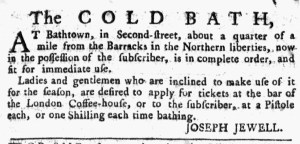
“Apply for tickets … at a Pistole each, or one Shilling each time bathing.”
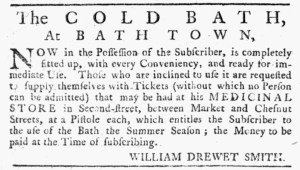
With the arrival of spring in 1776, Joseph Jewell opened the “COLD BATH, AT Bathtown, in Second-street, about a quarter of a mile from the Barracks in the Northern liberties” on the outskirts of Philadelphia. Readers sometimes encountered promotions for spas, baths, and mineral springs as they perused newspapers in the decade before the Revolutionary War, including the “Cold-Bath at Jackson’s Mineral Well” in Boston and a “NEW and CONVENIENT BATH” in Perth Amboy, New Jersey. The New-York Chronicle carried an advertisement for the “Chalybeat Springs, in the Borough of Bristol, in Pennsylvania.” The facility “answers the Description of the celebrated GERMAN SPAW.” In addition to the bath and mineral spring at Perth Amboy, residents of Philadelphia who read local newspapers encountered invitations to partake of “ABINGTON MINERAL WATER” when they visited the “most healthy Part of the Province of Pennsylvania.” The “COLD BATH, AT Bathtown,” however, was a more convenient location that offered greater access to those who wished to purchase admission.
In an advertisement in the April 30, 1776, edition of the Pennsylvania Evening Post, Jewell announced that the facility was “now in the possession of the subscriber,” indicating a transfer of ownership since the previous season. William Drewet Smith, an apothecary, previously operated the bath. Regardless of who ran it, the “COLD BATH” was “in complete order, and fit for immediate use.” Jewell instructed “[l]adies and gentlemen who are inclined to make use of it for the season” to acquire tickets directly from him or “at the bar of the London Coffee-house,” a popular place for socializing and conducting business in the bustling urban port. Just as advertisers frequently enlisted printers in supplying additional information to readers who followed directions to “enquire of the printer,” some also made arrangements for the proprietor of the coffeehouse to act as their agent. Such convenience likely increased sales. Jewell charged the same amount for a season pass, “a Pistole each,” as Smith had the previous year, but he also allowed for day passes at “one Shilling each time bathing.” Smith may have done so as well, though he did not promote it as an option in his advertisement. Jewell may have hoped that highlighting a less expensive option would stimulate greater demand and more visitors to the “COLD BATH.”