
What was advertised in revolutionary American newspaper 250 years ago today?
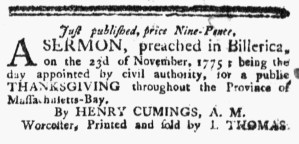
“A SERMON, preached [on] the day appointed by civil authority, for a public THANKSGIVING.”
Like many other newspaper printers, Isaiah Thomas used the pages of his own newspaper to promote other items that came off his press. On May 10, 1776, for instance, he ran two advertisements for sermons preached on November 23, 1775, a day designated as a “Public THANKSGIVING” by the Massachusetts Provincial Congress and announced in the November 16 edition of the New-England Chronicle.
The first of those advertisements appeared on the first page of the May 10 edition. When setting the type, the compositor had enough space for news from Philadelphia and Charleston with just a small amount left at the bottom of the last column. Several of the advertisements that ran on other pages would have fit there, but Thomas opted to give a privileged place to an advertisement for “A SERMON,” by Henry Cumings, “preached in Billerica on … the day appointed by civil authority, for a public THANKSGIVING throughout the Province of Massachusetts-Bay.” The notice declared that the sermon was “Just published” and cost “Nine-Pence.” Eighteenth-century readers knew that “Just published” meant that an item was now available for purchase, but it did not necessarily indicate that the advertiser who sold it had printed it. In this case, however, Thomas clarified that he “Printed and sold” the sermon in Worcester.
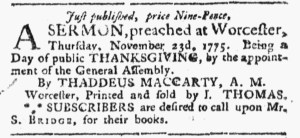
His advertisement for “A SERMON, preached at Worcester,” by Thaddeus MacCarty followed a similar format. It opened with a header that declared, “Just published, price Nine-Pence,” and reminded readers that November 23 had been “a Day of public THANSKGIVING, by the appointment of the General Assembly.” Once again, the printer stated that the pamphlet was “Printed and sold by I. THOMAS” rather than an item that he acquired from another printing office and retailed at his own. Although this advertisement now appeared on the fourth page among paid notices placed for a variety of purposes, when the two advertisements first ran in the April 26, 1775, edition of Thomas’s Massachusetts Spy they appeared together on the third page as the first commercial notices following the news. The printer sought to increase the chances that prospective customers would take note of advertisements for the sermons he published.