October 30

What was advertised in a revolutionary American newspaper 250 years ago today?

Boston-Gazette (October 30, 1775).

“He pays cash for all kinds of homespun cloths.”

Enoch Brown, a shopkeeper, had a history of promoting domestic manufactures (or goods made in the colonies) as alternative to items imported from Britain.  In the spring of 1768, for instance, he ran an advertisement alerting “those Persons who are desirous of Promoting our Own Manufactures … That he takes in all Sorts of Country-made Cloths at his Store on Boston Neck.”  In the wake of learning about duties levied on certain imported goods in the Townshend Revenue Act, many colonizers set about organizing nonimportation agreements.  They simultaneously embraced goods produced locally as a means of supporting the colonial economy and correcting a trade imbalance with Britain.  Several years later, Brown ran another advertisement with similar themes in January 1775.  Bearing the headline “American Manufacture,” that notice emphasized that the variety of textiles Brown stocked “were manufactured in this Province, and are equal in quality to any, and superior to most imported from England, and much cheaper than can be produced from any part of Europe.”

Although Brown had been at the same location for years, he departed Boston for Watertown following the battles at Lexington and Concord.  That presented challenges for both Brown and his customers, so “for greater Conveniency” he once again moved, this time to “Little-Cambridge” in the fall of 1775.  When he opened his shop, he advertised a “Variety of Winter Goods” for the coming season as well as “sagathees, duroys, camblets,” and other textiles “of American manufacture, which he sells extreme cheap.”  Customers could acquire any of those for low prices, despite the disruptions taking place as the siege of Boston continued.  Committed to giving consumers choices that matched their political principles, Brown sought new merchandise made locally.  In a nota bene at the end of his advertisement, he declared that he “pays cash for all kinds of homespun cloths.”  In so doing, he filled the role of intermediary between producers and consumers, giving both the opportunity to support the American cause.  After all, the Continental Association devised by the First Continental Congress did not merely instruct consumers to cease purchasing imported goods but also called on colonizers to “encourage Frugality, Economy, and Industry; and promote Agriculture, Arts, and the Manufactures of this Country.”  As a shopkeeper who bought and sold homespun cloth, Brown did his part.
September 18

What was advertised in a revolutionary American newspaper 250 years ago today?

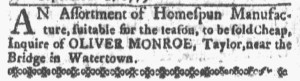
Boston-Gazette (September 18, 1775).

“AN Assortment of Homespun Manufacture.”

It was a short advertisement, just four lines in the September 18, 1775, edition of the Boston-Gazette, but it spoke volumes about the times in which the advertiser placed it and colonizers read it.  “AN Assortment of Homespun Manufacture, suitable for the season,” the notice announced, “to be sold Cheap.  Inquire of OLIVER MONROE, Taylor, near the Bridge in Watertown.”  Even before the battles at Lexington and Concord marked a new chapter in the imperial crisis, homespun cloth became a symbol of resistance to British abuses, especially duties on imported goods imposed by Parliament.  Over the past decade, colonizers had participated in a series of boycotts, first to protest the Stamp Act in 1765, then in response to the Townshend Acts in the late 1760s, and again when they learned of the Coercive Acts in 1774.  Each time, consumers opted for homespun cloth produced in the colonies as an alternative to textiles imported from England.

At the time that Monroe ran his advertisement, the Continental Association remained in place.  It had gone nine months earlier.  In addition to prohibiting merchants and shopkeepers from selling goods received after December 1, 1774, it called on colonizers to “promote Agriculture, Arts, and the Manufactures of this Country.”  That included purchasing homespun rather than the “Fine assortment” of imported textiles, ranging from corduroys to striped hollands to cambrics, listed in a longer advertisement that appeared in the same column as Monroe’s short notice.  Monroe did not need to invest much effort in marketing his “Homespun Manufacture” because the times spoke for themselves.  Prospective customers already recognized the political significance of the choices they made in the marketplace.  That they read his advertisement in the Boston-Gazette, now published in Watertown as the siege of Boston continued, only underscored the importance of practicing politics when they went shopping.

August 17

What was advertised in a revolutionary American newspaper 250 years ago today?

New-England Chronicle (August 17, 1775).

“Cash given … for homespun Cloth … and for yarn Stockings.”

Stephen Hall III placed an advertisement in the August 17, 1775, edition of the New-England Chronicle to inform “the Publick” that he “has again opened his Shop” in Medford, Massachusetts, and offered a variety of textiles, “Gloves and Mitts,” “handsome Fans and Ribbons,” and other items for sale.  The shopkeeper did not indicate when he had acquired these imported items, whether they had arrived in the colony before the Continental Association went into effect on December 1, 1774.

He did, however, state that he paid cash for “homespun Cloth” and “yarn Stockings” produced locally rather than imported from Britain.  The Continental Association called on colonizers to “encourage Frugality, Economy, and Industry; and promote Agriculture, Arts, and the Manufactures of this Country” as alternatives to imported goods.  That gave textiles and garments made from them political meaning beyond testifying to taste and status as consumers deployed their choices in the marketplace as leverage in their contest with Parliament.  In response to the Stamp Act in 1765, the duties levied in the Townshend Acts in the late 1760s, and the provisions of the Coercive Acts in 1774, colonizers participated in boycotts – nonimportation and nonconsumption agreements – to pressure Parliament to repeal offensive legislation.  Each round of boycotts came with renewed efforts to produce and to consume “domestic manufactures.”

This also presented women with opportunities to participate in politics.  They did so when they made choices as consumers, such as selecting homespun cloth over the “Shalloons,” “Serges,” “Ginghams,” “Poplins,” “Calimancoes,” and other fabrics that Hall and other merchants and shopkeepers imported.  Yet their role as producers gained political significance as well.  They undertook carding and spinning with new purpose, sometimes holding spinning bees in public spaces rather than the usual domestic settings to make their contributions to the American cause more visible and to inspire others to join them.  Similarly, weaving and making clothing also became political acts.  Although Hall did not mention women as producers in his newspaper advertisement, readers knew that women produced the “homespun Cloth” and “yarn Stockings” he sought.  They participated in the American Revolution in their own way.

September 27

What was advertised in a colonial American newspaper 250 years ago today?

Supplement to the South-Carolina Gazette and Country Journal (September 27, 1774).

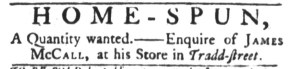
“HOME-SPUN, A Quantity wanted.”

In so many ways, James McCall’s advertisement appeared as a stark contrast compared to others in the September 27, 1774, edition of the South-Carolina Gazette and Country Journal.  In just three lines, it proclaimed, “HOME-SPUN, A Quantity wanted. – Enquire of JAMES McCALL, at his Store in Tradd-street.”  The word “HOME-SPUN” in all capitals in a significantly larger font occupied a line on its own, calling attention to the commodity that McCall sought.  He referred to linen and wool textiles produced in the colonies as an alternative to imported fabrics.  Spinning, a domestic chore undertaken by women, took on political significance when colonizers enacted nonimportation agreements in response to the duties imposed in the Townshend Acts in the late 1760s.  The homespun cloth that resulted from their efforts became a visible symbol of support for the Patriot cause.  McCall did not need to elaborate on the political principles associated with homespun when he placed his advertisement seeking a quantity of it.  In other advertisements, he had previously demonstrated that how well he understood consumer politics.

Elsewhere in the same issue of the South-Carolina Gazette and Country Journal, merchants who imported “fashionable” textiles from London and other English ports ran lengthy advertisements that listed and described their merchandise.  Edwards, Fisher, and Company, for instance, ran their notice about receiving “PART of their FALL GOODS.”  Mansell and Corbett inserted an even more lengthy advertisement that featured imported fabrics, emphasizing “the most fashionable colours” and “an entire new pattern,” as well as housewares.  Other advertisers were a bit more restrained in terms of length, but not their exuberance for imported textiles.  In addition to leading his list of merchandise with a “LARGE Assortment of printed Muslins, Linens, and Calicoes,” Z. Kingsley concluded with a nota bene that explained, “The printed Muslins and Linens, are all the newest Patterns.”  These merchants considered it necessary to offer assurances to prospective customers that their wares did indeed follow the latest styles, simultaneously emphasizing all the choices available to them.  Homespun cloth, on the other hand, turned fashion on its head.  What was the newest and the most sophisticated did not matter as much as the simple political message that producing, purchasing, and wearing homespun communicated during the imperial crisis.

June 29

What was advertised in a colonial American newspaper 250 years ago today?

Essex Journal (June 29, 1774).

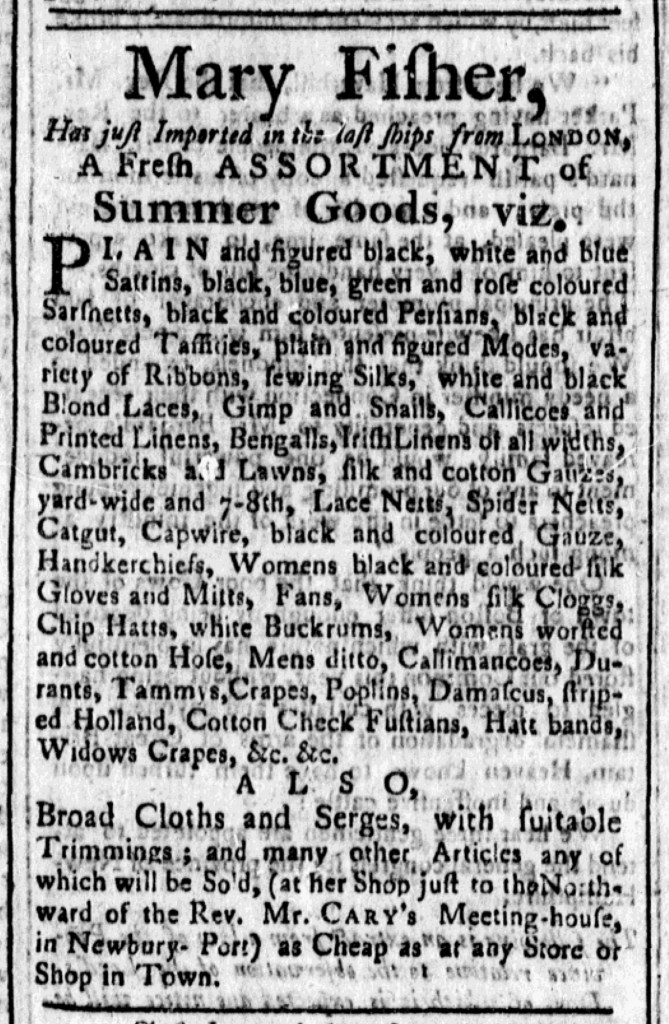
Imported in the last ships from LONDON, A Fresh ASSORTMENT of Summer Goods.”

As June 1774 came to a close, the final issue of the Essex Journal for that month carried news that arrived from Salem, Boston, New London, New York, Philadelphia, Williamsburg, and Charleston.  The editor also selected a short address “To the Farmers in America” from “FREEDOM” to reprint from the most recent edition of the Massachusetts Spy.  It advised, “INCREASE your SHEEP and raise WOOL as far as possible, that you from this time wear LIBERTY CLOTH.”  Although framed as advice to farmers, the suggestion to wear homespun cloth applied to all consumers who wished to protest various abuses by Parliament, especially the Boston Port Act that went into effect at the beginning of the month.  Colonizers discussed their prospects for using commercial means to achieve political ends, recognizing that any boycott of imported goods should be accompanied by encouraging “domestic manufactures” as alternative products.  That included clothing made of homespun fabrics to substitute for textiles imported from London.

Even as “FREEDOM” promoted “LIBERTY CLOTH” as a symbol of patriotism, merchants and shopkeepers hawked imported goods elsewhere in the newspaper.  No nonimportation or nonconsumption agreement had yet been adopted.  George Searle, for instance, “Just Imported from LONDON … an assortment of Painters Oils and Colours.”  Similarly, John Stickney and Son, announced that they “imported from London, a large assortment of English, India and hard ware GOODS.”  Those goods certainly included garments and fabrics.  Mary Fisher provided more detail, advertising that she “just Imported in the last ships from LONDON, A Fresh ASSORTMENT of Summer Goods.”  She then listed dozens of items, including an array of textiles that ranged from “PLAIN and figured black, white and blue Sattins” to “black, blue green and rose coloured Sarsnetts [sarcenets]” to “Callicoes and Printed Linens.”  Even as such items fell out of favor in some circles, Fisher offered an opportunity for consumers who desired imported textiles, even those who supported the patriot cause, and realized that they should buy what they could before discussions about boycotts became actual boycotts.  Fisher offered her wares “as Cheap as at any Store or Shop in Town,” making it possible for consumers to stockpile items they purchased from her.  Her imported textiles did not have the appearance of homespun “LIBERTY CLOTH,” but, for the moment, customers could at least equivocate that they had not bought those fabrics while a nonconsumption agreement was in effect.  Memories of boycotts in response to the Stamp Act and the duties on certain goods in the Townshend Acts guided consumers in preparing for a new round of protests.

February 6

GUEST CURATOR: Declan Dunbar

What was advertised in a colonial American newspaper 250 years ago today?

Massachusetts Gazette and Boston Weekly News-Letter (February 6, 1772).

“IRISH LINNENS.”

This advertisement is about an item that many colonists purchased in the years before the American Revolution. Colonists imported Irish linens as part of what we now call the consumer revolution. In “Baubles of Britain,” T.H. Breen describes how many American colonists sought goods imported from the British Isles as part of the consumer revolution.[1] Those goods, including linens imported from England, Scotland, and Ireland, gave them a sense of camaraderie with Britain at a time when most colonists were proud to be subjects of the British Crown. In “The British Linen Trade with the United States in the Eighteenth and Nineteenth Centuries,” N.B. Harte states, “[T]he American colonies up to the revolution provided the bulk of the export market for English linens. It is difficult to dis-entangle re-exports of Scottish and Irish linen through London and exports of English Linen.”[2] In this advertisement, William Beatty declared that he imported Irish linens “from the Manufacturers at BELFAST, in the North of Ireland” as part of the larger market that connected the British Isles and the American colonies.

Not only did American colonists depend on England, Scotland, and Ireland as a source of linens at the time, British merchants depended on the colonies as customers and a main source of their income as well. When the colonists first started to rebel against the British, one of the first items they boycotted was linen and other fabrics from overseas in favor of homespun cloth made in the colonies. The colonists wanted to show Britain how resilient they were, but they also believed that hurting the profits of British merchants would cause them to demand that Parliament repeal duties on imported goods. Colonists used decisions about buying imported linens as economic leverage to achieve political goals. Linens, although they might seem insignificant, contributed a great deal to the economy and were part of the American Revolution.

**********

ADDITIONAL COMMENTARY: Carl Robert Keyes

Declan explores some of the major themes from my Revolutionary America class.  We examine several kinds of protests from the period, including petitions by colonial assemblies, nonimportation agreements by colonial merchants, and demonstrations by colonizers.  We situate nonimportation and nonconsumption agreements within the context of the consumer revolution.  Despite the sense of British identity and close ties to Britain that colonizers experienced when they participated in a transatlantic consumer revolution, that did not prevent them from using trade as a political tool when they believed that Parliament infringed on their rights by imposing duties on certain imported goods.  Although colonizers in America did not benefit from direct representation in Parliament, British merchants did. American colonizers hoped that if they disrupted the marketplace then British merchants would join them in demanding that Parliament repeal the objectionable import duties.

Textiles became an important political symbol in the colonies.  Colonizers produced homespun cloth, usually not of the same quality as imported alternatives.  The quality hardly mattered compared to the symbolism of producing, purchasing, and wearing homespun.  This occurred within what Harte describes as a “dual economy” for linen in the colonies.  “[B]asic linen needs were provided outside the market by the widespread domestic production of homespun coarse linen, while the market was dominated by a range of better-quality (though still low-priced) linens imported from England, Scotland, and Ireland, and imported too from the continent of Europe (especially Germany) via London.”[3]  Embracing homespun, women participated in spinning bees.  College graduates wore suits made of homespun to ceremonies.  Consumers made choices about what to buy … and what not to buy.  All of those activities had political valences, communicating support for nonimportation agreements and opposition to Parliament.  Harte argues that linen “became the most important single commodity shipped across the Atlantic in the eighteenth century.”  That helped to make homespun a powerful symbol, especially in those years that colonizers participated in nonimportation agreements.

**********

[1] T.H. Breen, “‘Baubles of Britain’:  The American and Consumer Revolutions of the Eighteenth Century,” Past and Present 119 (May 1988):  73-104.

[2] N.B. Harte, “The British Linen Trade with the United States in the Eighteenth and Nineteenth Centuries,” Textile Society of America Symposium Proceedings (1990): 19.

[3] Harte, “British Linen Trade,” 15.

April 21

GUEST CURATOR: Mary Bohane

What was advertised in a colonial American newspaper 250 years ago today?

Apr 21 - 4:21:1768 Massachusetts Gazette
Massachusetts Gazette (April 21, 1768).

“New Rice by the Cask.”

Thomas Walley sold “New Rice by the Cask” at his “Store, on Dock-Square.” Rice was one of the most profitable goods cultivated in colonial America. According to James M. Clifton, settlers from Barbados and other colonies in the West Indies introduced rice to South Carolina. Colonists there had much to learn about rice, doing so through trial and error. The earliest mention of rice shipment recorded was in 1692, but after that point it became a staple crop, one that supported much of the economy for the entire colony.[1] In order to reduce the amount of strenuous labor required to produce this popular commodity, colonists in South Carolina sought to perfect machines and mills that could aid in processing rice.[2] Unfortunately, this proved quite unsuccessful and remained a challenging process throughout the colonial period. Rice crops became more profitable, however, with the labor of black slaves who worked on plantations and knew how to properly cultivate rice.

**********

ADDITIONAL COMMENTARY: Carl Robert Keyes

In addition to “New Rice by the Cask,” Thomas Walley also peddled a variety of other goods. He emphasized textiles and “all sorts of Groceries,” such as tea, olive oil, and mustard. The assortment of fabrics available at his store included “homespun check,” cloth that had been woven in the colonies rather than imported from England. Walley did not explicitly link his products to the imperial crisis that had intensified six months earlier when the Townshend Act went into effect, but he did offer prospective customers the opportunity to participate in a larger coordinated effort to resist Parliament’s attempts to impose taxes for the purpose of raising revenue without the consent of the colonies. Several months before Walley’s advertisement appeared in the Massachusetts Gazette, the Boston Town Meeting (followed by many others) had voted to use commerce as leverage in the political dispute with Parliament. They pledged to encourage “American manufactures” rather than continue their dependence on imported goods. In so doing, they acknowledged that in order to change their consumption habits that they first needed to modify the amount of goods produced in the colonies.

Just as this advertisement obscures the role of enslaved labor in producing “New Rice by the Cask,” it also obscures the role women played in this political strategy. Barred from participating in the formal mechanisms of government, women pursued other avenues when it came to participating in resistance efforts during the imperial crisis that culminated in the Revolution. American women produced Walley’s “homespun Check,” first spinning the thread and then weaving it into checkered cloth. Women also made choices about which goods to consume, their decisions extending to entire households. Women who purchased homespun could make very visible political statements by outfitting every member of their families in garments made from that cloth. The meanings of consumption increasingly took on political valences in the late 1760s and into the 1770s. In that realm, women often exercised as much power as men as they exercised their judgment in selecting which goods to acquire and which to reject. Their decisions reverberated beyond the point of purchase; everyday use of clothing, housewares, groceries, and other goods advertised in newspapers and sold by merchants and shopkeepers became laden with political significance.

**********

[1] James M. Clifton, “The Rice Industry in Colonial America,” Agricultural History 55, no. 3 (July 1981): 267.

[2] Clifton, “Rice Industry,” 278.

March 29

GUEST CURATOR:  Mary Aldrich

What was advertised in a colonial newspaper 250 years ago this week?

Mar 29 - 3:28:1766 New-Hampshire Gazette
New-Hampshire Gazette (March 28, 1766).

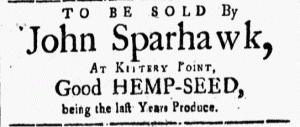
“TO BE SOLD by John Sparhawk, AT KITTERY POINT, Good HEMP-SEED.”

Hemp was a valuable commodity in eighteenth century America because it was used to make the ropes that were on every ship in this period. According to Ben Swenson at Colonial Williamsburg, all of the colonies grew hemp because of its ability to grow virtually anywhere. By the eighteenth century, the colonies of Virginia and Maryland grew the most hemp, but for farmers in New Hampshire it was still a valuable crop.

Farmers were profit driven and the best way to grow hemp to get nice long fibers to be used for ropes was to plant them close together. This limited the amount of female flowers the plants were able to produce, which is location of the greatest concentration of THC. (Colonists did know about the hallucinogenic properties of hemp.) Besides rope, hemp was used to make cloth for clothes and sacks, paper, and bed ticking, which kept the feathers or straw of the mattress from poking through. The cloth made from hemp grown in the colonies was especially valued when the colonists began to boycott goods from England. The growing and processing of hemp was already so well established that colonists were easily able to either grow more hemp or set aside a larger amount for the production of homespun.

The processing of hemp was difficult; after it was cut and rotted the waste had to be removed from the desired long fibers. The hemp needed to be rotted because it would loosen the fibers from the woody interior and the bark. The process of breaking the hemp separated the fibers from much of the waste. Afterward it needed to be beaten and scraped, then combed to remove the rest of the waste from the strands. Only then was the hemp suitable to be processed into its final product.

**********

ADDITIONAL COMMENTARY:  Carl Robert Keyes

At first glance today’s advertisement appears rather bland, but Mary’s analysis demonstrates why it is an appropriate sequel to yesterday’s featured advertisement for Barnabas Clarke’s shop “Near Liberty-Bridge” in Portsmouth. The two appeared on the same page of the New-Hampshire Gazette, Sparhawk’s about two-thirds of the way down the second column and Clarke’s filling the top half of the third and final column.

Clarke explicitly invoked many colonists’ sentiments about their relationship to Parliament when he listed the location of his shop, which would have called to mind the protests against the Stamp Act that occurred quite recently, less than three months earlier. Sparhawk, on the other hand, did not make reference to such difficulties, but, given the ubiquity of hemp in the colonial world, most colonists would have been aware that it was a resource for creating homespun. Sparhawk’s advertisement played off what colonists knew about nonconsumption and nonimportation even as it encouraged consumption of an alternate product. As the article from Colonial Williamsburg cited above explains, in the coming years newspapers increasingly encouraged growing and using hemp as a means of resistance as the imperial crisis intensified.

Mar 29 - Slave Ad 3:28:1766 New-Hampshire Gazette
New-Hampshire Gazette (March 28, 1766).

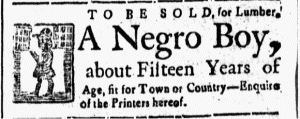
Given that the advertisements for yesterday and today each had connections to colonists’ understanding of liberty, it is worth noting a third advertisement that appeared on this page of the New-Hampshire Gazette, immediately to the right of Sparkhawk’s advertisement and a bit below Clarke’s. While Clarke peddled his wares “Near Liberty-Bridge” and Sparhawk offered a product that could help colonists reduce commercial ties with an oppressive England, readers of the New-Hampshire Gazette could purchase “A Negro Boy, about Fifteen Years of Age.” Once again, slavery and freedom were intertwined in the advertisements in the New-Hampshire Gazette.