Happy Birthday, Mathew Carey!

Though Benjamin Franklin is often considered the patron saint of American advertising in the popular press, I believe that his efforts pale in comparison to the contributions made by Mathew Carey (1760-1839) in the final decades of the eighteenth century. Franklin is rightly credited with experimenting with the appearance of newspaper advertising, mixing font styles and sizes in the advertisements that helped to make him a prosperous printer, but Mathew Carey introduced and popularized an even broader assortment of advertising innovations, ranging from inventive appeals that targeted potential consumers to a variety of new media to networks for effectively distributing advertising materials. In the process, his efforts played an important role in the development of American capitalism by enlarging markets for the materials sold by printers, booksellers, and publishers as well as a host of other goods marketed by merchants, shopkeepers, and artisans who eventually adopted many of Carey’s innovative advertising methods. Mathew Carey will probably never displace Benjamin Franklin as the founder of American advertising in the popular imagination, but scholars of early American history and culture should recognize his role as the most important leader in eighteenth-century advertising among the many other activities and accomplishments of his long career in business and public life.

mathew_carey_by_john_neagle_1825
Mathew Carey (January 28, 1760 – September 16, 1839). Portrait by John Neagle, 1825. Library Company of Philadelphia.

Carey’s efforts as an advertiser were enmeshed within transatlantic networks of print and commerce. Though he did not invent the advertising wrapper printed on blue paper that accompanied magazines in the eighteenth century, he effectively utilized this medium to an extent not previously seen in America, Ireland, or the English provinces outside of London. The wrappers distributed with his American Museum (1787-1792) comprised the most extensive collection of advertising associated with any magazine published in North America in the eighteenth century, both in terms of the numbers of advertisements and the diversity of occupations represented in those advertisements. In Carey’s hands, the American Museum became a vehicle for distributing advertising media: inserts that included trade cards, subscription notices, testimonials, and book catalogues in addition to the wrappers themselves.

Located at the hub of a network of printers and booksellers, Carey advocated the use of a variety of advertising materials, some for consumption by the general public and others for use exclusively within the book trade. Subscription notices and book catalogues, for instance, could stimulate demand among potential customers, but exchange catalogues were intended for printers and booksellers to manage their inventory and enlarge their markets by trading surplus copies of books, pamphlets, and other printed goods. Working with members of this network also facilitated placing advertisements for new publications in the most popular newspapers published in distant towns and cities.

Carey also participated in the development of advertising appeals designed to stimulate demand among consumers in eighteenth-century America. He targeted specific readers by stressing the refinement associated with some of his publications, while simultaneously speaking to general audiences by emphasizing the patriotism and virtue associated with purchasing either books about American history, especially the events of the Revolution and the ratification of the Constitution, or books published in America. In his advertising, Carey invoked a patriotic politics of consumption that suggested that the success of the republican experiment depended not only on virtuous activity in the realm of politics but also on the decisions consumers made in the marketplace.

For my money, Carey is indeed the father of American advertising.  Happy 266th birthday, Mathew Carey!

Happy Birthday, Isaiah Thomas!

Isaiah Thomas, patriot printer and founder of the American Antiquarian Society, was born on January 19 (New Style) in 1749 (or January 8, 1748/49, Old Style).  It’s quite an historical coincidence that the three most significant printers in eighteenth-century America — Benjamin Franklin, Isaiah Thomas, and Mathew Carey — were all born in January.

isaiah_thomas1818
Isaiah Thomas (January 30, 1739 – April 4, 1831). American Antiquarian Society.

The Adverts 250 Project is possible in large part due to Thomas’s efforts to collect as much early American printed material as he could, originally to write his monumental History of Printing in America.  The newspapers, broadsides, books, almanacs, pamphlets, and other items he gathered in the process eventually became the initial collections of the American Antiquarian Society.  That institution’s ongoing mission to acquire at least one copy of every American imprint through 1876 has yielded an impressive collection of eighteenth-century advertising materials, including newspapers, magazine wrappers, trade cards, billheads, watch papers, book catalogs, subscription notices, broadsides, and a variety of other items.  Exploring the history of advertising in early America — indeed, exploring any topic related to the history, culture, and literature of early America at all — has been facilitated for more than two centuries by the vision of Isaiah Thomas and the dedication of the curators and other specialists at the American Antiquarian Society over the years.

Thomas’s connections to early American advertising were not limited to collecting and preserving the items created on American presses during the colonial, Revolutionary, and early national periods.  Like Mathew Carey, he was at the hub of a network he cultivated for distributing newspapers, books, and other printed goods — including advertising to stimulate demand for those items.  Sometimes this advertising was intended for dissemination to the general public (such as book catalogs and subscription notices), but other times it amounted to trade advertising (such as circular letters and exchange catalogs intended only for fellow printers, publishers, and booksellers).

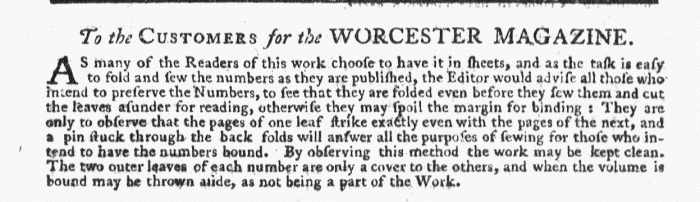
Thomas also experimented with advertising on wrappers that accompanied his Worcester Magazine, though he acknowledged to subscribers that these wrappers were ancillary to the publication:  “The two outer leaves of each number are only a cover to the others, and when the volume is bound may be thrown aside, as not being a part of the Work.”[1]

jan-30-worcerster-magazine-april-1786
Detail of Advertising Wrapper, Worcester Magazine (Second Week of April, 1786).

Thomas’s patriotic commitment to freedom of the press played a significant role in his decision to develop advertising wrappers.  As Thomas relays in his History of Printing in America, he discontinued printing his newspaper, the Massachusetts Spy, after the state legislature passed a law that “laid a duty of two-thirds of a penny on newspapers, and a penny on almanacs, which were to be stamped.”  Such a move met with strong protest since it was too reminiscent of the Stamp Act imposed by the British two decades earlier, prompting the legislature to repeal it before it went into effect.  On its heels, however, “another act was passed, which imposed a duty on all advertisements inserted in the newspapers” printed in Massachusetts.  Thomas vehemently rejected this law as “an improper restraint on the press. He, therefore, discontinued the Spy during the period that this act was in force, which was two years. But he published as a substitute a periodical work, entitled ‘The Worcester Weekly Magazine,’ in octavo.”[2] This weekly magazine lasted for two years; Thomas discontinued it and once again began printing the Spy after the legislature repealed the objectionable act.

jan-30-advertising-wrapper-worcester-magazine-4th-week-may-1786
Third Page of Advertising Wrapper, Worcester Magazine (Fourth Week of May, 1786).

Isaiah Thomas was not interested in advertising for its own sake to the same extent as Mathew Carey, but his political concerns did help to shape the landscape of early American advertising.  Furthermore, his vision for collecting American printed material preserved a variety of advertising media for later generations to admire, analyze, ponder, and enjoy.  Happy 277th birthday, Isaiah Thomas!

**********

[1] Isaiah Thomas, “To the CUSTOMERS for the WORCESTER MAGAZINE,” Worcester Magazine, wrapper, second week of April, 1786.

[2] Isaiah Thomas, The History of Printing in America: With a Biography of Printers, and an Account of Newspapers, vol. 2 (Worcester, MA: Isaac Sturtevant, 1810), 267-268.

Happy Birthday, Mathew Carey!

Though Benjamin Franklin is often considered the patron saint of American advertising in the popular press, I believe that his efforts pale in comparison to the contributions made by Mathew Carey (1760-1839) in the final decades of the eighteenth century. Franklin is rightly credited with experimenting with the appearance of newspaper advertising, mixing font styles and sizes in the advertisements that helped to make him a prosperous printer, but Mathew Carey introduced and popularized an even broader assortment of advertising innovations, ranging from inventive appeals that targeted potential consumers to a variety of new media to networks for effectively distributing advertising materials. In the process, his efforts played an important role in the development of American capitalism by enlarging markets for the materials sold by printers, booksellers, and publishers as well as a host of other goods marketed by merchants, shopkeepers, and artisans who eventually adopted many of Carey’s innovative advertising methods. Mathew Carey will probably never displace Benjamin Franklin as the founder of American advertising in the popular imagination, but scholars of early American history and culture should recognize his role as the most important leader in eighteenth-century advertising among the many other activities and accomplishments of his long career in business and public life.

mathew_carey_by_john_neagle_1825
Mathew Carey (January 28, 1760 – September 16, 1839). Portrait by John Neagle, 1825. Library Company of Philadelphia.

Carey’s efforts as an advertiser were enmeshed within transatlantic networks of print and commerce. Though he did not invent the advertising wrapper printed on blue paper that accompanied magazines in the eighteenth century, he effectively utilized this medium to an extent not previously seen in America, Ireland, or the English provinces outside of London. The wrappers distributed with his American Museum (1787-1792) comprised the most extensive collection of advertising associated with any magazine published in North America in the eighteenth century, both in terms of the numbers of advertisements and the diversity of occupations represented in those advertisements. In Carey’s hands, the American Museum became a vehicle for distributing advertising media: inserts that included trade cards, subscription notices, testimonials, and book catalogues in addition to the wrappers themselves.

Located at the hub of a network of printers and booksellers, Carey advocated the use of a variety of advertising materials, some for consumption by the general public and others for use exclusively within the book trade. Subscription notices and book catalogues, for instance, could stimulate demand among potential customers, but exchange catalogues were intended for printers and booksellers to manage their inventory and enlarge their markets by trading surplus copies of books, pamphlets, and other printed goods. Working with members of this network also facilitated placing advertisements for new publications in the most popular newspapers published in distant towns and cities.

Carey also participated in the development of advertising appeals designed to stimulate demand among consumers in eighteenth-century America. He targeted specific readers by stressing the refinement associated with some of his publications, while simultaneously speaking to general audiences by emphasizing the patriotism and virtue associated with purchasing either books about American history, especially the events of the Revolution and the ratification of the Constitution, or books published in America. In his advertising, Carey invoked a patriotic politics of consumption that suggested that the success of the republican experiment depended not only on virtuous activity in the realm of politics but also on the decisions consumers made in the marketplace.

For my money, Carey is indeed the father of American advertising.  Happy 265th birthday, Mathew Carey!

Happy Birthday, Isaiah Thomas!

Isaiah Thomas, patriot printer and founder of the American Antiquarian Society, was born on January 19 (New Style) in 1749 (or January 8, 1748/49, Old Style).  It’s quite an historical coincidence that the three most significant printers in eighteenth-century America — Benjamin Franklin, Isaiah Thomas, and Mathew Carey — were all born in January.

isaiah_thomas1818
Isaiah Thomas (January 30, 1739 – April 4, 1831). American Antiquarian Society.

The Adverts 250 Project is possible in large part due to Thomas’s efforts to collect as much early American printed material as he could, originally to write his monumental History of Printing in America.  The newspapers, broadsides, books, almanacs, pamphlets, and other items he gathered in the process eventually became the initial collections of the American Antiquarian Society.  That institution’s ongoing mission to acquire at least one copy of every American imprint through 1876 has yielded an impressive collection of eighteenth-century advertising materials, including newspapers, magazine wrappers, trade cards, billheads, watch papers, book catalogs, subscription notices, broadsides, and a variety of other items.  Exploring the history of advertising in early America — indeed, exploring any topic related to the history, culture, and literature of early America at all — has been facilitated for more than two centuries by the vision of Isaiah Thomas and the dedication of the curators and other specialists at the American Antiquarian Society over the years.

Thomas’s connections to early American advertising were not limited to collecting and preserving the items created on American presses during the colonial, Revolutionary, and early national periods.  Like Mathew Carey, he was at the hub of a network he cultivated for distributing newspapers, books, and other printed goods — including advertising to stimulate demand for those items.  Sometimes this advertising was intended for dissemination to the general public (such as book catalogs and subscription notices), but other times it amounted to trade advertising (such as circular letters and exchange catalogs intended only for fellow printers, publishers, and booksellers).

Thomas also experimented with advertising on wrappers that accompanied his Worcester Magazine, though he acknowledged to subscribers that these wrappers were ancillary to the publication:  “The two outer leaves of each number are only a cover to the others, and when the volume is bound may be thrown aside, as not being a part of the Work.”[1]

jan-30-worcerster-magazine-april-1786
Detail of Advertising Wrapper, Worcester Magazine (Second Week of April, 1786).

Thomas’s patriotic commitment to freedom of the press played a significant role in his decision to develop advertising wrappers.  As Thomas relays in his History of Printing in America, he discontinued printing his newspaper, the Massachusetts Spy, after the state legislature passed a law that “laid a duty of two-thirds of a penny on newspapers, and a penny on almanacs, which were to be stamped.”  Such a move met with strong protest since it was too reminiscent of the Stamp Act imposed by the British two decades earlier, prompting the legislature to repeal it before it went into effect.  On its heels, however, “another act was passed, which imposed a duty on all advertisements inserted in the newspapers” printed in Massachusetts.  Thomas vehemently rejected this law as “an improper restraint on the press. He, therefore, discontinued the Spy during the period that this act was in force, which was two years. But he published as a substitute a periodical work, entitled ‘The Worcester Weekly Magazine,’ in octavo.”[2] This weekly magazine lasted for two years; Thomas discontinued it and once again began printing the Spy after the legislature repealed the objectionable act.

jan-30-advertising-wrapper-worcester-magazine-4th-week-may-1786
Third Page of Advertising Wrapper, Worcester Magazine (Fourth Week of May, 1786).

Isaiah Thomas was not interested in advertising for its own sake to the same extent as Mathew Carey, but his political concerns did help to shape the landscape of early American advertising.  Furthermore, his vision for collecting American printed material preserved a variety of advertising media for later generations to admire, analyze, ponder, and enjoy.  Happy 276th birthday, Isaiah Thomas!

**********

[1] Isaiah Thomas, “To the CUSTOMERS for the WORCESTER MAGAZINE,” Worcester Magazine, wrapper, second week of April, 1786.

[2] Isaiah Thomas, The History of Printing in America: With a Biography of Printers, and an Account of Newspapers, vol. 2 (Worcester, MA: Isaac Sturtevant, 1810), 267-268.

December 12

What was advertised in a colonial American newspaper 250 years ago today?

New-York Gazette and Weekly Mercury (December 12, 1774).

“He will meet with due encouragement … by every real friend to American manufactures.”

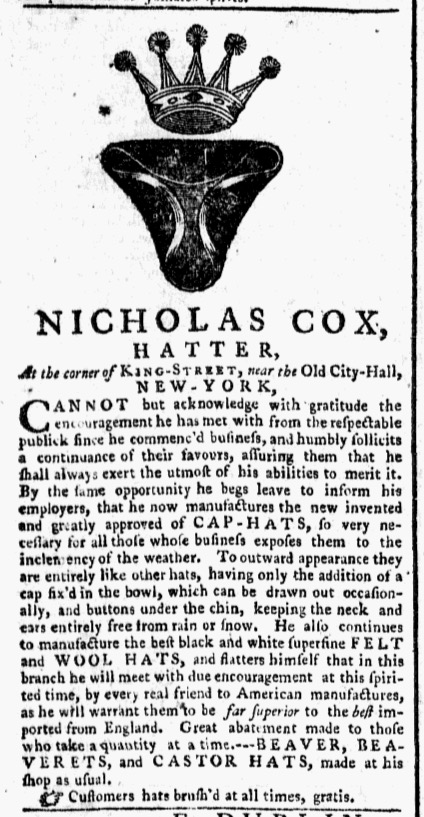
Nicholas Cox, a hatter, made several appeals to consumers in his advertisement in the December 12, 1774, edition of the New-York Gazette and Weekly Mercury.  He commenced with a standard expression of gratitude for “the encouragement he had met with from the respectable publick since he commenc’d business.”  Many purveyors of goods and services did so in their advertisements, signaling to readers that other consumers already considered them worthy of their business.  It was a familiar means of bolstering an advertiser’s reputation.

The hatter also incorporated commentary specific to his trade, proclaiming that he “manufactures the new invented and greatly approved of CAP-HATS.”  For those unaware of this innovation, eh explained that by “outward appearance they are entirely like other hats, having only the addition of a cap fix’d in the bowl, which can be drawn out occasionally.”  In such instances, it “buttons under the chin, keeping the neck and ears entirely free from rain or snow.”  Cox marketed this new style, a very practical element, as “so very necessary for all those whose business exposes them to the inclemency of the weather.”  According to Kate Haulman, colonizers debated whether they should carry umbrellas, “stylistic spoils of empire hailing from India,” in the 1760s and 1770s.  “Some regarded umbrellas as ridiculous and frivolous,” she notes, “serving no purpose that a good hat could not supply.”[1]  Cox produced and sold such hats for men of business who sought to eschew the effeminacy and luxury associated with umbrellas.

His next appeal made an even more explicitly political argument to prospective customers.  He made “the best black and white superfine FELT and WOOL HATS,” like the tricorne hat depicted in the woodcut that adorned his advertisement.  Cox asserted that patriotic consumers had a duty to support his business when they made choices about where to acquire their hats.  He expressed confidence that he “will meet with due encouragement at this spirited time, by every real friend to American manufactures.”  The Continental Association, a boycott of British goods adopted in response to the Coercive Acts, had recently gone into effect.  Cox offered an alternative to colonizers who desired to acquire hats yet wished to remain patriotically correct, either according to their own principles or at least to avoid the ire of others who observed the purchases they made.  Furthermore, his customers did not have sacrifice quality for principles.  The hatter pledged that “he will warrant [his hats] to be far superior to the best imported from England.” That being the case, the crown that appeared above the tricorne hat at the top of his advertisement may have testified to the superior quality of his hats, a general sense of pride in being part of the British Empire, or reverence for the monarch whom many colonizers still hoped would intervene on their behalf in their altercation with Parliament.

In addition to those appeals, Cox included two more common marketing strategies.  He promised a “[g]reat abatement … to those who take a quantity at a time.”  In other words, he gave discounts for buying multiple hats, both for consumers and for retailers who intended to sell them in their own shops.  He also provided a free ancillary service: “Customers hats brush’d at all times, gratis.”  Cox saw to the care and maintenance of the hats he made and sold long after the time of purchase.  He cultivated relationships with customers by encouraging them to return to his shop for assistance in keeping their hats in good order.  Overall, Cox resorted to a variety of familiar and specific appeals when advertising his hats, distinguishing him from competitors who did not put as much effort into marketing their wares.

**********

[1] Kate Haulman, “Fashion and the Culture Wars of Revolutionary Philadelphia,” William and Mary Quarterly, 3rd ser., 62, no 4 (October 2005): 632.

Happy Birthday, Mathew Carey!

Though Benjamin Franklin is often considered the patron saint of American advertising in the popular press, I believe that his efforts pale in comparison to the contributions made by Mathew Carey (1760-1839) in the final decades of the eighteenth century. Franklin is rightly credited with experimenting with the appearance of newspaper advertising, mixing font styles and sizes in the advertisements that helped to make him a prosperous printer, but Mathew Carey introduced and popularized an even broader assortment of advertising innovations, ranging from inventive appeals that targeted potential consumers to a variety of new media to networks for effectively distributing advertising materials. In the process, his efforts played an important role in the development of American capitalism by enlarging markets for the materials sold by printers, booksellers, and publishers as well as a host of other goods marketed by merchants, shopkeepers, and artisans who eventually adopted many of Carey’s innovative advertising methods. Mathew Carey will probably never displace Benjamin Franklin as the founder of American advertising in the popular imagination, but scholars of early American history and culture should recognize his role as the most important leader in eighteenth-century advertising among the many other activities and accomplishments of his long career in business and public life.

mathew_carey_by_john_neagle_1825
Mathew Carey (January 28, 1760 – September 16, 1839). Portrait by John Neagle, 1825. Library Company of Philadelphia.

Carey’s efforts as an advertiser were enmeshed within transatlantic networks of print and commerce. Though he did not invent the advertising wrapper printed on blue paper that accompanied magazines in the eighteenth century, he effectively utilized this medium to an extent not previously seen in America, Ireland, or the English provinces outside of London. The wrappers distributed with his American Museum (1787-1792) comprised the most extensive collection of advertising associated with any magazine published in North America in the eighteenth century, both in terms of the numbers of advertisements and the diversity of occupations represented in those advertisements. In Carey’s hands, the American Museum became a vehicle for distributing advertising media: inserts that included trade cards, subscription notices, testimonials, and book catalogues in addition to the wrappers themselves.

Located at the hub of a network of printers and booksellers, Carey advocated the use of a variety of advertising materials, some for consumption by the general public and others for use exclusively within the book trade. Subscription notices and book catalogues, for instance, could stimulate demand among potential customers, but exchange catalogues were intended for printers and booksellers to manage their inventory and enlarge their markets by trading surplus copies of books, pamphlets, and other printed goods. Working with members of this network also facilitated placing advertisements for new publications in the most popular newspapers published in distant towns and cities.

Carey also participated in the development of advertising appeals designed to stimulate demand among consumers in eighteenth-century America. He targeted specific readers by stressing the refinement associated with some of his publications, while simultaneously speaking to general audiences by emphasizing the patriotism and virtue associated with purchasing either books about American history, especially the events of the Revolution and the ratification of the Constitution, or books published in America. In his advertising, Carey invoked a patriotic politics of consumption that suggested that the success of the republican experiment depended not only on virtuous activity in the realm of politics but also on the decisions consumers made in the marketplace.

For my money, Carey is indeed the father of American advertising.  Happy 264th birthday, Mathew Carey!

Happy Birthday, Isaiah Thomas!

Isaiah Thomas, patriot printer and founder of the American Antiquarian Society, was born on January 19 (New Style) in 1749 (or January 8, 1748/49, Old Style).  It’s quite an historical coincidence that the three most significant printers in eighteenth-century America — Benjamin Franklin, Isaiah Thomas, and Mathew Carey — were all born in January.

isaiah_thomas1818
Isaiah Thomas (January 30, 1739 – April 4, 1831). American Antiquarian Society.

The Adverts 250 Project is possible in large part due to Thomas’s efforts to collect as much early American printed material as he could, originally to write his monumental History of Printing in America.  The newspapers, broadsides, books, almanacs, pamphlets, and other items he gathered in the process eventually became the initial collections of the American Antiquarian Society.  That institution’s ongoing mission to acquire at least one copy of every American imprint through 1876 has yielded an impressive collection of eighteenth-century advertising materials, including newspapers, magazine wrappers, trade cards, billheads, watch papers, book catalogs, subscription notices, broadsides, and a variety of other items.  Exploring the history of advertising in early America — indeed, exploring any topic related to the history, culture, and literature of early America at all — has been facilitated for more than two centuries by the vision of Isaiah Thomas and the dedication of the curators and other specialists at the American Antiquarian Society over the years.

Thomas’s connections to early American advertising were not limited to collecting and preserving the items created on American presses during the colonial, Revolutionary, and early national periods.  Like Mathew Carey, he was at the hub of a network he cultivated for distributing newspapers, books, and other printed goods — including advertising to stimulate demand for those items.  Sometimes this advertising was intended for dissemination to the general public (such as book catalogs and subscription notices), but other times it amounted to trade advertising (such as circular letters and exchange catalogs intended only for fellow printers, publishers, and booksellers).

Thomas also experimented with advertising on wrappers that accompanied his Worcester Magazine, though he acknowledged to subscribers that these wrappers were ancillary to the publication:  “The two outer leaves of each number are only a cover to the others, and when the volume is bound may be thrown aside, as not being a part of the Work.”[1]

jan-30-worcerster-magazine-april-1786
Detail of Advertising Wrapper, Worcester Magazine (Second Week of April, 1786).

Thomas’s patriotic commitment to freedom of the press played a significant role in his decision to develop advertising wrappers.  As Thomas relays in his History of Printing in America, he discontinued printing his newspaper, the Massachusetts Spy, after the state legislature passed a law that “laid a duty of two-thirds of a penny on newspapers, and a penny on almanacs, which were to be stamped.”  Such a move met with strong protest since it was too reminiscent of the Stamp Act imposed by the British two decades earlier, prompting the legislature to repeal it before it went into effect.  On its heels, however, “another act was passed, which imposed a duty on all advertisements inserted in the newspapers” printed in Massachusetts.  Thomas vehemently rejected this law as “an improper restraint on the press. He, therefore, discontinued the Spy during the period that this act was in force, which was two years. But he published as a substitute a periodical work, entitled ‘The Worcester Weekly Magazine,’ in octavo.”[2] This weekly magazine lasted for two years; Thomas discontinued it and once again began printing the Spy after the legislature repealed the objectionable act.

jan-30-advertising-wrapper-worcester-magazine-4th-week-may-1786
Third Page of Advertising Wrapper, Worcester Magazine (Fourth Week of May, 1786).

Isaiah Thomas was not interested in advertising for its own sake to the same extent as Mathew Carey, but his political concerns did help to shape the landscape of early American advertising.  Furthermore, his vision for collecting American printed material preserved a variety of advertising media for later generations to admire, analyze, ponder, and enjoy.  Happy 275th birthday, Isaiah Thomas!

**********

[1] Isaiah Thomas, “To the CUSTOMERS for the WORCESTER MAGAZINE,” Worcester Magazine, wrapper, second week of April, 1786.

[2] Isaiah Thomas, The History of Printing in America: With a Biography of Printers, and an Account of Newspapers, vol. 2 (Worcester, MA: Isaac Sturtevant, 1810), 267-268.

October 21

What was advertised in a colonial American newspaper 250 years ago today?

Massachusetts Spy (October 21, 1773).

“He has improved on the late patent Windlass.”

William Smith, a shipwright, advertised windlasses, mechanisms for moving heavy weights, in the October 21, 1773, edition of the Massachusetts Spy.  In his efforts to convince “Merchants or Captains” to purchase his windlasses, Smith emphasized innovations that made them superior to “the late patent Windlass.”  According to the shipwright, he “has contrived a new plan by which two men will have a strain equal to seven in less time.”  That significantly reduced the effort necessary to raise an anchor.  In addition, Smith noted that he “fixed the palls” or pawls “to catch twenty-four times in once going round.”  The “Merchants or Captains” that the shipwright addressed knew that pawls used on anchor windlasses prevented free-spooling chains by grabbing and securing individual links.

Innovation did not result in higher prices for Smith’s windlasses.  To the contrary, he asserted that his windlass “will not cost as much money as the late patent windlass, by at least one fourth.”  Those “Merchants or Captains” could acquire a superior piece of equipment at lower prices.  Furthermore, Smith advised that “the improvement may be fixed to any common windlass, with a power far greater then the late patent windlass.”  The shipwright encouraged prospective customers to consult with him about making the modifications.

When advertisers promoted new technologies, they sometimes included testimonials to demonstrate the accuracy of the claims they made.  Even more commonly, they reported that others examined and endorsed their products, neglecting to provide any names or commentary.  Still, they aimed to convince prospective customers that they did not have to rely on an advertiser’s word alone.  For his part, Smith confided that his “model has been surveyed by several gentlemen, who unanimously agree that it is the greatest improvement yet made.”  That suggested to “Merchants or Captains” that they would be satisfied with the performance of Smith’s windlass once they gave it a chance.  Today, many advertisers emphasize innovation and new technologies in their marketing campaigns.  When they do so, they draw on a long history.  Such advertising strategies had precursors in the eighteenth century.

August 8

What was advertised in a colonial American newspaper 250 years ago this week?

Maryland Gazette (August 5, 1773).

“Every possessor of a copy may himself enter the proper alteration or addition, agreeable to the advertisements I shall from time to time insert in the Gazette.”

In the summer of 1773, Elie Vallette placed an advertisement in the Maryland Gazette to provide an update on The Deputy Commissary’s Guide.  Intending to publish the book by subscription, he commenced a marketing campaign several months earlier.  He successfully attracted subscribers to the project, a sufficient number that the book “Is now in the Press, and will be speedily published.”  Still, Vallette continued to promote the book, hoping to gain additional subscribers to defray the costs and generate more revenue.  To that end, he once again declared that those who subscribed in advance would have their names printed on a personalized title page, but they needed “to be speedy in their application, as none but such can have their names printed in the title page.”  In the end, that particular enticement worked out a bit differently than Vallette originally described it.

The author also presented an endorsement from several prominent colonizers, all of them “gentlemen of the law” in Maryland, publishing it with their permission.  “WE have perused your manuscript, entitled ‘The deputy Commissary’s Guide,’” the lawyers wrote, “and do much approve of it; we apprehend that performance will be of general utility, and that it well deserves the encouragement of the publick.”  Even before this endorsement, the number of subscribers “increased far beyond what was conjectured” … and Vallette still had not received lists of subscribers from all of the “gentlemen who have been so obliging to take in subscriptions” throughout the colony.  Perhaps an unexpected number of subscribers played a role in Vallette ultimately altering his plans for the title page.  In this advertisement, he confided that the subscribers exceeded his original “provision.”

Vallette balanced the popularity and demand for the book with the opportunity to become a subscriber.  It was not too late!  To help convince any prospective subscribers who might have been wavering, the author revealed another feature of the book.  He planned to include “a number of blank leaves” for manuscript additions to reflect changes in the laws.  “In some few instances,” Vallette acknowledged, “the testamentary laws now existing, may, and probably will, soon undergo the revival of the legislature.”  In such instances, “every possessor of a copy [of The Deputy Commissary’s Guide] may himself enter the proper alteration or addition.”  To aid in that endeavor, the author pledged that he would place advertisements in the Maryland Gazette to guide subscribers in updating their books “whenever any such alteration shall take place.”  Vallette’s relationship with subscribers extended beyond a single transaction.  He continued to offer services after buyers received their books.

Vallette intended for each of these marketing strategies – personalized title pages, an endorsement from six prominent lawyers, and blank pages to enter alterations to current laws – to entice even more subscribers for The Deputy Commissary’s Guide.  Other authors, booksellers, printers, and publishers sometimes included recommendations from well-known figures in their advertisements for books.  The title pages and blank pages, however, represented innovative and novel techniques for encouraging prospective subscribers to reserve their own copies of the book.

Happy Birthday, Mathew Carey!

Though Benjamin Franklin is often considered the patron saint of American advertising in the popular press, I believe that his efforts pale in comparison to the contributions made by Mathew Carey (1760-1839) in the final decades of the eighteenth century. Franklin is rightly credited with experimenting with the appearance of newspaper advertising, mixing font styles and sizes in the advertisements that helped to make him a prosperous printer, but Mathew Carey introduced and popularized an even broader assortment of advertising innovations, ranging from inventive appeals that targeted potential consumers to a variety of new media to networks for effectively distributing advertising materials. In the process, his efforts played an important role in the development of American capitalism by enlarging markets for the materials sold by printers, booksellers, and publishers as well as a host of other goods marketed by merchants, shopkeepers, and artisans who eventually adopted many of Carey’s innovative advertising methods. Mathew Carey will probably never displace Benjamin Franklin as the founder of American advertising in the popular imagination, but scholars of early American history and culture should recognize his role as the most important leader in eighteenth-century advertising among the many other activities and accomplishments of his long career in business and public life.

mathew_carey_by_john_neagle_1825
Mathew Carey (January 28, 1760 – September 16, 1839). Portrait by John Neagle, 1825. Library Company of Philadelphia.

Carey’s efforts as an advertiser were enmeshed within transatlantic networks of print and commerce. Though he did not invent the advertising wrapper printed on blue paper that accompanied magazines in the eighteenth century, he effectively utilized this medium to an extent not previously seen in America, Ireland, or the English provinces outside of London. The wrappers distributed with his American Museum (1787-1792) comprised the most extensive collection of advertising associated with any magazine published in North America in the eighteenth century, both in terms of the numbers of advertisements and the diversity of occupations represented in those advertisements. In Carey’s hands, the American Museum became a vehicle for distributing advertising media: inserts that included trade cards, subscription notices, testimonials, and book catalogues in addition to the wrappers themselves.

Located at the hub of a network of printers and booksellers, Carey advocated the use of a variety of advertising materials, some for consumption by the general public and others for use exclusively within the book trade. Subscription notices and book catalogues, for instance, could stimulate demand among potential customers, but exchange catalogues were intended for printers and booksellers to manage their inventory and enlarge their markets by trading surplus copies of books, pamphlets, and other printed goods. Working with members of this network also facilitated placing advertisements for new publications in the most popular newspapers published in distant towns and cities.

Carey also participated in the development of advertising appeals designed to stimulate demand among consumers in eighteenth-century America. He targeted specific readers by stressing the refinement associated with some of his publications, while simultaneously speaking to general audiences by emphasizing the patriotism and virtue associated with purchasing either books about American history, especially the events of the Revolution and the ratification of the Constitution, or books published in America. In his advertising, Carey invoked a patriotic politics of consumption that suggested that the success of the republican experiment depended not only on virtuous activity in the realm of politics but also on the decisions consumers made in the marketplace.

For my money, Carey is indeed the father of American advertising.  Happy 263rd birthday, Mathew Carey!