What was advertised in a revolutionary American newspaper 250 years ago today?

“DOCTOR FENDALL, OPERATOR upon the TEETH, is just arrived in this town.”
During the first week of September 1776, “DOCTOR FENDALL, OPERATOR upon the TEETH,” arrived in Baltimore and began seeking patients. He placed an advertisement outlining his services in the Maryland Journal, announcing that he “cures the scurvy in the gums,” “prevents teeth from growing rotten,” “transplants natural teeth from one person to another,” “Makes and fixes artificial teeth,” and “extracts teeth and stumps.” For each of those procedures, he offered additional details intended to reassure prospective patients of his skill and the effectiveness of his treatments. When it came to artificial teeth, for instance, Fendall declared that he “makes and fixes [them] with the greatest exactness and nicety, without pain or the least inconvenience, so that they may eat, drink, or sleep with them in their mouths as natural ones.” Even better, Fendall’s artificial teeth “cannot be discovered by the sharpest eye.”
In addition to an array of dental procedures, Fendall also hawked his own “DENTRIFICE” or toothpaste, entering the market of patent medicines. He promised that his toothpaste was “quite free from any corrosive preparation” that would eat away at the teeth. Instead, it would “restore the gums to their pristine state, … prevent the tooth-ach, and render the breath delicately sweet,” but only “if the tartarous substance is off the teeth.” That suggested that patients who purchased Fendall’s toothpaste should first visit him for a cleaning. Among his services, he highlighted that he “scales the teeth from that corrosive, tartarous, gritty substance, [which] impedes the gum from growing, infects the breath, and is one of the principal cause of the scurvy, which … eats away the gums, so that many peoples teeth fall out.” Fendall hoped to make two sales at once, charging patients for cleaning their teeth and the toothpaste necessary to maintain the treatment. He also advised that each pot of his toothpaste was “signed with his own hand to prevent fraud.” Consumers could protect themselves from forgeries through that means of confirming the authenticity of the “DENTRIFICE” they purchased.
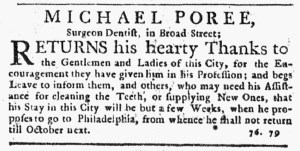
Fendall aimed to create a sense of urgency around scheduling appointments for procedures and purchasing his toothpaste. He concluded his advertisement with a nota bene that warned, “His Stay in Town will be only one Week.” He may have planned to stay longer, especially if prospective patients responded to his advertisement, but he wanted them to think that they could avail themselves of his services for a limited time only. He tried to drum up as much business as quickly as possible to make his stay in Baltimore, however long it lasted, a viable venture.