May 19

Who was the subject of an advertisement in a revolutionary American newspaper 250 years ago today?
South-Carolina Gazette and Country Journal Extraordinary (May 19, 1775).

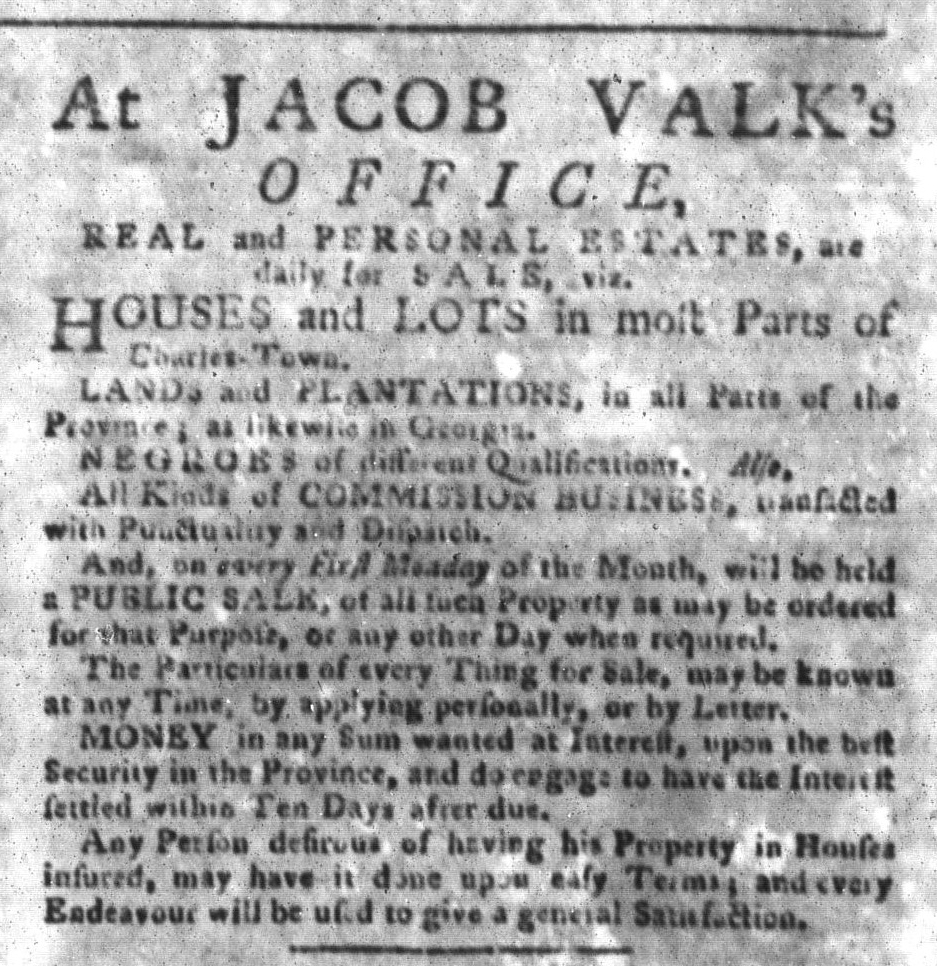
“NEGROES of different Qualifications.”

Charles Crouch usually published the South-Carolina Gazette and Country Journal on Tuesdays in 1775, distributing new issues on a different day than his competitors in Charleston.  Peter Timothy delivered the South-Carolina Gazette on Mondays and Robert Wells and Son presented the South-Carolina and American General Gazette on Fridays.  Yet as information about the battles at Lexington and Concord arrived in Charleston, Crouch published a two-page extraordinary issue on Friday, May 19.  He had first broken the news in the May 9 edition, printing “alarming Intelligence” received via “the Brigantine, Industry, Captain Allen, who sailed the 25th [of April] from Salem.”  Subsequent issues of both the South-Carolina Gazette and Country Journal and the South-Carolina and American Gazette carried news about Lexington and Concord.  (A gap in extant issues between April 10 and May 29 prevents determining when the South-Carolina Gazette reported on those events.)

Many, perhaps most, readers likely heard that British regulars had engaged colonial militia outside of Boston before they read anything in newspapers.  News and rumors spread via word of mouth more quickly than printers could set type, yet readers still clamored for coverage.  After all, the public prints carried more details about what happened, though not all of them were always correct.  Wells and Son printed the South-Carolina and American General Gazette as usual on Friday, May 19, carrying additional news about Lexington and Concord and the aftermath.  Refusing to be scooped, Crouch published his extraordinary issue on the same day.  He specified that the “particulars respecting the Engagement at Lexington, are copied from the Newport Mercury.”

Even as Crouch provided more news for subscribers and the public, he disseminated even more advertisements.  News accounted for only one-quarter of the contents of the May 19 extraordinary issue, with advertisements filling three-quarters of the space.  Those notices included three from Jacob Valk, a broker, looking to facilitate the sales of “ONE of the compleatest WAITING-MEN in the Province,” “Some valuable PLANTATION NEGROES,” and “NEGROES of different Qualifications” at his office.  In another advertisement, William Stitt described Lydia and Phebe, enslaved women who liberated themselves by running away, and offered rewards for their capture and return to bondage.  In yet another, the warden of Charleston’s workhouse described nearly a dozen Black men and women, all of them fugitives seeking freedom, imprisoned there, alerting their enslavers to claim them, pay their expenses, and take them away.  As readers learned more about acts of tyranny and resistance underway in Massachusetts, they also encountered various sorts of advertisements designed to perpetuate the enslavement of Black men and women.  The early American press simultaneously served multiple purposes, regularly featuring a juxtaposition of liberty and slavery that readers conveniently compartmentalized.
November 29

What was advertised in a colonial American newspaper 250 years ago today?

Supplement to the South-Carolina Gazette and Country Journal (November 29, 1774).

“Employ him in any Kind of Commission Business.”

Philip Henry worked as a bookkeeper and a broker in Charleston on the eve of the American Revolution.  In an advertisement in the South-Carolina Gazette and Country Journal, he advised the public that “Merchants, Tradesmen, and others, may have their BOOKS brought up with the utmost Dispatch.”  Those considering embarking on a new endeavor could engage his services to have their accounts and ledgers “opened and regulated in a proper Manner” from the start.  In addition, he assisted with “any Kind of Commission Business,” whether commodities, real estate, or enslaved laborers.

As part of that aspect of his business, Henry placed many more advertisements on behalf of his clients.  In the supplement that accompanied the November 29, 1774, edition of the South-Carolina Gazette and Country Journal, for instance, his advertisement describing the variety of services he offered at his office on Meeting Street served as an introduction for a series of advertisements that ran immediately below it.  He inserted eight additional advertisements, six of them for real estate and two offering enslaved people for sale.  His brokerage business was good business for Charles Crouch, the printer of that newspaper.

Henry was not alone as a broker or as an advertiser.  Peter Bounetheau ran a similar notice, one that also served as an introduction to a series of other advertisements.  He placed eleven on another page of the supplement that included Henry’s notices, requiring enough space to fill an entire column and spill over into another.  Those included six about enslaved people, two about real estate, one on behalf of the executor of an estate, and one about several lots in the city, a plantation in the country, and “Several NEGROES.”  Similarly, Jacob Valk, another broker, inserted advertisements that accounted for a significant amount of space in November 29 edition.  He collated most of the real estate handled by his office into a single advertisement that filled a column, yet placed five separate advertisements about enslaved people as well as an estate notice and an advertisement about horses.

Henry, Bounetheau, and Valk industriously placed their notices in the South-Carolina and American General Gazette and the South-Carolina Gazette in addition to the South-Carolina Gazette and Country Journal.  Even though brokers ran offices in other urban ports, they did not adopt a similar advertising strategy as part of their business model.  That made the rhythm of advertising in South Carolina’s newspapers distinctive compared to those published in Boston, New York, and Philadelphia.

August 9

What was advertised in a colonial American newspaper 250 years ago today?

South-Carolina Gazette and Country Journal (August 9, 1774).

“That large commodious Room, (for the better accommodating Business for the Public Utility).”

Jacob Valk continued to do well as a broker for “Lands, Houses, and Negroes” in Charleston in the summer of 1774.  He attracted so many clients that the advertisements he placed on their behalf filled two of the three columns on the first page of the August 9, 1774, edition of the South-Carolina Gazette and Country Journal.  In addition to that publication, he regularly bought a significant amount of space in the South-Carolina Gazette and the South-Carolina and American General Gazette.  His investment in advertising testified to his belief in its effectiveness, while the number of advertisements demonstrated the extensive demand for his services.

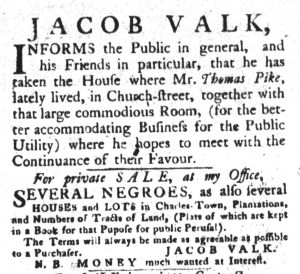
Such success prompted him to move his brokerage office to a new location.  He announced that he “has taken the House where Mr. Thomas Pike, lately lived … together with that large commodious Room, (for the better accommodating Business for the Public Utility).”  Pike had recently departed the city after offering dancing and fencing lessons to its residents for a decade.  He hosted an annual ball for his students to display their talents, most recently in the “New-Assembly Room” where Valk now conducted business.  Even while he was still in town, Pike had rented the room for “Public Sales, of Estates, Negroes, [and] Dry Goods.”  With Valk on the scene, the space only occasionally used for the buying and selling of enslaved men, women, and children now became a site dedicated to perpetuating the slave trade.

Immediately below his note about his new location, Valk advertised “SEVERAL NEGROES” available “For private SALE, at my Office.”  In the subsequent advertisements that filled those two columns, he also sought buyers for “two very valuable Negro Shoemakers” and “TWO or three exceeding good SEAMSTRESSES, and some young Negro Fellows, capable of all Work.”  He also put out a call for a “good Negro CARPENTER,” seeking an enslaver interested in selling a skilled artisan.  Although most of these enslaved people did not need to appear in the “New-Assembly Room” for Valk to broker the sales, that “large commodious Room” did lend itself to putting enslaved people on display.  Colonizers who sought Valk’s services buying and selling enslaved people did conduct business in the space formerly used for dancing lessons.  Some of them had likely socialized there during Pike’s annual balls before buying and selling enslaved people in the same space after the dancing master’s departure from the city.  Valk seamlessly moved his brokerage office there, a testament to how slavery was so deeply enmeshed in daily life in colonial Charleston and other urban centers.

April 26

What was advertised in a colonial American newspaper 250 years ago today?

Supplement to the South-Carolina Gazette and Country Journal (April 26, 1774).

“For further particulars, enquire of JACOB VALK.”

Jacob Valk established a brokerage office in Charleston in the early 1770s.  In his newspaper advertisements, he advised, “Lands, Houses, and Negroes, Bought and sold at private Sale, upon the usual Commission.”  If the pages of the public prints provide any guidance, many colonizers availed themselves of his services, entrusting the broker to conduct business on their behalf.  His name became a familiar sight as he placed advertisement after advertisement for his clients.

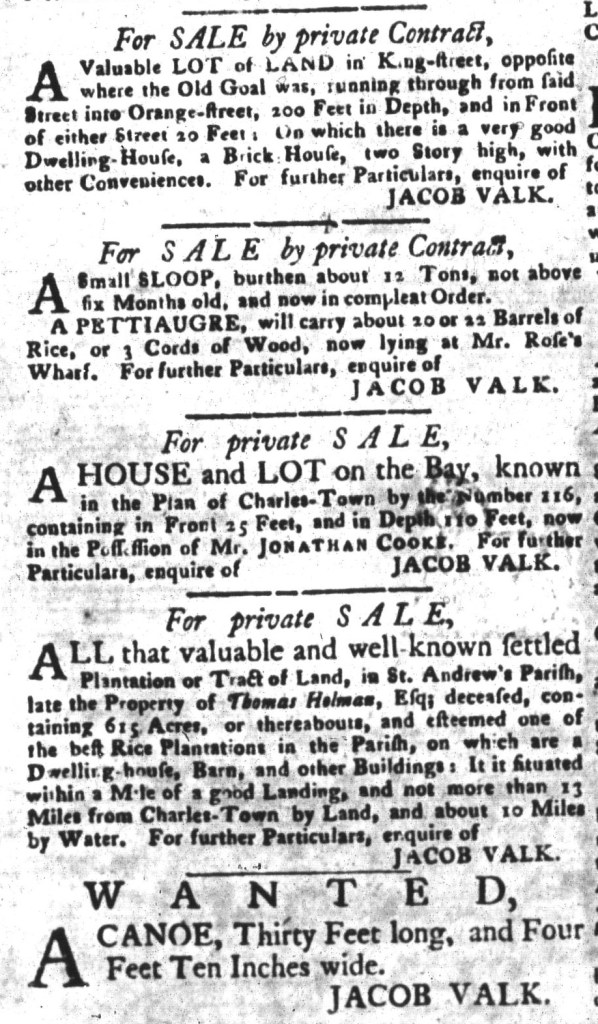
Consider the supplement that accompanied the April 26 edition of the South-Carolina Gazette and Country Journal.  Valk purchased an entire column on the third page, running fourteen advertisements.  Some offered tracts of land for sale, while others included houses and other buildings along with land.  Two of them announced sales of enslaved people, one indicating “SEVERAL NEGROES” without giving further details and the other describing “two very valuable Negro Shoe-makers.”  Valk sought buyers for “A Small Sloop” and a pettiaugre (or canoe).  In each instance, he invoked a familiar refrain: “For further Particulars, enquire of JACOB VALK.”  He also assisted executors of estates in calling on those who had unfinished business to settle accounts, inviting them to his office “where the Particulars of that Estate now lay ready for their Perusal.”  Four days earlier, Valk purchased a similar amount of space to run many of the same advertisements in the South-Carolina and American General Gazette.

The broker must have factored the cost of advertising into the “usual Commission” that he received for his services, especially considering that he was one of the best customers for the printing offices in Charleston.  That he continuously placed newspaper advertisement testifies to his confidence in their general effectiveness, though not every notice may have achieved the desired results.  Running so many simultaneously allowed him to distribute the risk and rewards of advertising.  Even if some advertisements did not attract buyers, sellers, or associates seeking to settle accounts, others apparently did.  When considered collectively, Valk came out ahead on what he invested in advertising.  His individual clients, however, would not have had the same experience had they gone it alone.  If they paid Valk on commission following a transaction he facilitated, then they paid only for successful advertisements without losing money on notices that did not produce the intended results.

August 10

Who were the subjects of advertisements in a colonial American newspaper 250 years ago today?

South-Carolina Gazette and Country Journal (August 10, 1773).

“NEW ADVERTISEMENTS … about One Hundred choice Gambia SLAVES.”

Advertising underwrote the dissemination of the news in eighteenth-century America.  Among the advertisements for consumer goods and services, legal notices, and real estate advertisements that usually filled at least half of any issue of any newspaper printed in the colonies in the 1760s and 1770s, advertisements about enslaved people described men, women, and children for sale and offered rewards for the capture and return of “runaways” who liberated themselves from their enslavers.  No printer rejected such advertisements on principle.  Indeed, when James Rivington launched a new newspaper in the spring of 1773, it took only three issues for him not only to publish an advertisement about a “Very fine Negro Boy” for sale but also to serve as a broker by instructing interested buyers to “Enquire of the Printer.”

From New England to Georgia, printers generate revenues by publishing advertisements about enslaved people, though such advertisements accounted for a greater proportion of all notices in newspapers in southern colonies.  The August 10, 1773, edition of the South-Carolina Gazette and Country Journal, for instance, carried forty-four advertisements.  Fifteen of them concerned enslaved people.  Ten of those offered enslaved men, women, and children for sale, either individually “by private Contract” or at auctions for a “CARGO OF … SLAVES” recently arrived in Charleston after surviving the Middle Passage from Africa.  One offered a reward for a “new negro fellow named TOM” who liberated himself while another described five Black men and youths “Brought to the WORK-HOUSE” and held there until their enslavers claimed them and paid charges for holding them.  Yet another advertisement sought an overseer for a “Rice Swamp Plantation,” stating that it would be more agreeable if an applicant “has a Wife, who is used to the Management of, and will pay due Attention to sick Negroes and children.”  One more gave notice to “Residents and Non-Residents of the Parish of St. Thomas and St. Dennis” that they needed to submit a “Return upon Oath, of all their Male Slaves, liable to work in the High Roads … in Order that an Assessment may be made for defraying the Expences or Repairs.”  In addition to advertisements about enslaved people for sale and rewards for returning fugitives from enslavement, newspaper notices seeking employees and preparing for public works projects sometimes incorporated enslaved people as critical components.

South-Carolina Gazette and Country Journal (August 10, 1773).

Advertisements about enslaved people were so ubiquitous in the August 10 edition that they appeared as the first and last notices that readers encountered.  After the list of ships that entered and cleared the customs house in Charleston, a header marked “NEW ADVERTISEMENTS.”  That header appeared immediately above the first of those advertisements, a notice about the upcoming sale of “about One Hundred choice Gambia SLAVES” currently in quarantine.  It included a brief overview of a boy who had smallpox during the voyage but recovered more than four weeks earlier.  In addition, the notice provided assurances that “not the smallest Symptom hath ever appeared on any of the other Slaves, who are now all in perfect Health.”  The issue concluded with two advertisements offering enslaved people for sale by a local broker, one for “FOUR valuable and seasoned Negroes” and the other for a “Likely young NEGRO FELLOW, … a good Bricklayer.”  The broker, Jacob Valk, also placed the advertisement for the four enslaved people in the South-Carolina Gazette the previous day, one of the sixteen notices about enslaved men, women, and children in that newspaper.  Those last two advertisements ran immediately above the colophon that provided publication information: “CHARLES-TOWN: Printed by CHARLES CROUCH, in Elliott-Street.”  Advertisements about enslaved people, so lucrative for printers, bookended the paid notices in that issue of the South-Carolina Gazette and Country Journal.

August 9

What was advertised in a colonial American newspaper 250 years ago today?

South-Carolina Gazette (August 9, 1773).

“Lands, Houses, and Negroes, Bought and sold at private Sale, upon the usual Commissions.”

Jacob Valk opened a brokerage office in Charleston in the early 1770s.  For months in 1773, he ran an advertisement in the South-Carolina Gazette and the South-Carolina Gazette and Country Journal to alert “the PUBLIC in general, and his Friends in particular” about the various services he provided.  He presented five primary categories of tasks undertaken in his office:  “Merchants and Tradesmen may have their Books regulated,” “Sets of Books opened properly, for Persons newly commencing any Kind of Business and superintended with the utmost Care,” “Persons desirous of settling their yearly Business expeditiously, by sending their Books to him may have it done,” “Money borrowed and lent at Interest,” and “Lands, Houses, and Negroes, Bought and sold at private Sale, upon the usual Commissions.”  Among the various jobs that he did on behalf of colonizers who employed him, Valk facilitated buying and selling enslaved men, women, and children.

To that end, he also placed advertisements on behalf of his clients.  In the August 9, 1773, edition of the South-Carolina Gazette, one of those advertisements ran immediately below his weekly notice about his various services.  On behalf of his clients, the broker described “Four valuable and seasoned Negroes” available “by private Contract” rather than auction.  Two young men were “fit for the Field,” but another young man as well as a woman possessed skills for contributing to a household.  The “young FELLOW” had experience as a “complete Waiting-Man” who had also seen to the “Care and Management of Horses, and can drive a Carriage.”  The woman was a “complete” housekeeper, “who is also a good ordinary Cook.”  Valk concluded with instructions that prospective buyers should contact him for more information about the enslaved men and woman and the “Terms of Sale.”

In another advertisement in the same issue, the broker described a house and lot for sale.  Valk’s newspaper advertisements outlining his services likely helped generate business in his brokerage office.  In turn, he placed additional notices that increased his visibility and, when successful, augmented his reputation among his clients and the general public.  Those advertisement also demonstrated that the broker actively worked on behalf of his clients, confirming for prospective customers that they might do better by entrusting sales to him “upon the usual Commissions” rather than invest their own time and effort.  In addition, those additional advertisements testified to the fact that others did indeed employ Valk, perhaps elevating the confidence that prospective clients had in his abilities.

September 11

What was advertised in a colonial American newspaper 250 years ago today?

South-Carolina Gazette and Country Journal (September 11, 1770).

“Merchants and Tradesmen may have their Books regulated by the Month.”

As summer turned to fall in 1770, Jacob Valk took to the pages of the South-Carolina Gazette and Country Journal to advertise his services as a bookkeeper.  He informed readers that he “keeps an Office where Merchants and Tradesmen may have their Books regulated by the Month.”  He assisted with balancing and closing accounts as well as opening accounts “properly for those commencing any Kind of Business.”  Valk oversaw books kept for various purposes: “Partnerships Accounts, and Accounts of Ships, Planters, or Executors.”  In each case, clients could depend on having their ledgers “properly scrutinized, and accurately adjusted.”  They could also expect confidentiality.  Valk promised “Secrecy and Dispatch.”

Valk made a special appeal to prospective clients “apprehensive of a Failure or Litigation at Law.”  By hiring his services, they could avoid Embarrassment in their Affairs.”  Although he did not offer any guarantees, he suggested that anyone anxious about their bookkeeping abilities could gain a sense of security by relying on his guidance and oversight.  It was “more than probable,” he asserted, that his clients would “meet with a happy Prevention” of undesirable outcomes, but only if they acted in a timely manner.  Valk encouraged prospective clients to consult with him early rather than wait until it was too late for him to help.

Valk presented a combination of invitation and warning in his advertisement.  By responding to his notice, “Merchants and Tradesmen” lessened the chances that they would find themselves in the position of having to respond to another sort of notice that frequently appeared in the South-Carolina Gazette and Country Journal and other newspapers, those that called on colonists to settle accounts or face legal action.  In the same issue that carried Valk’s advertisement, Andrew Taylor placed just such a notice directed at “all Persons indebted to me.”  Those who owed Taylor money were on the verge of experiencing “Embarrassment in their Affairs” if they did not settle accounts quickly.  Valk offered an alternative to clients who hired his bookkeeping services.