July 14

What was advertised in a revolutionary American newspaper 250 years ago today?
North-Carolina Gazette (July 14, 1775).

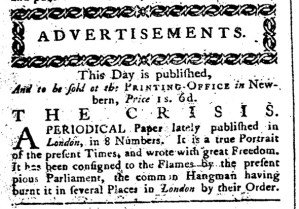
“THE CRISIS. A PERIODICAL Paper lately published in London, in 8 Numbers.”

Along with continued coverage of the Battle of Bunker Hill, the July 14, 1775, edition of the North-Carolina Gazettecarried an advertisement for The Crisis, a “PERIODICAL Paper lately published in London, in 8 Numbers.”  According to Neil L. York, The Crisis, published between January 1775 and October 1776, “was the longest-running weekly pamphlet series printed in the British Atlantic World during those years.”  (That London publication should not be confused with Thomas Paine’s “American Crisis,” a series of essays published in the United States between 1776 and 1783.)  The Crisis eventually included ninety-two editions, but James Davis, printer of the North-Carolina Gazette, had access to only the first eight.  According to his advertisement, he collected them together into a single volume.

Davis used the pamphlet’s colorful history in marketing it to readers in North Carolina.  “It is a true Portrait of the present Times,” he declared, “and wrote with great Freedom.  It has been consigned to the Flames by the present pious Parliament, the common Hangman having burnt it in several Places in London by their Order.”  York provides this overview: “The Crisis was condemned informally by leaders in the British government, and then formally in court, as a dangerous example of seditious libel [due to the depictions of George III].  Copies of it were publicly burned, and yet publication continued uninterrupted.”  American Patriots had their supporters among the British public, including authors and printers who “played on shared beliefs and shared fears: beliefs in the existence of fundamental rights … and the fear that loss of those rights in Britain’s American colonies could lead to their loss in Britain itself.”  York posits that the “men behind The Crisis were determined to interest the British public in American affairs and were no doubt pleased when various issues were reprinted in the colonies.”  Indeed, newspapers reprinted some of the essays in their entirety.  Printers also recognized opportunities to generate revenue while disseminating The Crisis to colonizers.  Advertisements for individual numbers of the pamphlet peppered the pages of American newspapers in the spring and summer of 1775 as printers in several colonies distributed new issues as they came to hand.  The day before Davis ran his advertisement in the North-Carolina Gazette, John Anderson announced in a notice in the New-York Journal that “on Monday will be published No. 9 of the CRISIS.”  Instead of printing one issue at a time, Davis packaged the first eight issues together for readers, hoping that providing such convenient access would entice them to buy the volume.

**********

This entry marks the final appearance of the North-Carolina Gazette in the Adverts 250 Project.  Few issues of that newspaper survive.  Only seven, all of them from 1775, have been digitized for greater access via databases of early American newspapers.  I have selected advertisements from the North-Carolina Gazette as often as possible to present a more complete representation of newspapers from throughout the colonies.

July 7

What was advertised in a revolutionary American newspaper 250 years ago today?

North-Carolina Gazette (July 7, 1775).

“EXTRACTS from the Votes and Proceedings of the AMERICAN CONTINENTAL CONGRESS.”

When they perused the July 7, 1775, edition of the North-Carolina Gazette, readers encountered an advertisement that proclaimed, “JUST PUBLISHED, And to be sold at the Printing Office … EXTRACTS from the Votes and Proceedings of the AMERICAN CONTINENTAL CONGRESS, held at Philadelphia, on the Fifth Day of September, 1774.”  The Extracts, however, were not “JUST PUBLISHED,” though James Davis certainly had them for sale at the printing office in New Bern.  The Adverts 250 Project previously featured this advertisement’s appearance in the April 7, 1775, edition of the North-Carolina Gazette.  Few issues of that newspaper survive, preventing a complete reconstruction of when the advertisement ran.  Only seven issues, all from 1775, are available via America’s Historical Newspapers, the most comprehensive database of digitized eighteenth-century newspaper.  Davis’s advertisement for the Extracts did not run on March 24, but appeared on April 7, May 5, and May 12.  It was not in the June 30 issue, yet it returned for the July 7 and July 14 issues.

It is not clear how often the advertisement ran between May 12 and June 30, but Davis did not insert it in the issue immediately before the one that delivered several important updates that might have influenced him to believe that readers who had not yet purchased the Extracts would have increased interest in the “Bill of Rights, a List of Grievance, Occasional Resolves,” and “General Gage’s Answer to the Letter sent him by the General Congress.”  The Extractsdocumented the meeting of the First Continental Congress in the fall of 1774.  When the advertisement ran on July 7, 1775, the Second Continental Congress had been meeting for nearly two months.  That issue included an update that “By Letters from the Congress of the 19th of June, we are informed, that Col. Washington, of Virginia, is appointed General and Commander in Chief of all the American Forces.”  It also delivered news of the Battle of Bunker Hill, acknowledging that the account received in the printing office was “very imperfect, and must leave us in Suspence till a further Account of this most momentous Affair arrives.”  Indeed, that “imperfect” account inaccurately claimed that “General Burgoyne fell … and was interred in Boston with great Funeral Pomp.”  As he sorted through newspapers and letters arriving from the north, Davis apparently believed that the news he selected for publication would spark new interest in his remaining copies of the Extracts from the First Continental Congress.

As had been the case in the April 7 edition, that advertisement ran alongside another that described an enslaved man who liberated himself by running away from his enslaver.  In this instance, “a Negro Slave … named JEM,” was a fugitive from slavery who might have been “harboured or kept out by his Wife, named Rachel.”  James Biggleston, Jem’s enslaver, suspected that Jem was “lurking in the Neighborhood” of the plantation where Rachel was enslaved. Biggleston offered a reward for the capture and return of Jem in a nota bene at the end of the advertisement, though the main body of the notice consisted of a warrant signed by “Two of his Majesty’s Justices of the Peace” that authorized that “if the said Jem doth not surrender himself, and return home immediately … that any Person or Persons may kill and destroy the said Slave … without Impeachment or Accusation of any Crime or Offence … or without incurring any Penalty.”  Most readers of the North-Carolina Gazette and other newspapers compartmentalized the contents of those publications.  They did so to such an extent that the juxtaposition of colonizers demanding freedom from oppression and enslaved people seeking liberty did not register as a contradiction.

May 6

What was advertised in a revolutionary American newspaper 250 years ago today?

Virginia Gazette [Dixon and Hunter] (May 6, 1775).

“LADIES RIDING HABITS made in the newest Fashion.”

When James Davis, a tailor, opened a shop at a new location in Yorktown in the spring of 1775, he placed an advertisement in John Dixon and William Hunter’s Virginia Gazette.  He opened by extending “his most grateful Acknowledgments to all those who have hitherto been his Customers,” incorporating an appeal in common use throughout the colonies.  Advertisers often thanked existing customers as a means of enhancing their reputations.  Yet that was not Davis’s only purpose; instead, he “takes this Opportunity to inform them, as well as the Public in general, that he has just opened Shop nearly opposite Swan Tavern.”  Any client could expect the tailor’s “close Application to his Business, and the utmost Endeavours to give Satisfaction,” prompting Davis to hope for “general Encouragement” from the residents of Yorktown.

The tailor concluded with a note that singled out one item in particular: “LADIES RIDING HABITS made in the newest Fashion.”  He may have benefited from where his advertisement appeared within the May 6 edition of the Virginia Gazette, immediately following the “POETS CORNER.”  That entry presented a new poem each week.  This time it featured “VERSES by a Lady, on gathering a SNOW-DROP in the garden of her lover.”  That was almost certainly by coincidence rather than by design.  After all, Davis’s advertisement ran at the bottom of the middle column on the fourth page of the supplement the previous week.  Still, the poem may have helped in directing more readers, especially “LADIES” interested in “the newest fashion,” to Davis’s notice.  Even if the verses did not, the decorative printing that called attention to the “POETS CORNER” also distinguished Davis’s advertisement from others on that page.  It was not the first time it had such a fortuitous place.  Two weeks earlier, it followed “AN ODE TO LIBERTY” in the “POETS CORNER.”  If the tailor perused the pages of the Virginia Gazette to confirm that it indeed carried his notice, he may have been more satisfied with where it happened to appear in some issues.  Its proximity to the “POETS CORNER” may have boosted engagement on those occasions that the one followed the other, though via happenstance rather than sophisticated and intentional marketing strategy.

April 9

What was advertised in a colonial American newspaper 250 years ago this week?

North Carolina Gazette (April 7, 1775).

“EXTRACTS from the Votes and Proceedings of the AMERICAN CONTINENTAL CONGRESS.”

The North-Carolina Gazette, published by James Davis in New Bern from May 1768 through November 1778, with some interruptions, only made its first appearance in the Adverts 250 Project a couple of weeks ago because extant copies are so rare that few have been digitized and made more broadly accessible to scholars.  America’s Historical Newspapers, the most comprehensive database of digitized eighteenth-century newspapers, includes only seven issues of the North-Carolina Gazette, all of them from 1775.  Other databases do not include any.

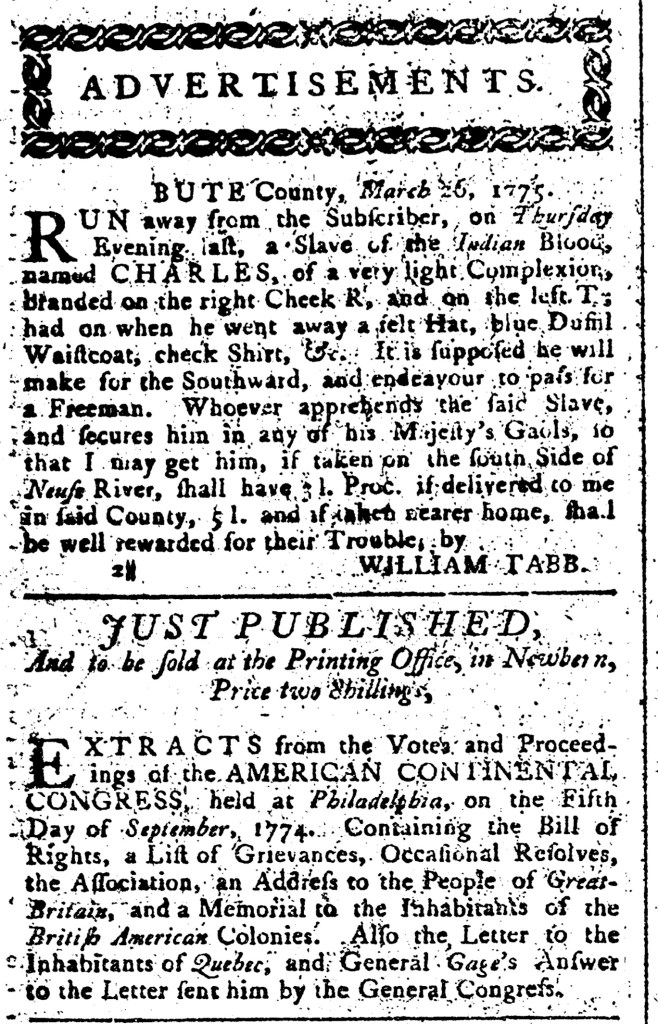
As a result, the April 7 edition is the second issue of the North-Carolina Gazette available for inclusion in the Adverts 250 Project and the Slavery Adverts 250 Project.  The first two advertisements in that issue drew my attention.  The first described and offered a reward for “a Slave of the Indian Blood, named CHARLES” who liberated himself by running away from his enslaver.  Charles’s story of resistance has been compiled with other advertisements about enslaved men, women, and children published in American newspapers on April 7, 1775, as part of the Slavery Adverts 250 Project.

The second promoted “EXTRACTS from the Votes and Proceedings of the AMERICAN CONTINENTAL CONGRESS, held at Philadelphia” in September and October 1774.  The Adverts 250 Project has traced the publication and marketing of the Extracts, starting with William Bradford and Thomas Bradford’s edition in Philadelphia and continuing with local editions published in many other towns.  This advertisement confirms that Davis sold the Extracts.

Did he print a local edition?  Or did he sell copies that he received from another printer?  The formulaic language in the advertisement — “JUST PUBLISHED, And to be sold at the Printing Office, in Newbern” — does not definitively answer those questions.  The phrase “JUST PUBLISHED,” for instance, merely meant that a book, pamphlet, or almanac was available.  When an advertisement first ran, “JUST PUBLISHED” meant that it had been published recently, but printers and booksellers sometimes ran advertisements for weeks or months without updating them.  They did not consider setting type once again worth investing their time or attention.  Eighteenth-century readers understood that “JUST PUBLISHED” did not always mean that the item was hot off the presses.  Similarly, they separated “JUST PUBLISHED” and “to be sold at the Printing Office,” realizing that printers often peddled books, pamphlets, and almanacs “JUST PUBLISHED” by other printers.

This language suggests that Davis may or may not have printed the edition of the Extracts that he advertised.  Some bibliographers, however, have trusted advertisements in the North-Carolina Gazette as sufficient proof that he did publish a local edition.  In “James Davis: North Carolina’s First Printer,” a thesis submitted to the School of Information and Library Science of the University of North Carolina at Chapel Hill, Scott Aaron Reavis includes the Extracts among works printed on Davis’s press.  He notes, “No copies are known to exist, however, it was advertised for sale in the North Carolina Gazette, 24 February 1775.”[1]  By the time the subsequent advertisement ran in the April 7 edition, the Extracts were “JUST PUBLISHED” indeed!  Charles Evans did not list Davis’s New Bern edition in American Bibliography: A Chronological Dictionary of All Books, Pamphlets, and Periodical Publications Printed in the United States of America from the Genesis of Printing in 1639 Down to and Including the Year 1820, but, according to Reavis, Douglas C. McMurtie included the Extracts in his “Bibliography of North Carolina Imprints.”[2]  Given how many printers published local editions of the Extracts, I am inclined to agree with McMurtie and Reavis that Davis did as well.  I disagree, however, with the date assigned to the work.  Davis’s edition has been dated to 1775 based on an advertisement in one of the few extant issues of the North-Carolina Gazette.  More likely, if Davis published the Extracts then he did so in November or December 1774, the same time that printers in other towns produced local editions, and occasionally inserted his advertisement that he had “JUST PUBLISHED” and sold the volume at his printing office several times over the next several months.

**********

[1] Scott Aaron Reavis, “James Davis: North Carolina’s First Printer” (master’s thesis, University of North Carolina at Chapel Hill, 2000), 44.

[2] Reavis, “James Davis,” 28.

March 24

What was advertised in a colonial American newspaper 250 years ago today?

North-Carolina Gazette (March 24, 1775).

“ADVERTISEMENTS, of a moderate Length, are inserted for THREE SHILLINGS the first Week, and TWO SHILLINGS for every Week after.”

Today, the North-Carolina Gazette makes its first appearance in the Adverts 250 Project and the Slavery Adverts 250 Project.  Few copies of this colonial newspaper from New Bern survive.  Clarence Brigham provides an overview of the publication history of the North-Carolina Gazette, noting that James Davis likely founded it on May 27, 1768, “judging from the date of the earliest issue located, that of June 24, 1768, no. 5.”  The volume numbering also suggests that “publication was suspended for several months between 1769 and 1773 and again in 1776.”[1]  The last known issue appeared on November 30, 1778.  Edward Connery Lathem reports “no copies extant” for 1770, 1771, 1772, 1773, and 1776 “few numbers known (usually less than 25% of those issued)” for 1768, 1769, 1774, and “complete or extensive coverage exists” for 1775, 1777, and 1778.[2]  America’s Historical Newspapers includes only seven issues that have been digitized for greater accessibility, all of them published in 1774.

The March 24, 1774, edition is the first of those issues.  In addition to news, letters, and the “POETS CORNER,” that issue carried nine advertisements, including two concerning enslaved people, that accounted for a quarter of the content.  The colophon at the bottom of the fourth and final page provided information about both subscription costs and advertising fees: “All Persons may be supplied with this PAPER at SIXTEEN SHILLINGS per Annum.  ADVERTISEMENTS, of a moderate Length, are inserted for THREE SHILLINGS the first Week, and TWO SHILLINGS for every Week after.”  Throughout the colonies, printers took a variety of approaches when it came to regularly publishing such information in their mastheads or colophons.  Some did not do so at all, some included only annual subscription costs, some listed only advertising fees, and some, like Davis, provided both.  He happened to charge the same price for advertisements as William Dixon and John Hunter’s Virginia Gazette and John Pinkney’s Virginia Gazette, both published in Williamsburg, suggesting that was the going rate in the region.  For some colonial newspapers it remains difficult or impossible to determine what printers charged for advertising.  Davis, on the other hand, incorporated that information for the North-Carolina Gazette into the colophon, making readily apparent the advertising fees and how much they cost relative to subscriptions.

**********

[1] Clarence S. Brigham, History and Bibliography of American Newspapers, 1690-1820 (Worcester, MA: American Antiquarian Society, 1947), 770.

[2] Edward Connery Lathem, Chronological Tables of American Newspapers, 1690-1820 (Barre, MA: American Antiquarian Society and Barre Publishers, 1972), 8, 12.