July 14

What was advertised in a revolutionary American newspaper 250 years ago today?
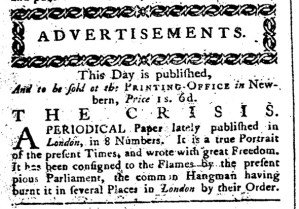
North-Carolina Gazette (July 14, 1775).

“THE CRISIS. A PERIODICAL Paper lately published in London, in 8 Numbers.”

Along with continued coverage of the Battle of Bunker Hill, the July 14, 1775, edition of the North-Carolina Gazettecarried an advertisement for The Crisis, a “PERIODICAL Paper lately published in London, in 8 Numbers.”  According to Neil L. York, The Crisis, published between January 1775 and October 1776, “was the longest-running weekly pamphlet series printed in the British Atlantic World during those years.”  (That London publication should not be confused with Thomas Paine’s “American Crisis,” a series of essays published in the United States between 1776 and 1783.)  The Crisis eventually included ninety-two editions, but James Davis, printer of the North-Carolina Gazette, had access to only the first eight.  According to his advertisement, he collected them together into a single volume.

Davis used the pamphlet’s colorful history in marketing it to readers in North Carolina.  “It is a true Portrait of the present Times,” he declared, “and wrote with great Freedom.  It has been consigned to the Flames by the present pious Parliament, the common Hangman having burnt it in several Places in London by their Order.”  York provides this overview: “The Crisis was condemned informally by leaders in the British government, and then formally in court, as a dangerous example of seditious libel [due to the depictions of George III].  Copies of it were publicly burned, and yet publication continued uninterrupted.”  American Patriots had their supporters among the British public, including authors and printers who “played on shared beliefs and shared fears: beliefs in the existence of fundamental rights … and the fear that loss of those rights in Britain’s American colonies could lead to their loss in Britain itself.”  York posits that the “men behind The Crisis were determined to interest the British public in American affairs and were no doubt pleased when various issues were reprinted in the colonies.”  Indeed, newspapers reprinted some of the essays in their entirety.  Printers also recognized opportunities to generate revenue while disseminating The Crisis to colonizers.  Advertisements for individual numbers of the pamphlet peppered the pages of American newspapers in the spring and summer of 1775 as printers in several colonies distributed new issues as they came to hand.  The day before Davis ran his advertisement in the North-Carolina Gazette, John Anderson announced in a notice in the New-York Journal that “on Monday will be published No. 9 of the CRISIS.”  Instead of printing one issue at a time, Davis packaged the first eight issues together for readers, hoping that providing such convenient access would entice them to buy the volume.

**********

This entry marks the final appearance of the North-Carolina Gazette in the Adverts 250 Project.  Few issues of that newspaper survive.  Only seven, all of them from 1775, have been digitized for greater access via databases of early American newspapers.  I have selected advertisements from the North-Carolina Gazette as often as possible to present a more complete representation of newspapers from throughout the colonies.

March 4

What was advertised in a colonial American newspaper 250 years ago today?

Massachusetts Gazette and Boston Weekly News-Letter (March 4, 1773).

“AN ESSAY Concerning the true original Extent and End of CIVIL GOVERNMENT.”

In 1773, Benjamin Edes and John Gill, printers of the Boston-Gazette, published an American edition of John Locke’s Essay Concerning the True Original Extent and End of Civil Government, the second of the political philosopher’s Two Treatises of Government.  The printers promoted the book in their own newspaper and in the Massachusetts Gazette and Boston Weekly News-Letter.

Edes and Gill exercised their prerogative as printers to give their advertisement a privileged place in the Boston-Gazette.  It appeared as the first item in the first column on the first page of the March 1 edition, immediately below the masthead.  The lengthy advertisement filled the entire column and overflowed into the next.  Even as Edes and Gill proclaimed that studying Locke’s treatise “will give to every Intelligent Reader a better View of the Rights of Men and of Englishmen” they published an advertisement offering an enslaved woman for sale in the lower right corner of the same page.  In addition to generating revenue from that advertisement, they served as brokers.  The anonymous advertiser instructed interested parties to “Inquire of Edes & Gill.”  Their advertisement in the March 4 edition of the Massachusetts Gazette and Boston Weekly News-Letter did not benefit from so prime a placement, running in the center column on the fourth page.  Consisting of the same copy that ran in the Boston-Gazette, it extended nearly an entire column.

In their efforts to convince colonizers to purchase the book, Edes and Gill asserted, “IT is well known among the Learned, that Mr. Locke’s two Treatise’ on Government, of which this is the Principal and by far the most Valuable, contributed more essentially to the establishing the Throne of our Great Deliverer King William, and consequently to the securing the Protestant Succession, than the Battle of the Boyne, or indeed all the Victories since obtained.”  They acknowledged that Locke’s “first Discourse has also been of great Use, as it is a most thorough Refutation of the Errors of Sir Robert Filmer,” known for defending the divine right of kings.  In a postscript, the printers explained why they opted not to publish both treatises.  Even though both had been “lately published together in England, and universally read and admired by all Lovers of Liberty there,” Edes and Gill did not consider the first treatise as essential for colonizers, in part because “few of [Filmer’s disciples] are yet to be found in this Country.”  That decision also made the book less expensive and more accessible to consumers since the second treatise was not “incumbered with the prolix Confutation of Filmer.”

Edes and Gill argued that all colonizers had a duty to read Locke’s work and discuss it with others.  They declared, “It should be early and carefully explained by every Father to his Son, by every Preceptor to his Pupils, and by every Mother to her Daughter.”  Just as many colonizers encouraged women to participate in politics through the decisions they made as consumers, the printers envisioned a role for women in educating their children about civic virtue.  In so doing, they drew upon the example of “Roman Ladies, especially those of the first Rank and Fashion” who “not only taught their Daughters, but their Sones, the first Rudiments of Learning.”  They achieved significant results; those “noble Matrons by their Sense and Virtue, contributed in this and a Thousand other Instances, no less toward the building up their glorious Republic than the Wisdom and Valour of the greatest Captain’s.”  Edes and Gill anticipated the notion of republican motherhood that citizens, male and female, embraced during the era of the early republic that followed the American Revolution.

Why did Edes and Gill publish and promote Locke’s Essay Concerning the True Original Extent and End of Civil Government?  Historians disagree about the motivations of printers, publishers, and booksellers who produced and sold political treatises during the imperial crisis.  Did they align with the ideology in the books and pamphlets they published and sold, hoping to convert other colonizers to share their perspective?  Or did they merely seek to generate revenues?  Such motivations are not necessarily mutually exclusive.  By the time they published an American edition of Locke’s Essay, Edes and Gill already established their reputation as patriot printers.  They very likely considered printing, promoting, and selling this treatise a political act … but that did not mean they did not also seek to make money.  For Richard Draper, the printer of the Massachusetts Gazette and Boston Weekly News-Letter, running an advertisement for Locke’s Essay may have been more about generating revenues, especially considering that he tended to support British officials.  Edes and Gill may have chosen to advertise in his newspaper as a means of reaching readers less likely to peruse newspapers published by patriot printers, exposing them to some of Locke’s reasoning in the lengthy advertisement even if they opted not to purchase or read the Essay.