January 31

What was advertised in a revolutionary American newspaper 250 years ago today?
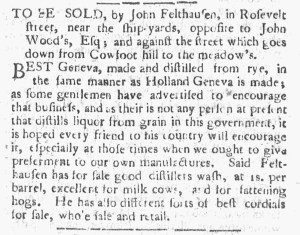
Constitutional Gazette (January 31, 1776).

“BEST Geneva, made and distilled from rye.”

Advertisements for consumer goods and services crowded the pages of early American newspaper.  Did they work?  Unfortunately, that question is difficult to answer.  The advertisements reveal what kinds of marketing appeals merchants, shopkeepers, artisans, and other entrepreneurs thought would resonate with consumers and influence them to make purchases, but they rarely indicated how readers responded.

That so many entrepreneurs advertised and that they invested in advertising regularly suggests that they believed that they received a sufficient return on their investment to make the expense worth it.  Consider John Felthausen and his advertisement for “BEST Geneva [or Jenever, a type of gin], made and distilled from rye,” in the January 31, 1776, edition of the Constitutional Gazette.  That was not the first time that Felthausen placed that advertisement.  Three months earlier, he ran an advertisement with nearly identical copy in the New-York Gazette and Weekly Mercury.  If Felthausen believed that previous advertisement had not yielded results, would he have run it again in another newspaper a few months later?

That new advertisement had nearly identical copy, though the compositor for the Constitutional Gazette made very different decisions about the format than the compositor for the New-York Gazette and Weekly Mercury.  Felthausen may have even clipped the advertisement from one newspaper and delivered it to the printing office for the other, making marks on it to indicate copy he wished to update.  Those revisions amounted to adding a sentence at the end: “He has also different sorts of best cordials for sale, wholesale and retail.”  He retained his appeal to “every friend to this country” to “encourage” or support his business, “especially at those times when we ought to give preferment to our own manufactures.”  The distiller apparently believed that his previous advertisement met with sufficient success to merit repeating it to hawk both his “BEST Geneva” and additional products not previously included.
October 23

What was advertised in a revolutionary American newspaper 250 years ago today?

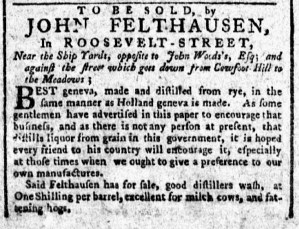
New-York Gazette and Weekly Mercury (October 23, 1775).

“BEST geneva, made and distilled from rye.”

When John Felthausen wanted the public to know about the “BEST geneva [or genever], made and distilled from rye,” that he produced, he placed an advertisement in the October 23, 1775, edition of the New-York Gazette and Weekly Mercury.  He declared that he distilled his spirits “in the same manner as Holland geneva is made,” assuring prospective customers of the quality and taste.  To entice readers to purchase his genever, Felthausen reported that “some gentlemen have advertised in this paper to encourage that business” because “there is not any person at present, that distills liquor from grain in this government” or colony.  In answer to colonizers who expressed a desire for someone to take responsibility for distilling genever and other spirits in New York, Felthausen suggested that they had a responsibility to support his business now that he accepted their charge to launch such an enterprise.

Yet Felthausen did not address solely those who had written of their desire to see genever produced locally.  Instead, he proclaimed that he “hoped every friend to his country” would buy his genever, “especially at those times when we ought to give a preference to our own manufactures.”  The distiller made a “Buy American” argument, confident that prospective customers knew all about the Continental Association, a nonimportation agreement devised by the First Continental Congress in response to the Coercive Acts.  The Continental Association also called on colonizers to promote “Agriculture, Arts, and the Manufactures of this Country” as alternatives to imported goods.  Throughout the colonies, supporters of the American cause mobilized around the choices that they made in the marketplace.  Many became even more determined to so after the battles at Lexington and Concord.  Entrepreneurs like Felthausen encouraged consumers to practice politics when they made purchases, presenting their decisions as civic duties for “every friend to his country.”