November 10

What was advertised in a revolutionary American newspaper 250 years ago today?
Virginia Gazette (November 10, 1775).

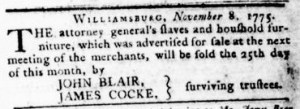
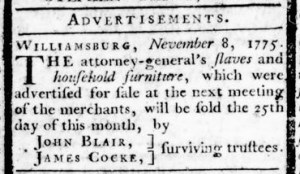
“JOHN BLAIR, JAMES COCKE, surviving trustees.”

An advertisement about the upcoming sale of the “attorney-general’s slaves and household furniture” in the November 10, 1775, edition of Alexander Purdie’s Virginia Gazette was signed by John Blair and James Cocke, the “surviving trustees.”  Upon learning of the death of Peyton Randolph, one of the original trustees, they had updated an advertisement that had been running in that newspaper as well as John Pinkney’s Virginia Gazette and John Dixon and William Hunter’s Virginia Gazette for several weeks.  John Randolph, the King’s Attorney General for the colony and a loyalist, had departed for England, leaving his brother, Peyton, along with Blair and Cocke as trustees to oversee and sell his estate. Peyton, a patriot and the president of the First Continental Congress, was in Philadelphia representing Virginia in the Second Continental Congress when he unexpectedly died, leaving Blair and Cocke as the “surviving trustees.”

Among the printers in Williamsburg, Purdie published the news of Randolph’s death first, nearly a week ahead of the other two newspapers.  Given that each published a new issue once a week, the news spread ahead of it appearing in print.  All the same, Purdie supplemented the brief notice that he ran in the November 3 edition with extensive coverage in the next issue on November 10.  “LAST sunday died of an apoplectick stroke,” the report began, “the hon. PEYTON RANDOLPH, Esq; of Virginia, late President of the Continental Congress, and Speaker of the House of Burgesses of that colony.”  On the following Tuesday, “his remains were removed … to Christ church, where an excellent sermon on the mournful occasion was preached … after which the corpse was carried to the burial ground, and deposited in a vault until it can be conveyed to Virginia.”  The dignitaries in the funeral procession included John Hancock, then serving as president of the Second Continental Congress, other “members of the Congress,” members of the Pennsylvania Assembly, and the mayor of Philadelphia.  Elsewhere in that issue, Purdie printed a memorial to Randolph, an eighteenth-century version of an obituary.  He also inserted a notice from Williamsburg’s Masonic Lodge: “Ordered, THAT the members of this Lodge go into mourning, for six weeks, for the late honourable and worthy provincial grand master, Peyton Randolph, esquire.”  To honor Randolph, Purdie enclosed the contents of the entire issue within thick black borders that signaled mourning.  Those borders ran on either side of the updated advertisement placed by the “surviving trustees” of John Randolph’s estate.

November 3

What was advertised in a revolutionary American newspaper 250 years ago today?

Virginia Gazette [Purdie] (November 3, 1775).

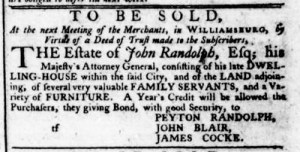
“To be SOLD … THE estate of John Randolph, esq; his majesty’s attorney-general.”

The advertisement for the “Estate of John Randolph” that ran in John Dixon and William Hunter’s Virginia Gazette in the fall of 1775 also appeared in the other newspapers published in Williamsburg, John Pinkney’s Virginia Gazette and Alexander Purdie’s Virginia Gazette.  When the Loyalist departed for England, either he left instructions to advertise widely or the trustees – Peyton Randolph (his brother), John Blair, and James Cocke – decided that they wanted news of the upcoming sale of Randolph’s house, furniture, and enslaved “family servants” to circulate as widely as possible.

Virginia Gazette [Purdie] (November 3, 1775).

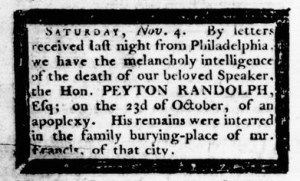
When the advertisement ran on the final page in the November 3 edition of Purdie’s Virginia Gazette, it contradicted news that appeared on the second page.  Thick black borders that indicated mourning surrounded a short article that informed readers, “By letter received last night from Philadelphia, we have the melancholy intelligence of the death of our beloved Speaker, the Hon. PEYTON RANDOLPH, Esq; on the 23d of October, of an apoplexy.  His remains were interred in the family burying-place of mr. Francis, of that city.”  Randolph had served as speaker of the colony’s House of Burgesses.  He also held very different political views than his brother, having served as president of the First Continental Congress when it met in Philadelphia in the fall of 1774 and, briefly, as president of the Second Continental Congress when it convened after the battles at Lexington and Concord the following year.  He had been in Philadelphia as one of Virginia’s delegates when he died.

Blair and Cocke, the “surviving trustees,” ran an updated advertisement the following week, but there had not been time to revise the notice that had been running for several weeks.  The side of the broadsheet that carried the advertisement may even have been printed already when Purdie’s printing office received word of Randolph’s death.  In addition, the report, dated “SATURDAY, Nov. 4,” introduces some confusion about when the news arrived and when Purdie printed and distributed the November 3 edition of his newspaper.  Purdie scooped the other two newspapers.  Pinkney delivered the news in his next edition on November 9 (along with the updated advertisement).  Dixon and Hunter inserted a news report and an extensive memorial on November 11.  Either they did not have the news in time for their November 4 edition, or the type had been set and the printing already commenced when it arrived.  That still does not describe the discrepancy in the dates for Purdie’s newspaper, though he may have been a day late in publishing it but listed November 3, the anticipated date of publication for the weekly newspaper, in the masthead as a polite fiction.

Not only did Purdie publish the news first with a brief article, but the following week he ran both a news article about Randolph’s death and funeral and a memorial to Randolph in his November 10 edition.  The text matched the memorial in Dixon and Hunter’s November 11 edition, but the compositor made different choices for the format.  Purdie also honored Randolph with thick black borders around the content on all four pages, not just enclosing the memorial.  That issue included the updated notice about John Randolph’s estate sale as the first of the advertisements on the final page, though the two-page supplement that accompanied it carried the original advertisement.  The news and an advertisement continued delivering contradictory information, suggesting that Purdie and others in his printing office were not attentive to every detail in every advertisement they published.  The original advertisement may have appeared again as filler to complete the page rather than as an intentional insertion by the trustees who oversaw the sale it announced.

October 14

Who was the subject of an advertisement in a revolutionary American newspaper 250 years ago today?

Virginia Gazette [Dixon and Hunter] (October 14, 1775).

“Several very valuable FAMILY SERVANTS.”

A notice concerning the “Estate of John Randolph, Esq; his Majesty’s Attorney General,” first appeared in the October 14, 1775, edition of John Dixon and William Hunter’s Virginia Gazette.  It was not Randolph’s death that occasioned the notice.  Instead, the Loyalist and his family departed for England at the beginning of the Revolutionary War, leaving trustees in charge of selling “his late DWELLING-HOUSE” in Williamsburg, “several very valuable FAMILY SERVANTS, and a Variety of FURNITURE.”

At a glance, modern readers might assume that those “FAMILY SERVANTS” consisted of indentured servants like the ones that had “JUST ARRIVED” in Virginia on the Saltspring.  According to an advertisement on the next page, those servants included “many Tradesmen,” such as carpenters, blacksmiths, shoemakers, weavers, a cabinetmaker, and a wheelwright, as well as “FARMERS and other COUNTRY LABOURERS.”  Yet that almost certainly was not the case for the “FAMILY SERVANTS” in the notice about Randolph’s estate.  They did indeed possess a variety of skills like the indentured servants recently arrived in the colony, yet that phrase – “FAMILY SERVANTS” – referred to enslaved people who had been part of the Randolph household.

Virginia Gazette [Pinkney] (November 9, 1775).

A subsequent advertisement did not use the same turn of phrase.  After Peyton Randolph, one of the trustees, died suddenly on October 22, a new advertisement that first appeared in the November 9 edition of John Pinkney’s Virginia Gazette clarified that the “attorney general’s slaves and household furniture, which was advertised for sale at the next meeting of the merchants, will be sold the 25th day of this month, by JOHN BLAIR, [and] JAMES COCKE, surviving trustees.”  Of course, eighteenth-century readers understood the reference to “FAMILY SERVANTS” in the original advertisement.  They did not need a subsequent notice to clarify that it meant enslaved men and women.  They knew the lexicon of newspaper notices about enslaved people just as well as they knew the lexicon of consumer culture in advertisements that promoted all sorts of goods, especially textiles, with names that seem unfamiliar to today’s readers.

January 20

Who was the subject of an advertisement in a colonial American newspaper 250 years ago this week?

Virginia Gazette [Rind] (January 17, 1771).
“A mulatto man slave named AARON, who brought suit against my father, Henry Randolph, in the General Court.”

Some historians and other scholars describe eighteenth-century newspaper advertisements about enslaved people who liberated themselves the first narratives of enslavement, though they acknowledge that those advertisements were not penned by enslaved people themselves.  Such advertisements document stories of resistance when read counter to the purposes of the enslavers who wrote them to encourage surveillance of Black people with the goals of identifying enslaved people who liberated themselves and returning them to bondage.  Filtered through the perspectives of enslavers who shaped the narratives, these advertisements told incomplete stories.  Still, these so-called runaway advertisements collectively testify to widespread resistance among enslaved people throughout the colonies.

The story of “a mulatto man slave named AARON” is among those countless incomplete narratives that almost certainly would have included different details had it been written by the enslaved man rather than his enslaver.  John Randolph placed an advertisement in the January 17, 1771, edition of William Rind’s Virginia Gazette to advise the public that Aaron had “RUN away” the previous June.  From Aaron’s perspective, however, he continued his quest for freedom by other means.  Randolph reported that Aaron previously “brought suit against my father, Henry Randolph, in the General Court, for his freedom.”  Aaron appeared before the court as Aaron Griffing.  Randolph did not explain the significance of the surname.  Notably, the enslaved man did not identify himself using the last name of his enslaver.  Randolph stated that “the suit was determined … in my father’s favour” even though “many of [Aaron’s] colour got their freedom [from] that court,” perhaps indicating that other enslaved “mulatto” men and women successfully sued for their freedom.  Even though he appeared in court as Aaron Griffing, Randolph suspected that he “may change his name” to improve his chances of remaining undetected and “endeavour to pass for a freeman.”  From Aaron’s perspective, no passing was involved.  He liberated himself after the court refused to do so.

Randolph’s advertisement included other information that Aaron might have described in more detail … or avoided altogether … had he told his own story.  For instance, Randolph declared that Aaron has been “marked on each cheek I, R, the letters very dull.”  The circumstances that led to the enslaved man bearing the initials of John Randolph (or another enslaver?) on his face may have been a significant motivation for liberating himself … or it may have been a story too painful for words.  Whichever may have been the case, Randolph’s advertisement survives today as a testament to Aaron’s courage and conviction to liberate himself.  It reverberates with meaning unintended by the enslaver who wrote and disseminated it a quarter millennium ago.