March 12

What was advertised in a colonial American newspaper 250 years ago today?
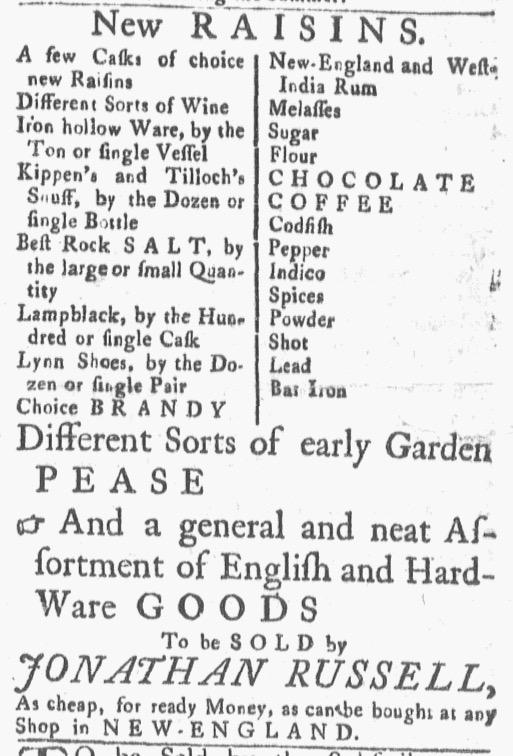
Providence Gazette (March 12, 1774).

“As cheap … as can be bought at any Shop in NEW-ENGLAND.”

Jonathan Russell offered a variety of goods to prospective customers in his advertisement in the March 12, 1774, edition of the Providence Gazette.  The headline promised “New RAISINS.”  A list of other items appeared below the headline, followed by a note about “Different Sorts of early Garden PEASE” and another about a “general and neat Assortment of English and Hard-Ware GOODS.”  Both ran in the same size font as the headline, suggesting that Russell may have instructed the compositor to place greater emphasis on that portion of his inventory.  Although he did not enumerate the “English and Hard-Ware GOODS,” he underscored the choices available to consumers when he asserted that he stocked a “general and neat Assortment.”

Some of the items in the list of goods also attracted attention because they appeared in capital letters.  “Best Rock SALT,” “Choice BRANDY,” “CHOCOLATE,” and “COFFEE” stood out among the “Kippen’s and Tilloch’s Snuff, by the Dozen or single Bottle,” “Lampblack, by the Hundred or single Cask,” “Lynn Shoes, by the Dozen or single Pair,” flour, codfish, and other commodities.  Notably, Russell peddled “CHOCOLATE” and “COFFEE,” but did not mention tea at all. Capitalizing “CHOCOLATE” and “COFFEE” called attention to the fact that tea was absent from his inventory as colonizers continued to debate the politics of consuming that beverage just a few months after the Boston Tea Party.

Russell concluded his advertisement with an appeal to price, claiming that customers could purchase his wares “As cheap … as can be bought at any Shop in NEW-ENGLAND.”  He did not place himself in competition solely with James Green, “HILL’s ready Money Variety Store,” and other merchants and shopkeepers in Providence.  Instead, he declared that his low prices matched those in Newport, Portsmouth, and Boston.  Prospective customers did not need to visit other shops in Providence or send away to merchants and shopkeepers in other towns to get better deals.  Although not as extensive as other advertisements in the same issue of the Providence Gazette, Russell’s notice incorporated consumer choice and competitive prices and even seemed to offer political commentary for those who read carefully.

December 10

What was advertised in a colonial American newspaper 250 years ago today?

Providence Gazette (December 10, 1768).

“The Sign of the Black Boy and Butt.”

No advertisements for enslaved men, women, and children happened to appear in the December 10, 1768, edition of the Providence Gazette, but that did not mean that the black body was absent from the commercial landscape of the port city that newspaper served. Jonathan Russell inserted an advertisement for his “large and fresh Assortment of ENGLISH and INDIA GOODS,” noting that readers would easily recognize his store “on the West Side of the Great Bridge” because “the Sign of the Black Boy and Butt” marked its location. It was not the first time that he invoked his shop sign when giving directions to prospective customers, though he had previously referred to it simply as “the Sign of the BLACK-BOY.” Perhaps he had acquired a new sign, but it may have always included a depiction of a butt, a large cask. Russell’s description of it could have shifted over time.

Even when Russell was not advertising in the local newspaper, his sign was constantly on display in Providence, reminding residents and visitors alike of the connections between black bodies and colonial commerce. Nor was Russell the only merchant or shopkeeper to adopt such iconography. Two years earlier Augustus Deley placed an advertisement in the Connecticut Courant to proclaim that he “CONTINUES to carry on the Business of manufacturing TOBACCO … for chewing or smoaking.” Interested parties could find him “At the Sign of the Black Boy, Near the North Meeting-House in Hartford.” Signs depicting black boys had a long history in New England. More than thirty years earlier, Jonathan Williams placed an advertisement for imported wine and New England rum sold “at the Black Boy and Butt.”[1] In some instances, the youths represented enslaved workers closely associated with the products sold. Such was the case for Deley’s tobacco, grown on plantations in other colonies, and Williams’s rum, produced from molasses acquired as a byproduct of sugar cultivation on Caribbean plantations. The connection between Russell’s “Black Boy” and his “ENGLISH and INDIA GOODS” was not as immediate. Instead, it offered a shorthand description of the networks of trade, production, and consumption that crisscrossed the Atlantic in the eighteenth century. Commercial exchange in Providence was part of a larger system that included the transatlantic slave trade and forced labor at sites of cultivation and production. Residents of Providence did not need “the Sign of the Black Boy and Butt” to inform them of that. Instead, it testified to a reality that was familiar to consumers throughout the Atlantic world.

**********

[1] New England Weekly Journal (March 8, 1737).

May 9

What was advertised in a colonial American newspaper 250 years ago today?

May 9 - 5:9:1767 Providence Gazette
Providence Gazette (May 9, 1767).

“Assortment of English and India GOODS, at his Shop at the Sign of the BLACK-BOY.”

Jonathan Russell ran a shop “at the Sign of the BLACK-BOY; on the West Side of the Great-Bridge, in PROVIDENCE.” As I compiled today’s entries for the Slavery Adverts 250 Project I debated whether Russell’s advertisement should be included. Two other notices in the same issue of the Providence Gazette explicitly sold slaves, “A Negro Woman, who understands all sorts of houshold Work” and “A Likely, healthy Negro Boy … fit for either Town of Country,” but Russell’s advertisement did not promote the sale of slaves.

The Slavery Adverts 250 Project casts a wide net when it comes to including notices that mention slaves. Most of the advertisements fall into three main categories: slaves for sale, runaway slaves, and captured slaves. Enslaved men, women, and children, however sometimes found themselves the subjects of other sorts of advertising. Rather than sell slaves, some masters preferred to hire them out. Others mentioned the role slaves played in commercial ventures, such as Lewis Johnson’s help wanted notice seeking “AN OVERSEER who understands the BUSINESS of STAVEMAKING, to take charge of a few negroes employed in that way” in the Georgia Gazette (May 6, 1767). Some provided evidence of the presence of enslaved people in everyday life in the colonies, such as Robert Murray’s notice in the South-Carolina and American General Gazette (May 8, 1767) offering to return a “PLAIN gold RING” upon the owner “paying for this advertisement, and giving something to the negro who found it.”

Russell’s advertisement for “his Shop at the Sign of the BLACK-BOY,” however, does not refer to an actual person or to any humans treated as commodities that he attempted to sell. Yet “the Sign of the BLACK-BOY” drew meaning from the context of transatlantic commerce that included the slave trade and the production of “indigo, rum, melasses, sugar, rice,” and other goods produced by enslaved men, women, and children and transported to Russell’s and other shops throughout the Atlantic world. Slaves lived and toiled in Providence. Many merchants from the city and other ports in Rhode Island made their livings, at least in part, by participating in the slave trade. In his own fashion, Jonathan Russell also exploited black bodies for his own benefit when he adopted “the sign of the BLACK-BOY” as the device to mark his location and identify his commercial enterprises. Accordingly, I have included his advertisement in the Slavery Adverts 250 Project.