
Who was the subject of an advertisement in a colonial American newspaper 250 years ago today?
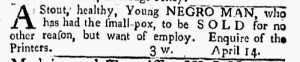
“A Stout, healthy, Young NEGRO MAN … to be SOLD … Enquire of the Printers.”
On April 14, 1775, Enoch Story and Daniel Humphreys published “VOL. I. NUMB. 2,” the second issue of their new newspaper. They updated the title in the masthead from The Pennsylvania Mercury; and the Universal Advertiser to Story and Humphreys’s Pennsylvania Mercury, and Universal Advertiser. The colophon running across the bottom of the final page remained the same, advising readers that they “gratefully received” subscriptions, advertisements, articles, and “Letters of Intelligence” at their printing office in Norris’s Alley in Philadelphia. Their first issue featured a significant number of advertisements. The second issue contained even more. Advertisers were willing to take a chance with this new newspaper, apparently believing that its circulation justified the investment in purchasing space to disseminate their notices.
Among the advertisements that ran for the first time in the second issue of Story and Humphreys’s Pennsylvania Mercury, one offered “A Stout, healthy, Young NEGRO MAN, who has had the small-pox, to be SOLD for no other reason, but want of employ.” It advised interested parties to “Enquire of the Printers” to learn more. The notice was dated “April 14” and had a notation, “3 w,” that let the compositor know to include it in three issues. Last week, Story and Humphreys’s Pennsylvania Mercury made its first appearance in the Adverts 250 Project to examine the advertisements in it (or its second appearance when counting subscription proposals that ran in another newspaper). Today, the Adverts 250 Project features that newspaper once again because it is making its first appearance in the Slavery Adverts 250 Project.
Yet Story and Humphreys did not merely publish an advertisement that offered an enslaved man for sale. They published an “Enquire of the Printers” advertisement that made them active participants in the sale. They may have facilitated an introduction, or they may have negotiated on behalf of the advertiser. The notice does not reveal the extent of their involvement, but it does indicate that they were involved beyond publishing the advertisement and earning revenue for doing so. As Jordan E. Taylor documents, American printers acted as slave brokers in thousands of advertisements in newspapers published throughout the colonies and, later, states in the eighteenth century.[1] Participating in the slave trade was part of the business model for operating a viable newspaper. Taylor could not identify any printers who refused to run advertisements that offered enslaved people for sale as a matter of principle; the financial incentives were too strong to ignore. Story and Humphreys very quickly incorporated perpetuating slavery into the practices for their press, both as printers who disseminated advertisements offering enslaved people for sale and as printers who served as slave brokers via “Enquire of the Printers” advertisements.
**********
[1] Jordan E. Taylor, “Enquire of the Printer: Newspaper Advertising and the Moral Economy of the North American Slave Trade, 1704-1807,” Early American Studies: An Interdisciplinary Journal 18, no. 3 (Summer 2020): 287-323.


